District Judge to Brief Young Republicans as a Circuit Seat Opens Up
Mobile County District Judge George Hardesty was set to address the Mobile County Young Republicans on judicial developments, with a circuit judgeship coming open after 40 years on the bench.
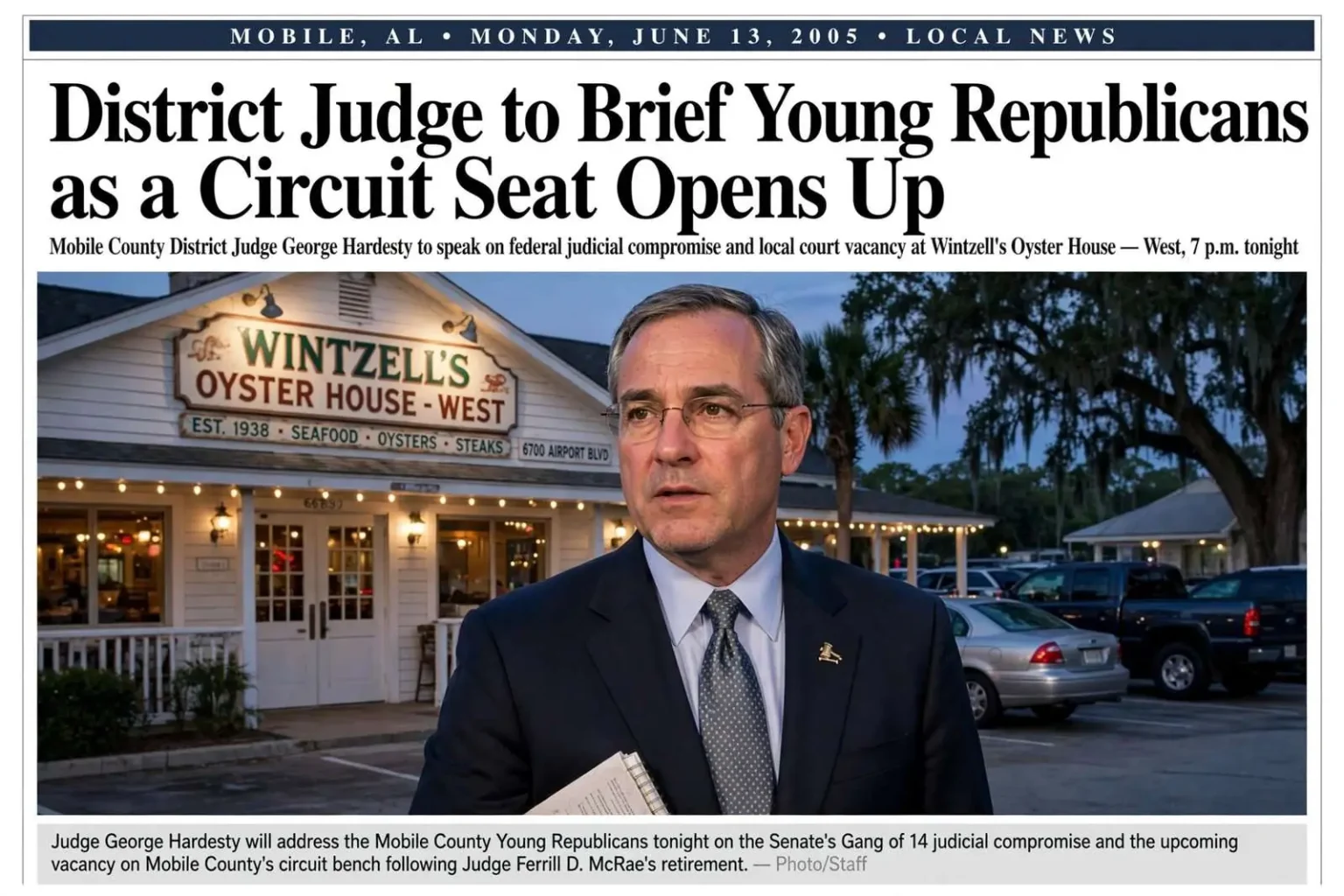
MOBILE — Mobile County District Judge George Hardesty was scheduled to address the Mobile County Young Republicans at 7 p.m. on Monday, June 13, 2005, speaking on developments in the judicial arena both locally and in Washington. The meeting was set for Wintzell’s Oyster House — West, at 6700 Airport Blvd.
Alex Mathis of the Mobile County Young Republicans said Hardesty would address the recent compromise in the U.S. Senate over federal judicial appointments as well as “other happenings in local judicial races.” The pairing of the two topics — a national fight over federal courts and a county courthouse bracing for change — captured the unusual moment Alabama’s judiciary occupied that summer.
The Young Republicans, a party organization for members under 40, met regularly in Mobile, and the group’s leadership said the Hardesty appearance promised one of the more substantive programs of the year. The gathering was open to the public, an invitation that reflected the organization’s role as a recruiting ground for campaign workers and future candidates alike.
A Judge With a Decision to Make
The second half of that description was the part with local consequence. Hardesty was, at the time, considering a race for the circuit judgeship that would be vacated the following year when Judge Ferrill D. McRae retired after 40 years on the bench — an extraordinary tenure that made his departure one of the most significant openings in Mobile County’s judicial system in a generation.
McRae’s four decades had stretched across an era of sweeping change in Alabama courtrooms, from the modernization of the state’s unified court system in the 1970s to decades of high-stakes civil litigation that made Mobile a familiar venue for major cases. A seat held that long rarely comes open, and by the spring of 2005 lawyers across the county were already sizing up whether to enter the contest to succeed him.
Hardesty was a veteran Republican loyalist whose career had covered most of the room. He had worked as a defense attorney and as a prosecutor before taking the district bench. That combination — both sides of the courtroom, plus judicial experience — was exactly the profile that tends to attract support in a contested judicial race.
He was not the only name in circulation. Attorneys mentioned as prospective candidates for the McRae seat that spring included Robert Smith, a Mobile lawyer who had run for the state Supreme Court the previous year; Mobile attorneys Jim Frost and Duncan Crow; City Councilman Ben Brooks; and Walter Honeycutt, who had run unsuccessfully as the Republican nominee against incumbent Democratic District Attorney John Tyson.
Smith’s statewide run had given him name recognition beyond Mobile County, while Brooks brought the visibility of an incumbent city councilman with a legal practice. Honeycutt’s recent campaign against Tyson had left him with an organization and a donor list. Whether any of them ultimately qualified, the breadth of the discussion underscored how attractive an open circuit seat in Alabama’s second-largest county could be.
The Federal Fight
The national subject on Hardesty’s agenda was fresh news in June 2005. Weeks earlier, a bipartisan group of fourteen U.S. senators — quickly dubbed the Gang of 14 — had reached an agreement to defuse a standoff over judicial filibusters. Senate Republicans had threatened to abolish the filibuster for judicial nominations, a maneuver known as the “nuclear option.”
The compromise allowed several stalled appellate nominees to receive votes while preserving the filibuster for “extraordinary circumstances,” a phrase left deliberately undefined. The deal was intensely controversial among conservative activists, many of whom regarded it as a surrender. For a room of Young Republicans in Mobile, it was a live and genuinely contested question, and a sitting judge’s read on it carried weight.
The standoff had been building since the early months of President George W. Bush’s second term, when Democrats blocked a handful of appellate nominees and Republicans warned they would change Senate rules in response. The agreement signed by the fourteen senators — seven from each party — pulled the chamber back from the brink but satisfied neither side completely, and it remained a frequent topic at party gatherings across the country that summer.
Alabama’s own senators were part of the debate, and the compromise’s terms were watched closely in a state where conservative organizations had been among the most vocal critics of the stalled nominees. Hardesty’s assessment of how the deal would shape future appointments was, for many in the audience, the evening’s main draw.
Why Judicial Races Matter Locally
Alabama elects its judges in partisan contests, which means that circuit and district judgeships are political offices in a way that is not true in many other states. A 40-year incumbent’s retirement therefore does not merely create a vacancy; it triggers a full campaign, complete with fundraising, endorsements and party organization. That is what gave a Young Republicans meeting at a west Mobile oyster house more significance than the venue suggests.
Groups like these are where local judicial candidates test their pitches, collect volunteers and measure whether the party faithful will be with them. A candidate’s first appearances often come before small party audiences months before any formal announcement, and the reaction in those rooms frequently shapes whether a campaign is launched at all.
Wintzell’s, a Mobile institution dating to 1938, was a natural stage for it. The oyster house’s original downtown location had long been a crossroads for the city’s lawyers and politicians, and its west Mobile outpost on Airport Blvd. put the restaurant near the growing neighborhoods where much of the county’s Republican base lived.
The 2006 election cycle in Mobile County would ultimately reshape a considerable share of the courthouse. Along with the McRae seat, there was talk of a challenge to Circuit Judge Herman Thomas and a Republican bid for circuit clerk against the Democratic incumbent. Probate Judge Don Davis, whose name had also been floated for the circuit bench, said he intended instead to seek a second term in probate court.
Davis’s decision removed one frequently mentioned prospect from the circuit race and left the field clearer for the lawyers weighing their options. The circuit clerk’s race, meanwhile, offered Republicans a chance at an administrative office that controls court records, juries and filings — less glamorous than a judgeship, but a foothold in county government that parties value.
The Young Republicans meeting was open to the public. For anyone following Mobile County’s courts, the June gathering offered an early look at the players and the issues that would define a courthouse election year still more than a year away.
Those early gestures often proved more predictive than any announcement. In a county where judicial campaigns are decided in party primaries more often than in general elections, the primary electorate’s instincts — shaped by bar association reputations, church networks and civic involvement — were the market every prospective candidate was testing. A circuit judgeship in Mobile County had historically drawn crowded fields precisely because the office carried a six-year term, statewide courtroom influence and a place at the top of the local legal community.
The stakes extended beyond personality. Circuit judges in Alabama handle felony criminal cases, major civil litigation and family matters at the trial level, and their sentencing and docket-management choices reach thousands of cases over a term. In a county the size of Mobile, with one of the busiest court systems on the Gulf Coast, a single open seat altered the distribution of caseloads across the entire bench.
For the Young Republicans, the evening also served organizational purposes that would matter as the 2006 cycle approached. Judicial candidates in Alabama rely heavily on volunteers for yard signs, fundraisers and get-out-the-vote work, since races between little-known attorneys rarely attract paid advertising budgets early. Groups like the one meeting on Airport Blvd. supplied much of that early infrastructure.
Hardesty’s dual subject matter — the Gang of 14 compromise and the local judicial picture — mirrored the dual reality of Alabama’s courts. The state’s judges run as partisans and participate in politics to win office, yet the work of the bench itself, from the trial courts of Mobile County to the federal appointments being argued in Washington, was the subject of genuine ideological contest in 2005. Both halves of that reality were on the agenda that Monday night.
The meeting’s timing, barely a month before qualifying would begin to take shape for the following year’s races, placed it at the moment when speculation starts to harden into decisions. Attorneys contemplating the McRae seat had to weigh fundraising timelines, the possibility of a primary against multiple rivals, and the chore of introducing themselves to voters who rarely follow trial courts closely. A warm reception from the party’s young activists was one data point among several, but in 2005 Mobile County it was a meaningful one.
Court watchers that year also remembered how Mobile County’s judicial elections had unfolded in the past. Races for the circuit and district benches had periodically produced crowded primaries, runoff elections and expensive campaigns, and open seats — far rarer than challenges to incumbents — had historically drawn the strongest fields. The pending McRae vacancy fit that pattern, and the early names in circulation suggested it would again.
The rules of the game shaped those calculations. Judicial candidates in Alabama have long operated under restrictions on what they may say about issues likely to come before their courts, which pushes campaigns toward emphasis on experience, temperament and community ties rather than platform promises. That makes personal contact through party organizations, bar networks and civic clubs all the more central to how a judicial campaign is built, and it is why a June appearance before a party group could matter months before any announcement.
Fundraising timelines added urgency. A contested primary the following spring meant candidates needed to raise money through the fall and winter, and attorneys weighing the race had to decide whether to commit before the end of the year. Late entrants in judicial races face the twin burdens of a shortened calendar and an already-formed field, a combination local campaigns have rarely overcome.
For the audience at Wintzell’s that Monday night, the practical takeaways were as valuable as the commentary. Younger party members heard directly about how a federal compromise reached in Washington would echo through future appointments, and about the openings a 40-year retirement would create at home. Both subjects, organizers noted, were reasons the judicial branch of government was worth the attention of people at the start of their political lives.
Hardesty, for his part, had served in a role that put him in front of the public regularly, and his appearances before civic groups were a familiar fixture in Mobile County political life. Whether he would add one more campaign to his career remained, as the meeting began, an open question — one that the 2006 election year would answer in due course.