Mobile County Commission Moved to Name Doug Anderson as County Attorney
In October 2005, Mobile attorney and Republican stalwart Doug Anderson was in line to take over the Mobile County Commission's legal work, succeeding Larry Wettermark, who followed Sam Jones to City Hall.
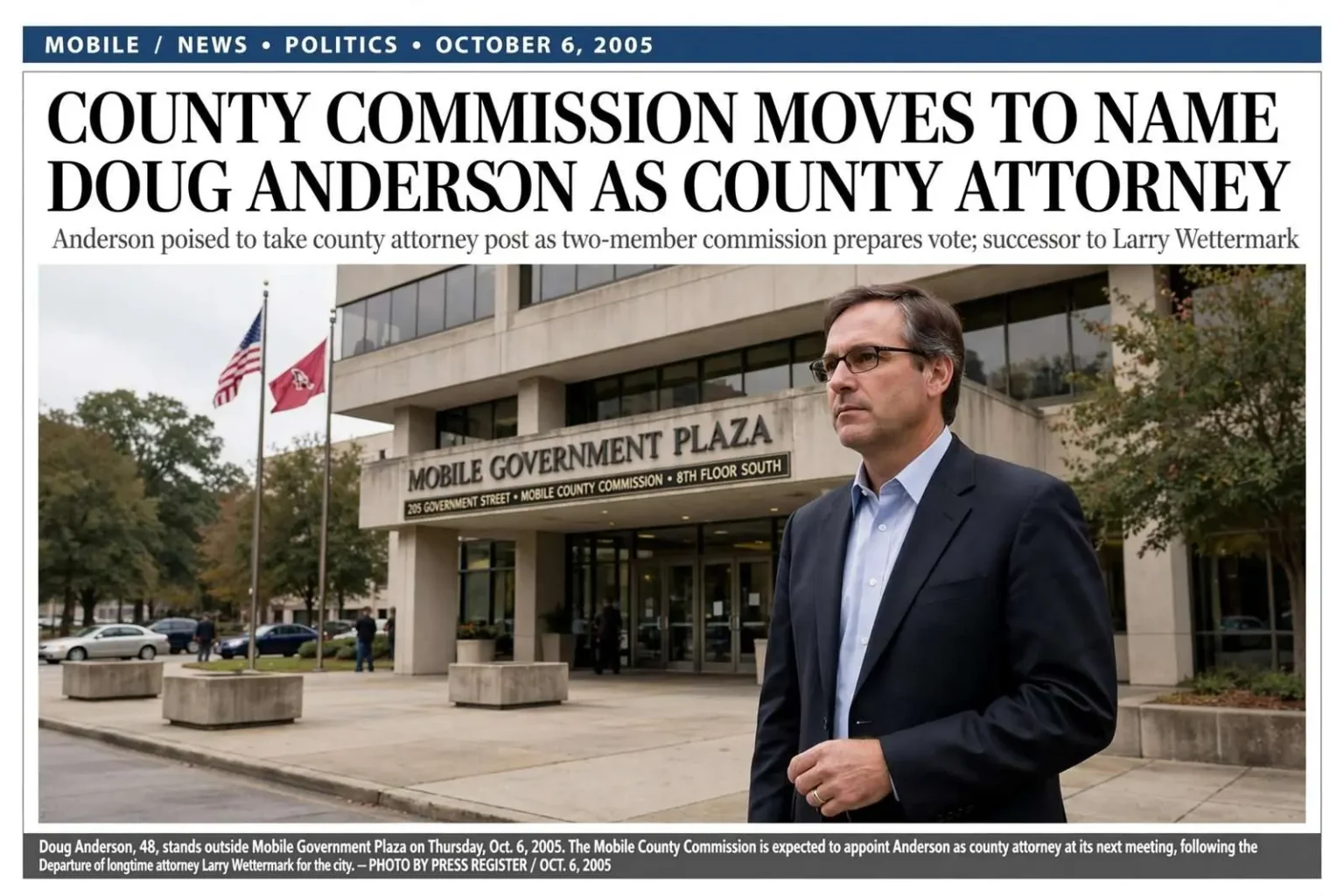
Mobile attorney Doug Anderson, a fixture in local Republican circles, was in line in early October 2005 to take over the legal work of the Mobile County Commission, a post that carries quiet but considerable influence over how county government conducts its business. Anderson, then 48, was positioned to succeed outgoing county attorney Larry Wettermark, who was moving across the government complex to the municipal side to serve as city attorney in the administration of newly elected Mobile Mayor Sam Jones.
The county attorney is a behind-the-scenes job that most residents never see, yet it touches nearly everything the county does. Every contract the commission signs, every lawsuit the county faces, every land purchase, personnel dispute and open-meetings question passes across that desk. Whoever holds the engagement becomes, in practice, one of the most consequential unelected figures in county government — which is why the race to fill it drew attention well beyond the courthouse annex.
A Vacancy Created by City Hall’s Turnover
The shuffle was a direct consequence of the 2005 mayoral election. Jones, who had represented north Mobile and north Mobile County as a Democrat on the county commission for 18 years, resigned his commission seat with three years remaining on the term in order to take the helm of city government. Wettermark, the county’s longtime legal representative, went with him.
Alabama’s quirky overlapping geography explains how one election could upend two governments. The City of Mobile and Mobile County operate as separate governments, but the city’s boundaries sit inside the county, and elected officials frequently cross between the two arenas. Jones’s move followed a pattern Mobile voters knew well: a commissioner leveraging a countywide profile into the mayor’s office, exactly as earlier city leaders had done in decades past. The 2005 election, which sent Jones to Government Plaza and shifted the city’s political leadership, thus emptied a seat on the county side at the same time it emptied a legal engagement.
An agenda item naming Anderson as the county’s legal representative surfaced on a Thursday, when Commissioners Stephen Nodine and Mike Dean met in conference. Official action was expected to follow at the commission’s next regular meeting, likely to be held on a Tuesday because the Columbus Day holiday fell on the preceding Monday.
Both Dean and Nodine were Republicans, and with Jones gone the two of them made up the sitting membership of what is ordinarily a three-member body. Dean said he planned to recommend Anderson for the job. Nodine, for his part, said he had met with several prospective legal representatives but would not confirm his support for Anderson ahead of the conference. Anderson declined to comment pending the commission’s official action.
With only two members seated, every decision the commission made in the interim required unanimity — a single dissent could deadlock county government. That structural reality put extra weight on the selection of a county attorney, because the remaining commissioners could not afford to be at odds over who would counsel them through the vacancy dispute itself.
A Commission Seat in Limbo
The appointment unfolded against a partisan fight over who would replace Jones on the commission itself. Gov. Bob Riley and his legal advisors held that the power to fill the vacancy rested with the governor. A Montgomery judge, ruling on a lawsuit brought by the Democratic Party, sided with the argument that a special election was required.
The dispute turned on a question Alabama law has long left murky: what happens when a commissioner leaves office mid-term? Riley’s administration argued that county commission vacancies were gubernatorial appointments, a reading that would hand the governor’s office the power to tip a local governing body’s balance. Democrats countered that voters in the district deserved to choose their own representative and sued to force a special election. The fight was not academic. In a body normally seated with three members, whichever side prevailed would decide whether Mobile County’s commission tilted Republican or regained a Democratic voice.
The stakes were plain enough. With two Republicans holding the remaining seats, the manner in which the third was filled would determine whether the commission’s partisan balance shifted, and it framed every personnel decision the two remaining commissioners made in the interim, including the choice of a county attorney.
The Terms of the County’s Legal Work
The county attorney’s post is not a salaried civil-service job but a professional engagement, and the compensation figures on the record at the time offer a window into its value: a monthly retainer paid to Wettermark of $7,000, plus an hourly rate for litigation of $140. The structure is common across Alabama counties, where governing bodies contract with private attorneys rather than employing a full-time in-house counsel. The retainer covers routine advising — attending meetings, drafting opinions, reviewing contracts — while litigation is billed separately, meaning the county’s actual legal costs could climb substantially whenever a major dispute landed in court.
Between the retainer and expected litigation work, the engagement represented a six-figure annual relationship with one firm — and a foothold in county government that many Mobile lawyers courted for years. Wettermark had held it through a long tenure that spanned multiple commissions, building the kind of institutional memory that private counsel accumulate only with time: knowledge of old land deals, aging litigation files, and the unwritten understandings that govern a county’s operations.
One expectation attached to the change was structural rather than personal. Observers anticipated that under Anderson’s oversight the county’s legal work would be distributed more widely among outside firms than it had been under Wettermark’s stewardship, a shift that would spread both the workload and the fees across a larger share of the Mobile bar.
That shift had real implications for local law practice. Centralizing county legal work with one attorney concentrates fees with that attorney’s firm; distributing it spreads business to dozens of lawyers, each building a relationship with the county that could pay off in future engagements. Specialized matters — environmental work, bonding counsel for road projects, employment defense — often require outside specialists regardless, so the question was always how much of the routine business stayed with the county attorney and how much went to the wider bar.
Who Doug Anderson Was
Anderson was a Mobile native who attended UMS and the University of Alabama. He and his wife, Leslie, were the parents of three daughters. He practiced as a partner in the law firm of Bowron, Latta and Wasden.
His pedigree was a familiar one in Mobile’s legal and civic establishment. UMS-Wright Preparatory School has educated generations of the city’s professional class, and the firm he led — with roots in Mobile’s oldest law practices — carried the kind of name recognition that mattered in a job awarded by two Republican commissioners. Anderson’s standing in local Republican circles gave Dean a politically comfortable nominee at a moment when the party’s hold on the commission was itself under litigation.
His refusal to comment until the commission acted reflected the delicacy of the situation. A lawyer waiting to be hired by a board that still had an unresolved seat and an unresolved dispute with the governor’s office over its own composition had every reason to stay quiet.
Why It Mattered
For Mobile County residents, the composition of the commission and the identity of its lawyer were anything but abstract. The county paved subdivision streets, funded emergency services in the unincorporated areas, controlled zoning outside city limits and operated parks and senior centers across a jurisdiction of more than 400,000 people at the time. Decisions about all of it would be made by a two-member board, advised by a lawyer they had picked without public input, at least until the vacancy dispute was resolved.
The county attorney advises the commission on contracts, personnel matters, open-meetings questions, land dealings and litigation exposure. In a county the size of Mobile, with a portfolio that includes roads, the jail, public health facilities and economic development agreements, the person holding that engagement helps shape which projects move forward and which stall.
Mobile County in 2005 was one of the largest county governments in Alabama, with a capital program of road and drainage projects, a growing industrial and port economy, and a steady stream of development agreements with companies locating along the mobile harbor and I-10 corridor. Legal counsel sat behind each of those transactions: negotiating with state agencies, vetting incentive deals, defending the county in employment and jail litigation, and advising on the Alabama Open Meetings Act as commissioners weighed decisions in conference sessions. A change in that office was never just a personnel swap — it changed whose advice shaped those decisions.
Looking back from the present day, the episode is a useful reminder of how tightly the city and county sides of Mobile government have long been braided together. A single election for mayor set off a chain of consequences that emptied a commission seat, moved the county’s lawyer to City Hall, opened a new legal engagement worth six figures a year, and touched off a partisan court fight in Montgomery over how the vacancy should be filled. Those threads would take months to untangle, and the arguments made in the fall of 2005 about appointments versus special elections would echo in Alabama vacancy disputes for years afterward.