What Mobilians Love and Loathe About Their City, Part One
In the fall of 2005, with a new mayor at City Hall and Katrina's cleanup underway, dozens of Mobile residents answered three questions about what they loved, what they loathed and what they could not stop thinking about in their city.
In the autumn of 2005, with a new mayor settling into City Hall and the Gulf Coast still sweeping up after Hurricane Katrina, the newspaper put three deceptively simple questions to a few dozen Mobile-area residents: What do you like most about Mobile? What do you like least? And what is the one thing you feel most strongly about that you suspect matters less to everyone else?
The answers, gathered from attorneys, business owners, public officials and ordinary neighbors, painted a candid portrait of a city its residents plainly loved and just as plainly wished were a little different.
The timing sharpened every answer. Sam Jones had been elected mayor in September, ending an era at City Hall and becoming the first African American to hold the office. Hurricane Katrina had come ashore weeks earlier, sending thousands of Gulf Coast evacuees into Mobile and reminding the city how much of its identity lay in its exposure to the water it loved. The respondents were, in effect, taking inventory of their city at a hinge moment.
What They Loved
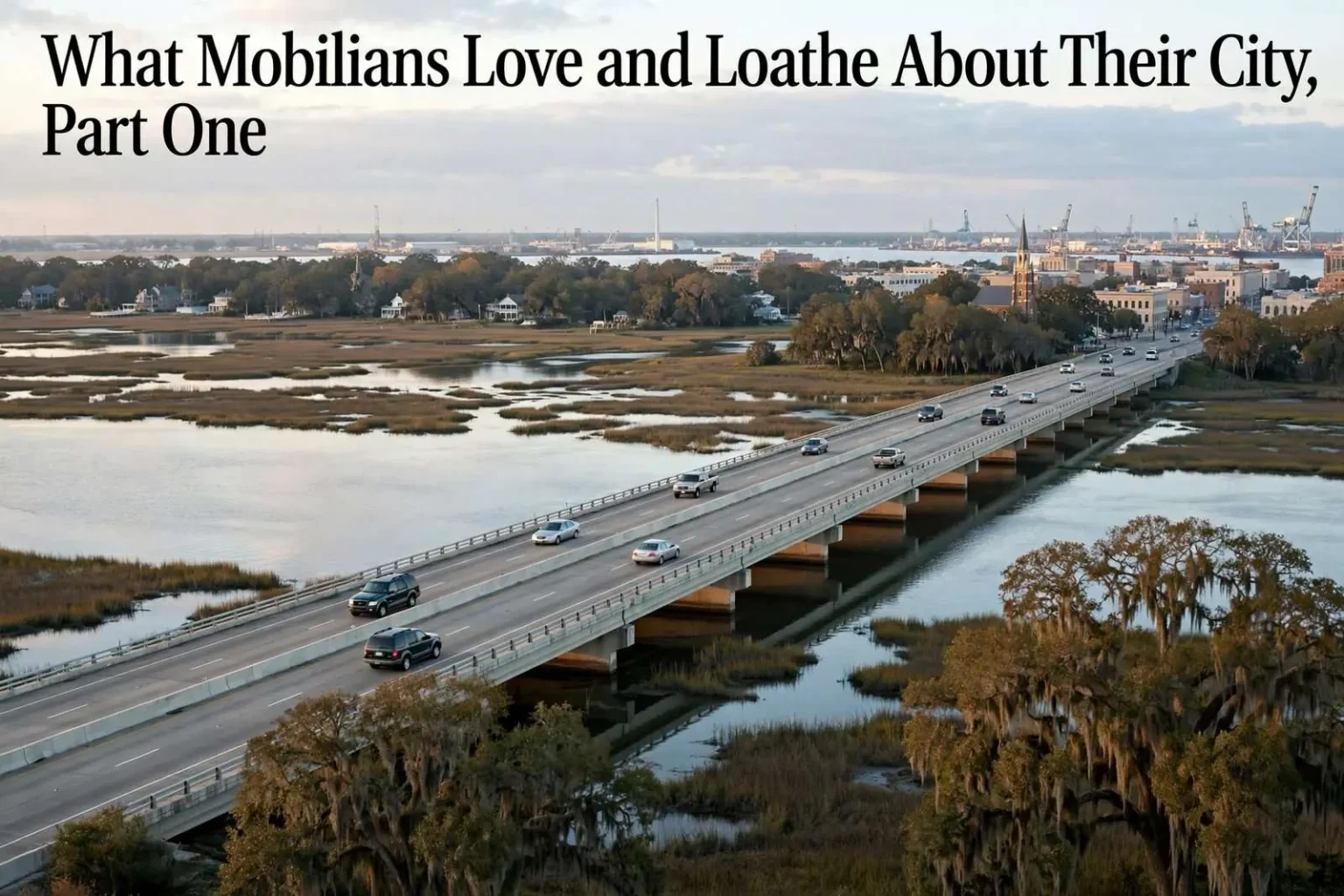
Water ran through nearly every answer. Again and again, residents named the bay, the nearby Gulf beaches and the everyday luxury of living in a coastal city. One writer described the wow factor of crossing the Bayway on a clear day; others pointed to fishing, hunting and birding within easy reach.
The Bayway — the elevated span of Interstate 10 that carries traffic across the upper reaches of Mobile Bay — is an acquired commute that never quite loses its effect. On a clear morning, drivers cross open water and marsh with the delta spreading to the north and the Gulf light playing across the surface, a view that residents from other cities routinely describe as the moment they understood what Mobile had. It figured in the responses as something more than scenery: proof that the city’s setting was an asset no peer of its size could claim.
The access argument repeated in different registers. Within an hour’s drive a Mobilian can reach the beaches of Baldwin County, the bass and bream of the delta’s rivers, the duck blinds of the Mobile-Tensaw wetlands, and the birding corridors where migratory species funnel across the coast each spring and fall. For outdoors-minded residents, the city’s location was not an amenity to be scheduled around but a daily fact of life.
A few singled out the region’s restaurants and festivals, while others simply cited the everyday comfort of a place where they still recognized their neighbors. Just as common was affection for Mobile’s Southern character, its historic homes and shaded streets, its Mardi Gras traditions and the unhurried pace that many said they would not trade for a faster, bigger city.
The Mardi Gras reference carried its own weight of pride. Mobile’s carnival season predates New Orleans’ by years, and the city’s mystic societies have marked it continuously since the early eighteenth-century French colonial period — a claim to cultural depth that locals deploy the moment anyone suggests Mobile is a smaller imitation of its western rival. The answered loyalty to oak-lined streets and historic districts reflected the same instinct: an old city, conscious of its age, in a region that often tears its past down.
School board member Bradley Byrne singled out the months from mid-September through June, when the coastal climate is at its kindest. It was a love letter with an asterisk — the months he skipped were the ones everyone else complained about first.
What Wore on Them
The complaints clustered, too. The summer heat and humidity drew groans from nearly everyone, often delivered with good humor. Mobile’s summers are not a matter of opinion but of physics — a city at the same latitude as the tropics’ edge, ringed by water that holds the heat through September — and even residents who cherished their coastal home treated the season as a tax collected annually on the rest.
A deeper frustration was what several respondents called a stubborn negativity in local life, the reflexive habit of finding fault, which more than one blamed on the tone of the newspaper call-in columns. The observation amounted to a diagnosis of the city’s civic psychology: that Mobile’s worst enemy was Mobile’s own voice, and that decades of “it’ll never work here” had done more damage than any outside force.
Others pointed to high city taxes, an airport they felt was losing travelers to Pensacola, and a public school system many judged to be underperforming. Each complaint had data behind it. Mobile Regional Airport competed against a Pensacola facility whose low-fare carriers drew Gulf Coast travelers willing to drive an hour to save hundreds of dollars, and the leakage was a standing grievance among business travelers. The public schools, meanwhile, were the subject of recurring state scrutiny and of the private-school migration that kept Mobile’s parochial and independent academies full.
Crime and a sense that city leadership had lost its way surfaced in several of the bluntest replies. Those responses came from the city’s realist wing — residents who had stopped expecting the argument about the schools or the airport to resolve and had moved on to wondering whether anything would.
The Things They Could Not Let Go
Asked to name a private conviction, residents grew specific. Byrne argued for far earlier foreign-language instruction so that a port region tied to international commerce could raise a multilingual workforce.
The argument drew on the port itself. Mobile’s docks ship and receive cargo for trading partners on several continents, and the companies that cluster around the harbor — freight forwarders, customs brokers, shipping agents — depend on employees who can conduct business across language barriers. Byrne’s point was that the skill should be built in childhood, in the public schools, rather than improvised in adulthood by a workforce that had never been taught to make the port’s global reach its own.
Businessman William Yeager pressed his long-held view that the planned Interstate 10 bridge belonged upriver at the Cochrane-Africatown crossing rather than south of the tunnel.
The bridge question has divided Mobile for decades, and Yeager’s position was its north-side school of thought. A crossing at the Cochrane-Africatown alignment would connect the city’s northern neighborhoods and give Africatown — the community founded by the survivors of the last slave ship to reach America — a span named in its history, while relieving the Wallace Tunnel bottleneck that chokes downtown traffic. A bridge south of the tunnel, by contrast, rises over the waterfront that downtown’s future was thought to depend on. Every version of the debate ultimately asks what Mobile believes its harbor should look like.
Terry Lathan wondered aloud why Mobilians did not storm City Hall to demand lower taxes. The image was deliberately theatrical — a civic mobilization over property rates — and its point was about temperament: a city whose residents grumble quietly about taxation rather than organize loudly against it.
Others worried about sprawl, the loss of green space and a small-town mindset they feared would keep the city from competing. The sprawl concern reflected the era’s growth pattern: new development pushing west and southwest along the corridor highways while older neighborhoods aged in place, a geography that scattered the population the city’s core needed back.
A City on the Move, With Reservations
For all the grievances, a thread of optimism held the responses together. Several credited recent leadership with putting Mobile on a path of steadier growth, courting cleaner industry and paying new attention to the arts, the port and downtown.
The optimism had concrete referents. The city had spent the preceding years recruiting industrial employers whose payrolls outmatched the smokestack reputation they replaced, investing in the waterfront, and building the arts and festival calendar that a downtown revival requires. The Port of Mobile’s expansion, the arrival of major manufacturing along the region’s corridors, and the slow refurbishment of the historic core all figured in respondents’ sense that the trajectory had bent upward.
One longtime real estate executive urged the city simply to stay the course and reward excellence. The advice, from someone whose industry measured the city block by block, amounted to a warning against the churn that has undone downtown revivals elsewhere — the tendency to change leadership, strategy or fashion just as an investment begins to compound.
The counsel assumed what several other respondents doubted: that Mobile could sustain attention on any plan long enough to see it through. Between the negativity diagnosis and the stay-the-course appeal, the survey’s portrait of the city’s civic temperament came into focus — a community that agreed more about direction than its quarrels suggested, and whose chief deficit was confidence.
Even the sharpest critics tended to circle back to the same conclusion: Mobile was a good place to live and, most believed, getting better. The belief was not universal — the bluntest replies had come from residents who had run out of patience — but it was the majority position, and it rested on evidence rather than sentiment. The port was growing, the industrial pipeline was fuller than it had been in a generation, and the city’s natural advantages had not depreciated a day.
The survey’s three questions worked because they separated love from grievance from conviction. The first produced a consensus; the second produced a list that any city’s residents could have signed; the third produced the specific ideas — early language instruction, a northern bridge crossing, a taxpayers’ uprising — that residents had carried for years without a forum. Read together, they described a city whose problems were known by heart and whose affection for itself survived them.
This account is the first in a series drawn from those conversations.
The series format mattered in itself. A newspaper that had absorbed its share of the negativity complaint — the call-in columns several respondents blamed for the city’s fault-finding tone — had turned its pages over to residents’ own assessments, favorable and not. The responses that followed, from attorneys to retirees, would build a composite portrait no single interview could: of a Gulf city entering a new political era with its arguments intact and its loyalty, for the most part, unshaken.