Beyond the Marquee: Party Committee Seats Also on the June 1 Ballot
Contested races for the state Republican Executive Committee in Mobile and Baldwin counties will be decided June 1, alongside the district attorney and state Senate contests drawing the headlines.
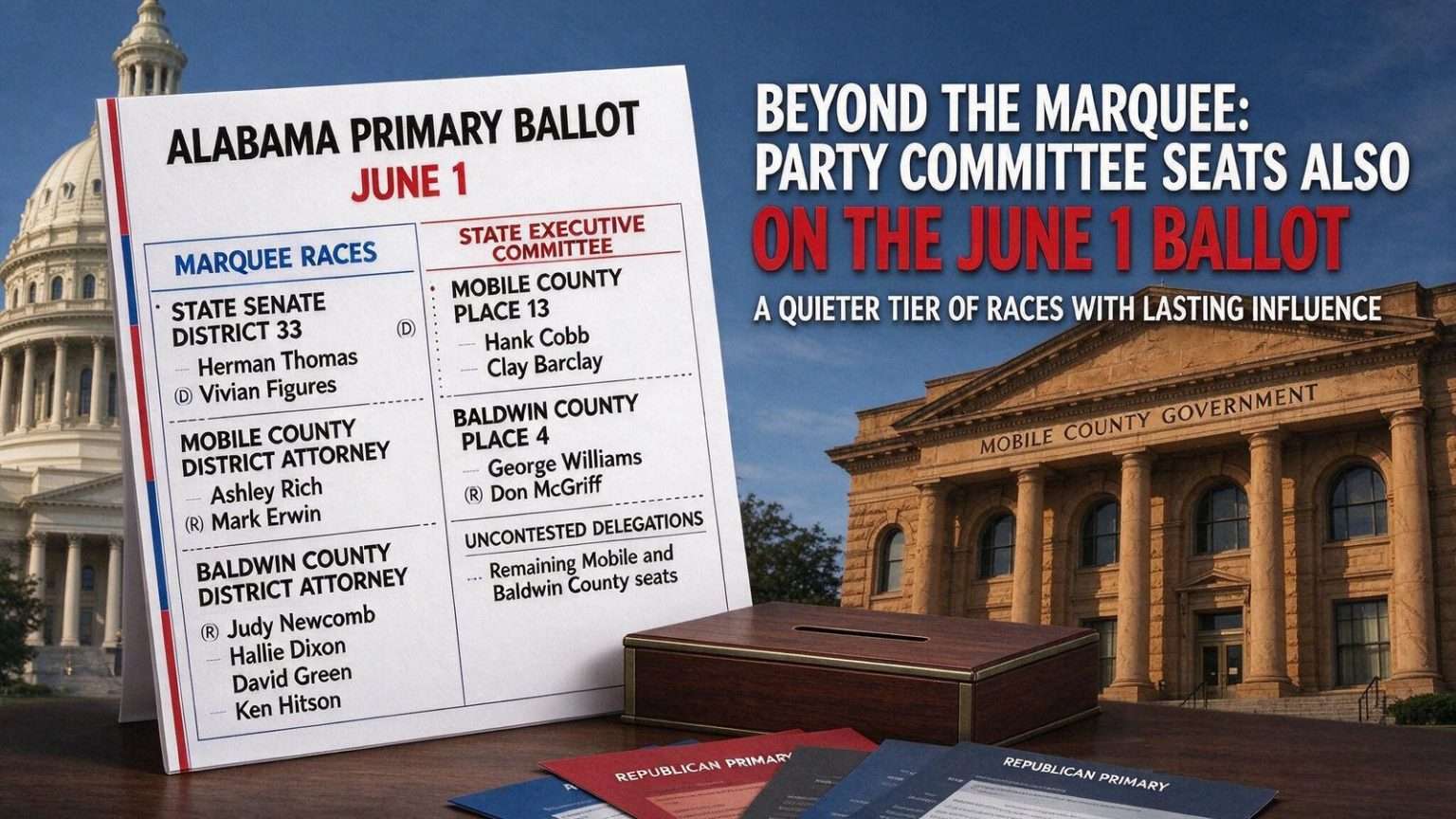
The June 1 primary ballot in south Alabama is crowded with intra-party fights, and not all of them are for public office. The marquee contests are well known. Herman Thomas is challenging state Sen. Vivian Figures in the Democratic primary for Senate District 33. Ashley Rich and Mark Erwin are competing for the Republican nomination for Mobile County district attorney. In Baldwin County, incumbent District Attorney Judy Newcomb faces three Republican challengers — Hallie Dixon, David Green and Ken Hitson.
Beneath them sits a quieter tier of races that most voters never notice and party regulars watch closely: seats on the Alabama Republican Executive Committee, the body that sets the state party’s rules, certifies its candidates and, in practice, decides a good deal about how Republican politics in Alabama is conducted.
Two contested seats
In Mobile County, Hank Cobb and Clay Barclay are competing for Place 13 in what amounts to a generational contest for a party post. In Baldwin County, George Williams and Don McGriff are battling for the Place 4 slot. Those are the only two committee races in the two counties that will actually be decided by voters.
Contested committee seats are rare enough that their appearance on a ballot draws notice among party activists. The committee’s numbered places are apportioned so that each county’s delegation reflects its Republican vote, and when two candidates file for the same place, the outcome is decided in the primary — no runoff, no general election opposition, just the June 1 electorate of one party’s voters. That makes the handful of contested seats the only moments when the grassroots gets a direct say in who represents it on the state committee.
The rest of the field is set.
Running unopposed in Mobile County
The uncontested Mobile County slots on the state committee are: Place 1, Jerry Lathan; Place 2, Alleen Barnett; Place 3, Karen J. Hamilton; Place 4, Adam Bourne; Place 5, Charles R. Larrimore; Place 6, Susan Butler McConnell; Place 7, Al Sessions; Place 8, Frank F. Millsaps; Place 9, Virginia Miller Delchamps; Place 10, Austin L. Rainwaters; Place 11, Connie Hudson; Place 12, open; Place 14, Les Barnett; Place 15, Terry Murphy Lathan; and Place 16, Brittany Lathan Bailey.
The Mobile delegation mixes veteran party figures with officeholders and civic names that Mobile voters know from other ballots. County Commissioner Connie Hudson’s presence on the committee illustrates how party posts and elected office overlap in Alabama, where many local officials also hold seats in the party’s governing structure. The open seat at Place 12 will be filled after the election by the committee’s own processes, since no candidate qualified to run for it.
Running unopposed in Baldwin County
The uncontested Baldwin County slots are: Place 1, Becky Vasko; Place 2, Huey “Hoss” Mack; Place 3, Stephen Dampier; Place 5, Doris A. Hearn; and Place 6, Dan Benton.
Baldwin’s delegation is smaller because the committee’s formula allocates places based on the county’s Republican strength in past elections, but it is no less consequential — Baldwin is one of the most reliably Republican counties in Alabama, and its committee members arrive in Montgomery with the weight of a county where the party’s primary is often the only election that matters.
Why these seats matter
Executive committee members do the unglamorous work that shapes every other race on the ballot. The committee writes and revises the party’s rules, decides how candidates qualify for the ballot under the party label, certifies primaries, fills vacancies and weighs disputes between factions. When Alabama Republicans argue about party unity, candidate loyalty oaths or who counts as a “real” Republican, the argument ultimately lands in the room where these members sit.
The committee also elects its own officers — the chair and vice chairs who become the public faces of the party — and its makeup determines which faction of Alabama Republicanism controls those positions. In a state where the primary is the decisive contest for most offices, the organization that governs the primary process holds real power over the practical machinery of politics: who gets certified, which rules govern challenges, and how the party’s resources and endorsements flow.
That is why party regulars track these races even when general voters scroll past them. A committee seat has no district office, no budget and no news conferences, but it carries a vote in the rooms where the rules are made — and in Alabama’s one-party-dominant politics, the rules are often where elections are actually won.
The marquee races above them
The attention the committee races lack flows instead to the contests at the top of the ballot. In Senate District 33, a Mobile-centered seat long held by the Figures family, Herman Thomas’ challenge to Sen. Vivian Figures heads the Democratic side of the June 1 primary — an intra-party fight for a district the party has held for generations.
The district attorney races give both counties their sharpest contests. In Mobile County, incumbent Ashley Rich and Mark Erwin are competing for the Republican nomination in a race that will likely settle who leads the county’s prosecutorial office, given the strength of the Republican label in countywide elections. Baldwin County’s race is a four-way fight, with incumbent Judy Newcomb defending the nomination against Hallie Dixon, David Green and Ken Hitson — a field large enough that the outcome may hinge on name recognition, legal-community support and the ability of one challenger to consolidate the anti-incumbent vote.
Those contests will decide who wields prosecutorial power in the region’s two most populous counties. But the quieter races one tier down — the committee seats — will help decide the rules under which every future candidate in both counties runs. Voters who take the time to scroll to the bottom of the June 1 ballot will find two of them actually contested: Cobb versus Barclay in Mobile County, and Williams versus McGriff in Baldwin County, with the rest of the delegation already set and waiting to take office.
For the parties, June 1 is a sorting day: nominees chosen for the fall, committee delegations seated for years of internal politics, and the machinery of both parties adjusted once again by the only voters who matter in a primary — the ones who show up.
How the committee is built
The State Executive Committee’s membership is designed to tie the party’s governing board directly to county-level Republican strength. Each county is entitled to one member for every portion of the party’s statewide vote it casts in a given election, which is why populous, heavily Republican counties like Mobile and Baldwin field multi-member delegations while smaller counties may have one or two. Members serve terms that run through the party’s state conventions and are nominated and elected through the primary process, meaning the same June 1 ballot that picks nominees for public office also seats the party’s internal government.
Once seated, the committee’s members join a body that convenes periodically to conduct the party’s business, with much of the detailed work handled between meetings by subcommittees and by the party’s professional staff in Birmingham. The committee’s decisions on rules and candidate qualification are formal actions with binding effect: a candidate the party certifies appears on its primary ballot, and a dispute over a candidate’s standing is resolved under the procedures the committee itself writes and revises.
What contested seats signal
When a committee place draws two candidates, it usually signals a live difference within the county party — of generation, of faction or of approach. Party insiders read those contests the way barometers read weather. A challenge to an incumbent committee member suggests an organized effort by one wing of the local party; a race for an open seat often reflects a competition over who inherits an outgoing member’s network. Either way, the campaigning happens at the retail level — among the activists, officeholders and regular primary voters who actually know what the State Executive Committee is and what its members do.
Turnout is the other variable. Down-ballot party races are decided by the most engaged slice of the primary electorate, which means the voters who bother to find Place 13 or Place 4 on the ballot are, in effect, the party’s most committed participants choosing its internal leadership. Campaigns for these seats tend to be built on personal contact and organizational support rather than advertising, and the results often serve as a quiet measure of which faction’s ground game is stronger heading into the rest of the election year.
The longer arc
The June 1 primary fits into a longer pattern of south Alabama politics. Mobile and Baldwin counties together anchor the Republican base of the state’s second congressional district and supply a large share of the party’s statewide margins, and the composition of their committee delegations echoes through every state party fight over rules, leadership and direction. The marquee races — a Senate district challenge, two district attorney primaries — will draw the headlines and the advertising. But the committee seats settled the same day will shape how the party qualifies candidates, writes its rules and chooses its leaders for the term that follows, one largely unnoticed vote at a time.