Mobile’s Civic Delegation Went to Baltimore Looking for a Blueprint
More than 100 Mobilians joined the Chamber's annual leadership trip to Baltimore in June 2005, studying the rebounding city's accountability programs, 311 call center and revived Inner Harbor for lessons to bring home.
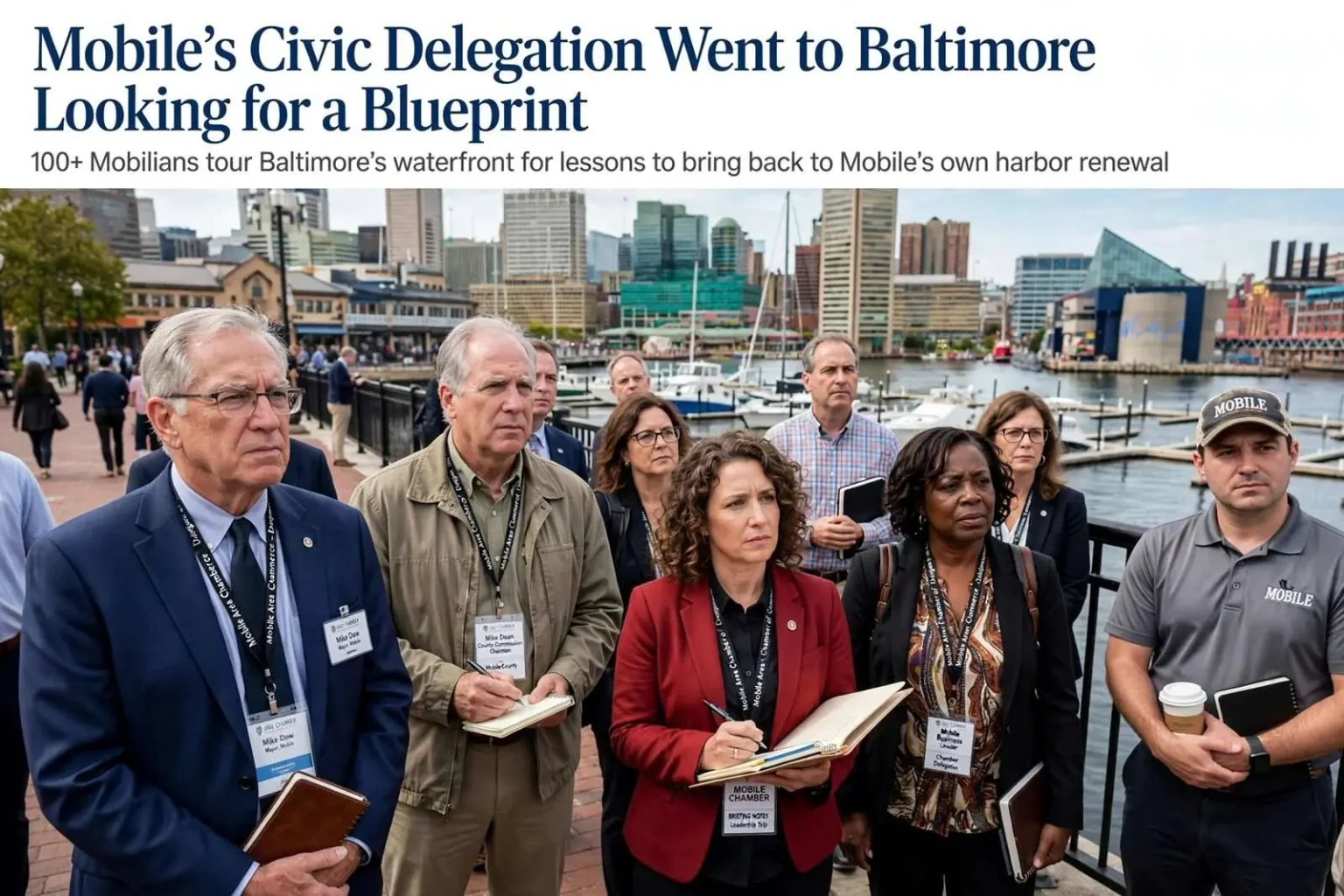
A little more than 100 Mobilians traveled together to Baltimore in early June for the Mobile Area Chamber of Commerce’s annual leadership trip, hoping to carry home lessons from a waterfront city whose landscape and history rhyme with the Alabama port’s own. Mayor Mike Dow and County Commission Chairman Mike Dean co-chaired the excursion, the Chamber’s first return to Baltimore in 14 years. The trips have become a fixture of the Chamber’s civic calendar — a deliberate attempt to put mayors, council members, county commissioners, business executives and nonprofit leaders on the same buses, in the same briefing rooms and, ideally, on the same page by the time the charter flight home lands.
The choice of Baltimore was no accident. Like Mobile, it is an old port city whose fortunes were built on a deep harbor; like Mobile, it watched its traditional industries shrink and its middle class head for the suburbs in the decades after mid-century; and like Mobile, it has spent recent years betting its recovery on its waterfront and its neighborhoods. Fourteen years earlier, a previous Mobile delegation had come to study the city’s famous harbor redevelopment. The question this time was what a city half again Mobile’s size had learned in the years since — and what parts of the answer could survive the trip home to the Gulf Coast.
A City That Lost Everything but Kept Going
What the delegation found was a city that had clawed its way back from decline. Between 1960 and 1990, Baltimore had lost nearly a third of its population, falling from close to a million residents to about 625,000, hollowed out by crime, decaying neighborhoods and a government many had stopped trusting. The numbers describe a generation of loss: tens of thousands of rowhouses abandoned or demolished, factory jobs that vanished and did not return, and a tax base that shrank even as the cost of policing, fire protection and infrastructure in an aging city kept climbing.
The Baltimore the Mobilians toured was visibly on the rebound. The Inner Harbor — in the 1970s a derided stretch of failing wharves — had become one of the most studied waterfront successes in America, drawing millions of visitors a year to its aquarium, its marketplace pavilions and its promenades. New housing had followed the water back into neighborhoods that had been written off, and downtown offices that had emptied in the 1980s were filling again. The delegation heard repeatedly that none of it happened quickly: the harbor redevelopment took two decades of patient, politically uncomfortable investment before the private market believed in it.
For a Mobile audience, the echo was hard to miss. Mobile’s own downtown had spent decades watching retail and population drain toward the western suburbs before the convention center, the cruise terminal and two decades of streetscape and nightlife investment began pulling life back toward the river. Baltimore’s lesson, several delegates said, was less about any single project than about staying power — the willingness of a city and its business community to hold a strategy through multiple administrations and multiple recessions.
Accountability, Up Close
A small group sat in on a session of CitiStat, the accountability program built under Mayor Martin O’Malley, who was by then running for governor. Every two weeks, the format requires city department heads to face the mayor’s team and answer for costs, performance and citizen complaints. The technique — borrowed from the CompStat crime-mapping program the New York Police Department pioneered in the 1990s — turns a city’s own data into a public examination: overtime hours per shift, response times, missed pickups, complaint volumes, all laid out on screens and interrogated line by line.
The Mobile visitors watched a transportation official grilled over cost overruns and a towing contract about to renew automatically without competitive bids. Nobody on the dais raised their voice, the delegates reported; the pressure was in the questions themselves, asked by analysts who had read the department’s numbers before the meeting and were not satisfied with the first answer. The renewal contract — the kind of routine item that passes through most city halls without a second look — did not survive the session unexamined.
Some private-sector guests were unsettled by the intensity; others saw exactly the kind of scrutiny they wished for back home. Business people who live inside quarterly reviews and performance dashboards recognized the format instantly — it was a board meeting with a mayor in the chairman’s seat — and several asked why a government that spends public money should be held to a softer standard than a company spending private money. Others worried aloud that a public grilling every two weeks teaches managers to defend numbers rather than to fix problems, a known failure mode of the Stat-model programs. Baltimore’s answer, its officials said, was persistence: the same metrics, revisited until the trend lines move.
What CitiStat demonstrated for the delegation was that accountability is a system, not a speech. The program required data infrastructure, analyst staffing, meeting discipline and, above all, a mayor willing to sit through his own administration’s bad numbers twice a month. O’Malley had made it the centerpiece of his mayoralty and, deliberately or not, his campaign — the idea that a city government could be measured, and measured publicly, was the platform he was carrying to statewide voters.
Answering the Phone
The delegation also studied Baltimore’s 311 call center, a clearinghouse that greets residents politely, tells them how long a request will take and issues a tracking number they can check online. The concept — pioneered by Baltimore as the first city in America to dial the number in 1996 — is simple: one memorable phone number for every non-emergency city service, a real human being on the line around the clock, and a service-request system that turns every complaint into a trackable ticket with an owner and a deadline.
The tracking number is the quiet revolution. A resident who reports a pothole is not told “we’ll look into it” but given a case number and a stated timeframe, and the request lands in the same data system CitiStat reviews. Missed deadlines show up in the mayor’s twice-monthly meetings. Complaint data, mapped by neighborhood, tells the city which streets, which routes and which problems recur — turning thousands of individual grievances into a maintenance map.
Mobile had its Action Center, several visitors noted, but nothing that guaranteed a callback. The difference, as one delegate put it, was the difference between a suggestion box and a promise. Anyone who has ever waited on a pothole report or a missed garbage pickup understands the gap: not the absence of a phone number, but the absence of any mechanism that obliges the city to close the loop. Several of the visiting officials took notes on staffing levels, software vendors and startup costs, and the Chamber’s follow-up committee was expected to push the idea through the summer.
The Discipline Behind the Programs
What struck several visitors was less any single program than the discipline behind them: a city that measured itself, published the numbers and expected its managers to explain the gaps. That habit of accountability, Baltimore’s officials argued, had done more to rebuild public trust than any individual initiative, because it gave residents evidence — response times, closure rates, published statistics — that reporting a problem actually mattered. A city can promise responsiveness; a city that posts its own performance data is making a verifiable claim.
The delegation heard versions of that argument in every briefing. Redevelopment worked because the city set measurable goals for its harbor investments. Crime fell because the police department mapped incidents and commanders answered for their districts. The through-line, one Baltimore official summarized, was refusing to accept “that’s just how city government is” as an answer to anything. Whether every claim survives scrutiny is a fair question — Baltimore still had neighborhoods in deep distress, and its recovery was uneven by any honest measure — but the delegation saw a city that at least kept score in public.
Bringing It Home to Mobile
Chamber trips like this one are judged by what survives the return flight, and history offered reasons for both hope and skepticism. Previous Mobile delegations had brought home ideas that took root and ideas that evaporated; the difference, veterans of earlier trips said, was usually whether a specific champion and a specific cost estimate came home with the idea. That is why the delegation’s committee structure mattered: each tour group was charged with writing up its findings, and the Chamber planned to compile them into recommendations for the city and county governments.
The realistic near-term candidates were clear. A 311-style request-tracking system is a purchase, not a revolution — the software is commercial, other mid-size cities had adopted it, and Mobile’s Action Center could be upgraded into the promise-based model without rebuilding city government. CitiStat-style reviews require no software at all, only data the city already collects and a mayor and council willing to sit through the results in public. The harbor lesson was slower and larger: keep a waterfront and downtown strategy funded across administrations, and measure it.
What the 100-plus Mobilians who flew home in June carried back, in the end, was a standard. Baltimore is bigger, older and more battered than Mobile, and its recovery is unfinished — but it showed a peer city measuring itself, publishing the results and holding its own leadership to the numbers. Whether Mobile chooses to adopt that habit is now a question with names and dates attached to it, and the Chamber’s report, the mayor’s budget and the next election will each supply part of the answer.