Mobile Hosts Regional Summit on Bringing Passenger Rail Back to the Gulf Coast
Mayor Sam Jones hosted a regional summit in Mobile bringing together mayors, federal officials and rail advocates to press for the return of Gulf Coast passenger rail service lost after Hurricane Katrina.
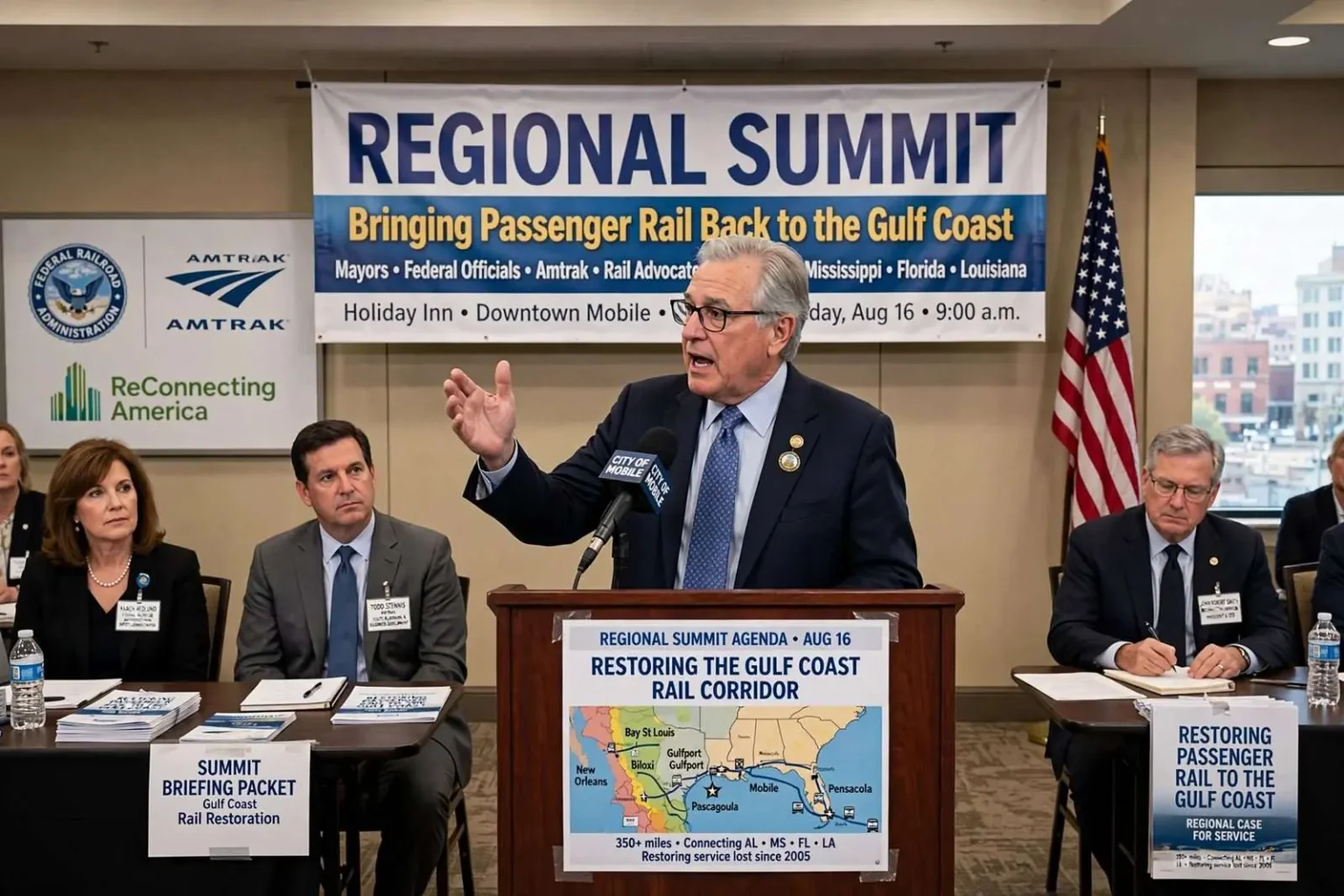
The push to restore passenger rail service to the Gulf Coast took center stage in Mobile as Mayor Sam Jones prepared to host a regional summit of mayors, federal officials and rail advocacy groups. The gathering was set for 9 a.m. Thursday, Aug. 16, at the Holiday Inn in downtown Mobile.
A coast without its train The summit addressed a loss the coast had felt for years. Damage to the rail lines between New Orleans and Jacksonville, Florida, after Hurricane Katrina caused Amtrak to discontinue service for Gulf Coast residents and visitors. In the years since, communities strung along the coast had been left without a passenger rail connection, and the effort to bring it back had become a shared regional cause.
Before the storm, Amtrak’s Sunset Limited carried passengers across the Gulf Coast three days a week, linking Mobile with stops along the Mississippi and Florida panhandle on its route between Los Angeles and Orlando. Hurricane Katrina washed out tracks, bridges and signal systems across the region in August 2005, and while freight service returned quickly, passenger service east of New Orleans never resumed. The suspension left a corridor of more than 350 miles — home to millions of people along one of the fastest-growing stretches of the Sun Belt — without a single scheduled passenger train.
The loss fell unevenly but universally along the coast. Residents without cars lost an independent way to travel between cities; seniors, students and travelers connecting to the national rail network lost a link; and the region’s cities lost the economic activity that a station stop brings downtown. For coastal Alabama, where Mobile’s historic rail terminal had served generations of travelers, the silent tracks became a standing reminder of a connection severed by the storm and never restored.
Mayors from Alabama, Mississippi, Florida and Louisiana were scheduled to attend the one-day summit, a reflection of how the issue crossed state lines and required cooperation among coastal cities that stood to benefit together.
The regional character of the campaign is its defining feature. A restored train would pass through a string of cities in four states, and no single municipality could bring it back alone: the route, the stations and the funding all require coordination among governors, members of Congress, state departments of transportation and the freight railroads that own the tracks. By gathering mayors in one room, organizers aimed to present the restoration not as a local wish but as a regional demand with unified backing.
The corridor itself makes a strong case on paper. The route runs through cities — New Orleans, Bay St. Louis, Biloxi, Gulfport, Pascagoula, Mobile, Pensacola and communities beyond — that are dense with tourists, casinos, military installations, colleges and growing populations, all connected today only by congested Interstate 10. Transportation planners note that few potential corridors in the country combine this much existing travel demand with rails already in place; what is missing is not infrastructure so much as an agreement to run the trains.
Federal and Industry Voices
The program featured a lineup of officials with direct influence over the question. Karen Hedlund of the Federal Railroad Administration, Todd Stennis of Amtrak and John Robert Smith of ReConnecting America were among those slated to take part, alongside others who wanted to see passenger rail service restored to the region.
Hedlund, the keynote speaker, served as deputy administrator of the Federal Railroad Administration. Before taking that post in December 2011, she had been the agency’s chief counsel, providing legal oversight and advice for its safety and passenger rail programs. She had led negotiations with several Class I host railroads to secure Service Outcome Agreements, supporting the timely obligation of nearly $8 billion in high-speed rail grants to 32 states and the District of Columbia.
Her presence carried particular significance for the Gulf Coast delegation. The Federal Railroad Administration administers the federal grant programs that any restoration effort would ultimately draw on, and an audience with its deputy administrator gave the mayors a direct channel to the officials who would evaluate, and eventually fund, the projects. The Service Outcome Agreements she negotiated established the template for how passenger service now operates on freight-owned tracks — agreements that define performance standards, dispatching priorities and penalties, resolving the core tension that has historically kept passenger trains slow and unreliable on lines their host railroads have no incentive to clear.
Stennis brought the perspective of the railroad itself, representing Amtrak’s route planning and business development side as the company evaluated which corridors offered realistic prospects for new or restored service. Smith, the former mayor of Meridian, Mississippi, had turned a standing station into a multi-modal center in his own city and now led a national organization devoted to transit-oriented development, giving him both a mayor’s understanding of what a rail connection means to a city and a national view of how communities have made the case for theirs.
The advocacy organizations in the room rounded out the coalition. Groups that had spent years keeping the restoration issue alive along the coast provided the sustained pressure between election cycles, compiling ridership studies, hosting public forums and maintaining contact with the congressional offices whose support any funding request would require.
The summit’s timing reflected a window of opportunity. Federal transportation programs had shifted significantly since the storm, with new grant programs targeting intercity passenger rail and a federal administration that had made rail investment a visible priority. Officials involved in the effort understood that corridors with organized local coalitions, completed studies and unified political backing stand first in line when grant applications are scored — and that a region still arguing with itself about whether it wants a train would fare poorly against regions that arrived with a united delegation. The Mobile gathering was, in effect, an exercise in building the application before writing it.
The mayor makes the case For Jones, restoring rail was tied directly to the region’s economic ambitions. “Restoring passenger rail service is vital for the growth in our area,” the mayor said, framing the train as infrastructure for the coast’s next generation of development rather than a nostalgic return to the past.
The economic argument for the service rests on the region’s growth and its tourism economy. The Gulf Coast from New Orleans through Mobile to Florida hosts casino destinations, beaches, conventions and a medical and aerospace corridor, all strung along a single highway — Interstate 10 — that grows more congested each year. A passenger train threading those cities offers an alternative for tourists, business travelers and residents alike, and every city on the route gains a downtown station that anchors hotels, restaurants and redevelopment nearby.
The practical obstacles are as well known to the advocates as the benefits. The tracks between New Orleans and the Florida line are owned by freight railroads, whose capacity, dispatching and track conditions would have to be upgraded to host passenger trains on a reliable schedule. Stations along the route — some closed, some repurposed — would need restoration. Operating support from the states along the corridor would be required, since federal grants historically covered capital costs but not the ongoing expenses of running trains. None of those obstacles is technical; each is a matter of funding decisions and agreements among parties with different priorities.
What the Summit Set Out to Do
The Mobile summit was designed to move the issue from advocacy to agenda. By gathering the region’s mayors with the federal officials who control grant programs and the Amtrak officials who would run the service, organizers aimed to establish a working framework — a unified regional voice, a shared set of asks, and a channel into the federal decision-making that would ultimately decide the corridor’s fate.
For Mobile, hosting the summit signaled the city’s stake in the outcome. The city’s port, its growing downtown and its position at the route’s eastern gateway into Alabama all depend on connections beyond the highway system, and a restored rail link would place Mobile back on the national passenger map for the first time since the storm. Jones’s decision to convene the region’s mayors in his city put Mobile at the center of the campaign it had long supported.
The gathering also gave the participating mayors a public commitment to hold one another to, a form of accountability that regional coalitions require to survive the years a project like this takes. A resolution adopted in one morning’s session becomes the reference point for every meeting that follows — the shared position each city’s delegation can carry to its legislators and its congressional office without renegotiating the basics each time.
Seven years after the storm washed out the tracks, the trains had not returned — but the coalition working to bring them back had grown broader, better organized and better connected to the federal government’s programs than at any point since the service was suspended. The Aug. 16 summit marked the latest and most formal step in that campaign, gathering in one room the mayors, federal officials and advocates whose combined action the coast’s next train would require.