Probate Judge Don Davis Sues Over Mobile County Voter Precinct Mix-Up
Mobile County Probate Judge Don Davis filed suit naming the Alabama secretary of state and county officials, arguing a postcard error let some voters cast regular ballots in the wrong precincts.
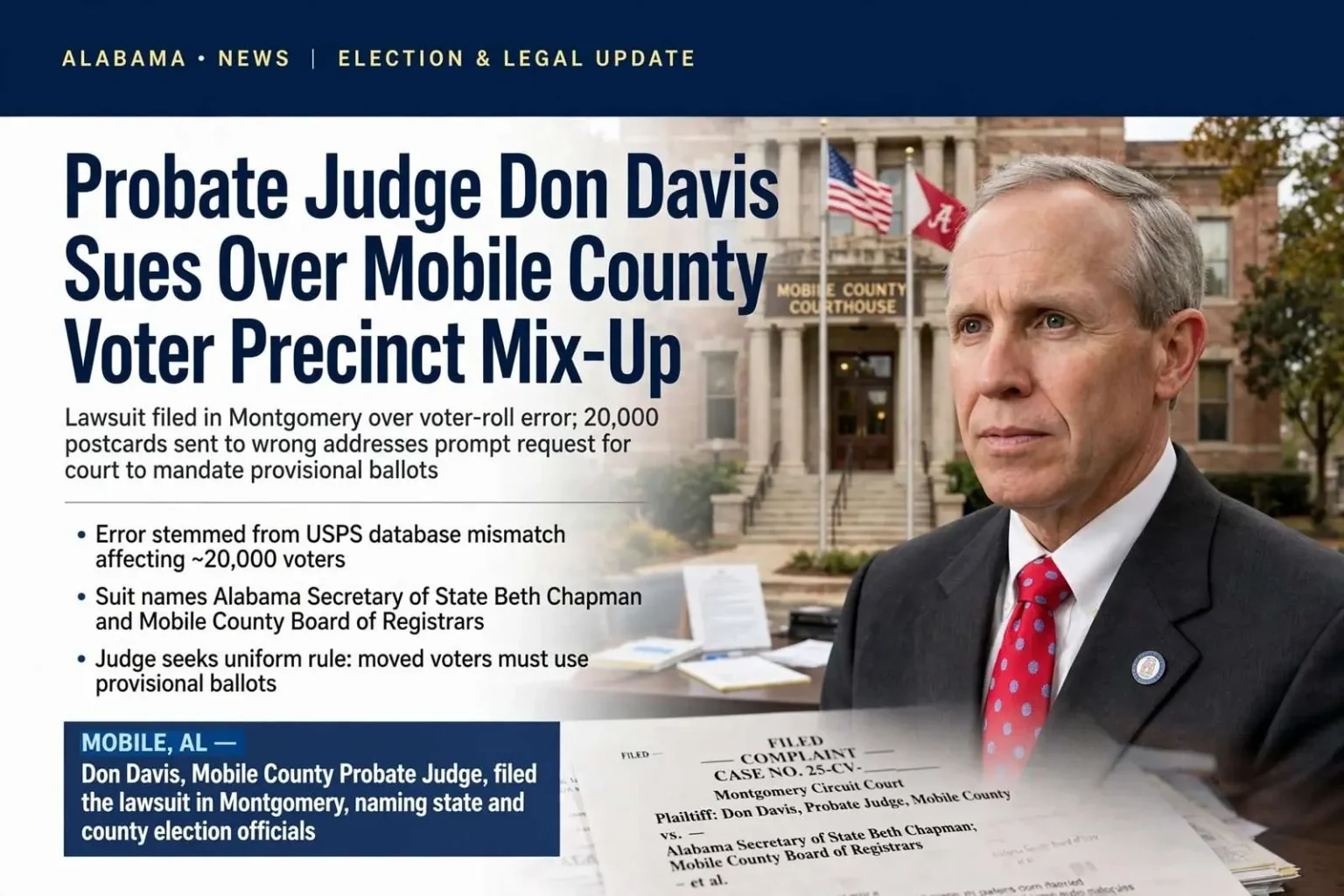
Mobile County Probate Judge Don Davis filed a lawsuit in Montgomery over a voter-roll mix-up he said could allow some residents to cast regular ballots in precincts where they no longer lived. The complaint named Alabama Secretary of State Beth Chapman along with Mobile County officials.
How the problem surfaced
According to the judge, the trouble came to light through an error in a routine mailing. A newspaper that won the contract to print courtesy postcards reminding voters of important voting information mistakenly used the U.S. Postal Service’s database rather than the state’s voter registration database. Election officials then used cards returned as undeliverable to help clean up the voter rolls.
Because of that mismatch, the suit said, about 20,000 individuals received cards that did not correspond to the state’s voter list. The result was confusion over which voters belonged in which precincts — a discrepancy Davis argued needed to be resolved before it affected the integrity of an election.
The error illustrates how much modern election administration depends on matching databases that were never designed to talk to each other. A postal database is built around delivery routes and address changes; a voter roll is built around precinct boundaries and registration records. When a printing contractor reaches for the wrong file, the output can look perfectly plausible — correctly addressed postcards, cleanly printed — while carrying addresses that have nothing to do with where a voter is actually registered. Returned mail is a standard hygiene tool for election offices, but it is only as reliable as the list it was drawn from, which is why the mismatch mattered far beyond a printing mistake.
Mobile County is Alabama’s second-largest county and one of its most complicated electorates, with voters spread from downtown precincts to the suburbs of the western shore to the communities down the Bay. Precinct lines are drawn to balance the load at each polling place, and a voter’s address determines not only where she votes but which races appear on her ballot — county commission districts, school board seats, legislative districts. A roster that blurs those lines threatens both the count and the ballot itself.
What the suit seeks
Davis asked the court to find that voters may not cast a regular ballot in a precinct in which they do not reside. Instead, the suit requested, voters who move from one precinct to another without updating their registration should be allowed to vote a provisional ballot.
The distinction matters: a provisional ballot is set aside and counted only after officials confirm the voter’s eligibility, providing a safeguard against improper votes being tallied outright.
Provisional ballots exist precisely for the gray areas of Election Day — the voter who moved last month, the registration that never caught up with a change of address, the name missing from a printed list. Casting one takes minutes; counting one takes diligence, because each envelope must be matched against registration records and state law before the vote inside is accepted or rejected. Regular ballots, by contrast, are tallied on the spot. Davis’s argument was that the mismatch created exactly the situation provisional ballots were designed for, and that the rules for handling moved voters should be stated clearly by a court rather than improvised at polling places.
Also named as defendants were the members of the Mobile County Board of Registrars — Virginia Delchamps, Shirley Short and Pat Tyrrell — the officials responsible for maintaining the county’s voter rolls.
The board occupies an unusual position in Alabama election law. Its members are appointed, not elected, and they administer registrations under state supervision, which puts them at the intersection of local knowledge and state authority. Naming the board meant the lawsuit reached everyone with a hand on the roll: the secretary of state who oversees the statewide database, the registrar members who maintain the county’s records, and the probate judge who in ordinary times administers the county’s elections from the other side of the bench.
An attorney general’s opinion
Both Davis and the Mobile County Board of Registrars had sought guidance on the matter from the office of Alabama Attorney General Luther Strange. The response laid out two acceptable paths for a voter whose name did not appear on a precinct list.
“When a voter’s name does not appear on the precinct voter registration list, a voter may use the fail-safe voting provision to cast a regular ballot at his or her former (‘old’) polling place or a voter may use the provisional ballot process to vote at his or her current (‘new’) polling place,” advised Brenda F. Smith, chief of the attorney general’s opinion division.
The two routes amount to a fork in the road for a voter caught between addresses. Fail-safe voting preserves a regular ballot by sending the voter back to the old precinct — the place where the registration is still unquestionably valid — while the provisional route lets the voter vote near home and have eligibility confirmed afterward. Both protect the franchise; they simply answer different voter needs. The voter who wants certainty chooses the old polling place. The voter who cannot return there relies on the provisional process and the canvass that follows. What the attorney general’s opinion could not do, Davis argued, was settle the deeper question of which ballots should count when the underlying rolls were known to be flawed — that, he said, was for a court.
Stakes for a busy election season
The dispute unfolded against the backdrop of a busy election calendar, when precise voter rolls carry outsized importance. A mistake affecting some 20,000 mailings, and the cleanup that followed, raised legitimate questions about how the county maintained its lists and how it should handle voters caught between an old address and a new one.
By taking the question to court, Davis sought a clear rule rather than a case-by-case scramble at the polls.
Election officials and poll workers had reason to want that clarity as much as anyone. Poll workers face these questions one voter at a time, often with a line forming behind them, and inconsistent answers from one precinct to the next are precisely what both parties to an election fear. A court order, by contrast, gives every precinct the same script. It also gives the canvass board a uniform standard for judging the provisional envelopes when they are opened after the election, when every accepted or rejected ballot may matter to a close race.
Whatever the outcome, the litigation highlighted the quiet but crucial machinery behind every election — the databases, mailings and precinct lists that determine where a citizen may lawfully cast a ballot — and the consequences when that machinery slips out of alignment. The postcards were, in the end, a courtesy; the questions they raised about residence, eligibility and uniform rules were anything but, and they are the questions every Alabama county confronts each time the rolls are cleaned and the polls are set.
The probate judge’s own office offers a vantage point worth noting. In Alabama, the probate judge serves as the county’s chief election official, appointing poll workers, receiving qualifications of candidates and absorbing the operational blame when anything from weather to paperwork disrupts a vote. Davis’s lawsuit, filed in that capacity, was unusual chiefly in its route — asking a Montgomery court to resolve a dispute that touched his own administrative duties and named the state officials above him in the election hierarchy. Election-law litigation of this kind typically moves quickly precisely because the calendar will not wait; courts understand that a ruling issued after Election Day is worth little.
The underlying vulnerability the case exposed — courtesy mailings drawn from the wrong database — also became a lasting lesson for election offices everywhere. Outreach programs depend on public trust: a voter who receives official-looking mail with a wrong address may ignore the next mailing, question the next notice, or show up at the wrong polling place and lose an hour of a workday. Restoring that trust after a mass error takes more than correcting the list; it takes public explanation of what went wrong, what was fixed, and what safeguards keep a contractor’s database choice from silently reshaping the voter file again. That is the practical stakes behind the legal language of the complaint — twenty thousand postcards were the symptom, and the diagnosis concerned the plumbing underneath the entire election.
For voters themselves, the practical guidance from the episode was straightforward: when you move, update your registration — and if a notice from election officials arrives with an address you do not recognize, call the board of registrars before Election Day rather than trusting either the card or your assumptions. The poll book, not the mailbox, remains the document that decides where a regular ballot may be cast, and keeping it accurate is the cheapest election insurance a county can buy.