Gulf Oil Spill Claims Administrator Brings Progress Report to Mobile
Deepwater Horizon Claims Administrator Patrick Juneau planned a Mobile press conference to update officials on the settlement process, reporting thousands of claims filed and millions in determination letters.
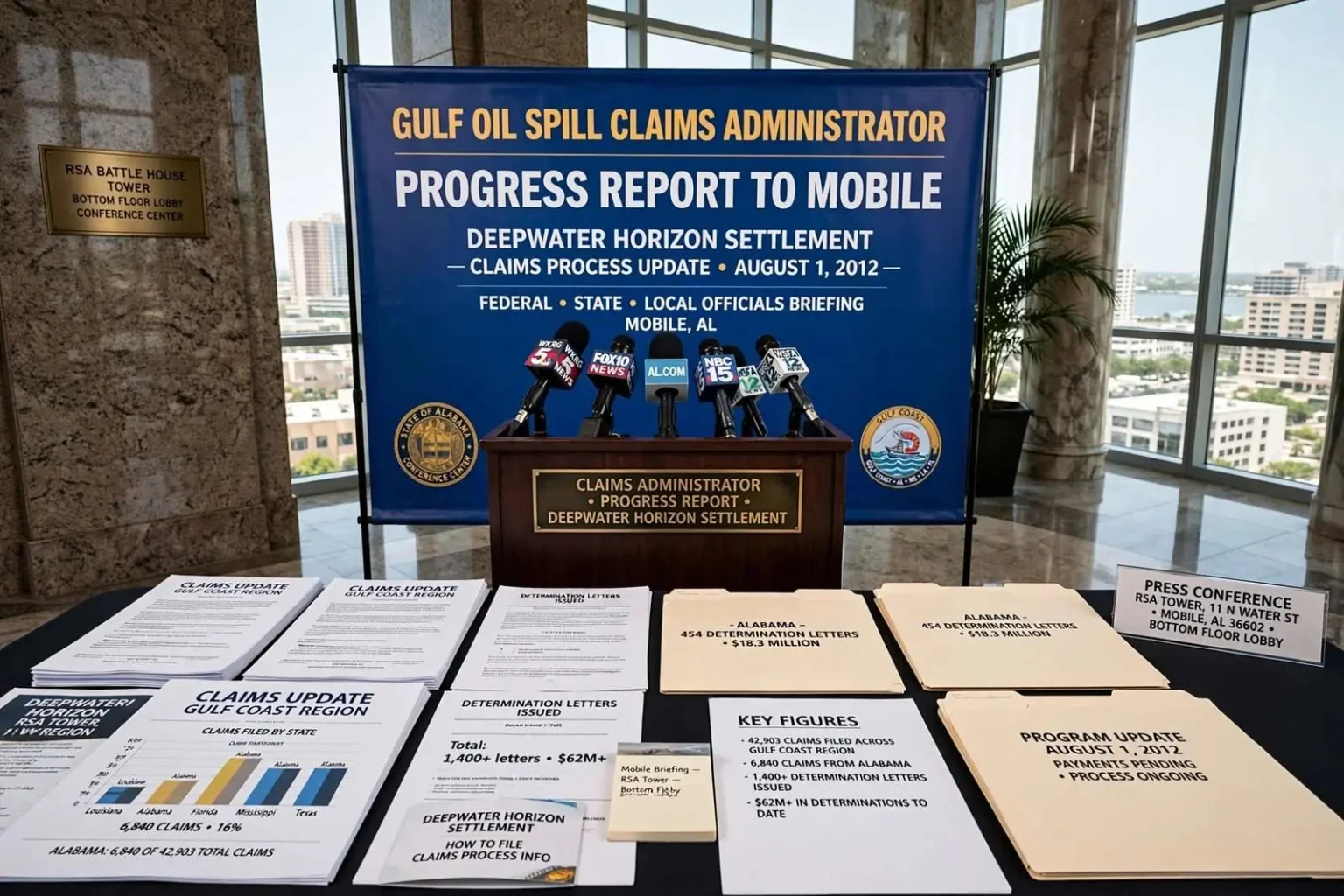
Deepwater Horizon Claims Administrator Patrick Juneau prepared to bring a progress report to Mobile, planning a press conference with federal, state and local officials from across the Gulf Coast region to update leaders and the public on the settlement claims process more than two years after the catastrophic 2010 oil spill.
The briefing was set for the bottom-floor lobby of the RSA Tower in downtown Mobile, placing the update at the base of the tallest building on the city’s skyline and a symbolic center of the region’s business community.
An update for the coast
“As we move further into the Claims Process, I think it is important to keep our federal, state and local officials updated on the status of the process,” Juneau said. “For this reason, I am planning to be in Mobile to share our progress with area leaders and the public.”
Juneau, a Lafayette, Louisiana attorney appointed by the federal court to administer the settlement created after the spill, had taken charge of one of the largest claims programs in American legal history. The settlement he administered grew out of the litigation that followed the April 2010 blowout of the Deepwater Horizon rig, which killed 11 workers and dumped millions of barrels of crude oil into the Gulf of Mexico, fouling shoreline from Louisiana to the Florida panhandle over a summer that reshaped the region’s economy.
The choice of Mobile as a venue reflected the region’s central place in the spill’s aftermath. Coastal Alabama, from the fishing communities of south Mobile County to the beaches of Baldwin County, had absorbed both the environmental blow and the economic disruption that followed, and residents and businesses had a direct stake in how the claims process unfolded.
Alabama’s coast had reason to watch those numbers closely. The state’s fishing and seafood sector, concentrated in Bayou La Batre and Coden, had spent two years lobbying for compensation that matched its losses, and each statistical update from the claims office was read locally as a progress report on whether that effort was paying off.
Alabama’s coastline is short by Gulf standards, but its economic dependence on the water is not. Tourism along the Baldwin County beaches, the commercial and recreational fishing fleets based at Bayou La Batre, the charter boat industry out of Orange Beach and the seafood processing houses of south Mobile County all depend on a healthy Gulf — and all saw revenue collapse in the months after the spill as beaches emptied and fishing grounds closed.
The numbers so far
Juneau said the claims continued to move smoothly. As of Aug. 1, more than 42,903 claims had been filed across the Gulf Coast region. Alabama accounted for 6,840 of those, or about 16 percent of the overall total — a share that underscored how heavily the state had been affected.
The filings came from every category the settlement covered: seafood processors and deckhands, hotel operators and restaurant owners, condominium managers and charter captains, plus the property owners and workers whose losses the program’s payment frameworks were designed to capture. The breadth of eligible claimants was itself a measure of how far the spill’s economic ripples had traveled — well beyond the docks and beaches most people associate with the disaster.
Beyond the raw number of filings, Juneau reported that more than 1,400 determination letters had been sent to claimants, representing amounts totaling over $62 million. Of those, 454 determination letters had gone to Alabama citizens, for a combined $18,255,000.
The Alabama figures were striking in proportion. The state held about one in six of the region’s filed claims but had received roughly 30 percent of the determination letters issued to that point — a pace that put Alabama claimants ahead of the curve relative to their share of filings. For a state whose leaders had spent two years pressing for a fair share of spill-related compensation, the numbers offered early evidence that the program was reaching the coast’s hardest-hit communities.
First steps toward payment
Juneau was careful to characterize the determination letters as an early stage rather than a finish line. “As I mentioned before, these determination letters are the first part in the payment process,” he said.
In other words, a letter marked progress toward a payment, not the payment itself — an important distinction for households and businesses still waiting to be made whole. A determination letter states what the claims program has calculated a claimant is owed under the settlement’s formulas, but the money arrives only after the letter’s accounting is reviewed, any objections or eligibility disputes are resolved, and payment processing runs its course. Claimants who disputed their determinations could submit appeals, adding another layer of time.
For claimants navigating a complex, multi-state settlement, that kind of clarity mattered. The process had drawn scrutiny and impatience along the coast, where many families had watched a single season’s losses stretch into years of uncertainty. Fishing families in Bayou La Batre had borrowed against boats to survive; condo owners and hoteliers along the shore had absorbed seasons of vacancies; restaurant workers had drifted to other industries. Two years on, the question that dominated public meetings was not whether compensation would come but when.
The settlement framework itself was the product of hard negotiation between BP and a committee of plaintiffs’ attorneys representing businesses and individuals across the Gulf states, approved by the federal court overseeing the sprawling spill litigation. The framework traded the uncertainty of individual lawsuits for standardized formulas — revenue-based tests, tourism-sector multipliers, fixed payment categories — that could process claims at a volume individual trials never could.
Keeping the region informed
By coming to Mobile in person, Juneau signaled an intent to keep the region’s officials and residents apprised as the settlement machinery ground forward. He directed those seeking more information to the settlement’s website, which published program statistics, eligibility explanations and filing instructions for claimants across the four affected Gulf Coast states.
For businesses deciding whether to file at all, the statistics carried practical weight. Many potential claimants along the coast had sat on the fence for two years, uncertain whether their losses qualified, and public updates showing real money being calculated for real categories of claimants were among the most effective prompts for late filings that the program’s outreach could offer.
The press conference format — the administrator standing before federal, state and local officials in a city that lived with the spill’s consequences — was itself part of the accountability structure. Juneau’s office operated under federal court supervision, but its credibility with claimants depended on public reporting, and the regular progress updates became the program’s way of demonstrating that filings were being processed rather than accumulating unanswered.
Local officials who attended brought their own constituencies’ frustrations. Mayors of beach towns, county commissioners from Baldwin, legislators from south Mobile County and fishing industry representatives had all fielded constituent questions about delayed determinations, eligibility disputes and the settlement’s complicated categories. An in-person accounting from the administrator gave those leaders concrete numbers to carry home.
What the visit did not answer
The visit offered no final tally and made no promises about how long the full process would take. What it provided was a snapshot — tens of thousands of claims filed, millions of dollars in determination letters issued, and a coast still working its way through the long financial reckoning of the Deepwater Horizon disaster.
That snapshot captured a program still in its relative infancy. With 1,400 determination letters against more than 42,900 filed claims, the overwhelming majority of claimants had not yet reached the determination stage, and the payments those letters represented had not yet begun to flow in bulk. The mathematics of the program meant months and years of processing lay ahead — a reality Juneau acknowledged in describing the letters as a first step.
For Alabama’s 6,840 claimants, the early Alabama figures offered both encouragement and a reminder of the scale still to come. The 454 determination letters totaling $18.3 million showed the program’s formulas producing substantial payments for the state’s claimants; the remaining thousands of filings showed how much work remained before the coast’s losses had been fully counted and compensated.
The Deepwater Horizon disaster remains the largest offshore oil spill in American history, and its claims program correspondingly the largest of its kind. Settlement programs of that scale have no precedent to follow, and the administrators who run them operate in full public view — every processing statistic, every payment category and every delay subject to scrutiny from claimants, attorneys and elected officials across four states.
Juneau’s stop in Mobile was one station on that circuit of accountability. The numbers he brought — 42,903 claims region-wide, 6,840 from Alabama, 454 determination letters and $18.3 million calculated for the state’s residents — marked the distance the process had traveled since the well was capped, and, by implication, how far it still had to go before the Gulf Coast’s longest financial recovery reached its end.