University of South Alabama Mobile
Mobile Eye-Drug Startup InnoRx Sold to SurModics in $38.7 Million Deal
InnoRx Pharmaceuticals, a Mobile company built around an implant that delivers drugs inside the eye for more than a year, has been acquired by Minnesota-based SurModics in a cash-and-stock deal valued at $38.7 million.
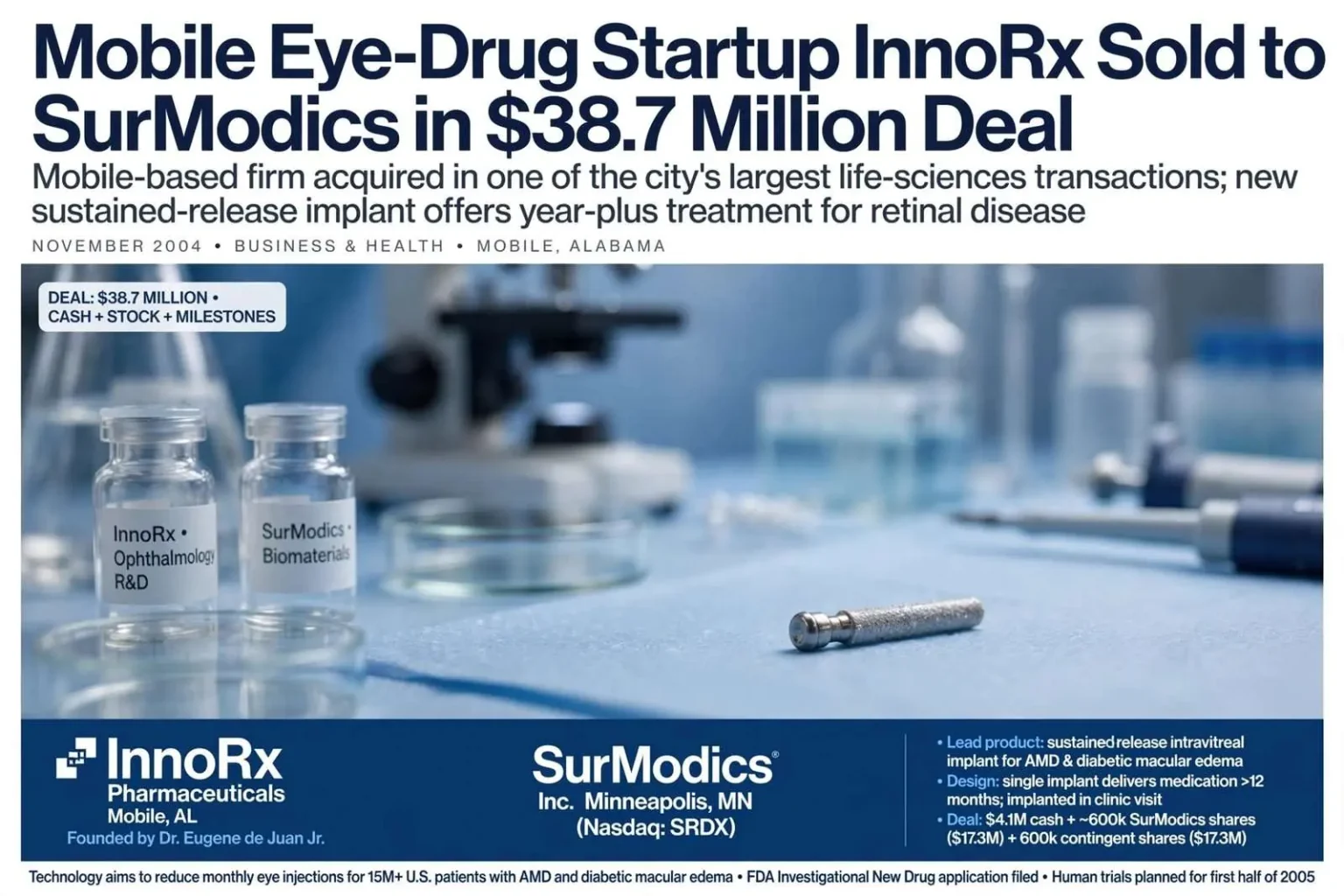
A homegrown Mobile drug-delivery company has been sold in one of the largest life-sciences transactions the city has seen. InnoRx Pharmaceuticals, a Mobile-based firm developing novel therapies for the ophthalmology market, has been acquired by SurModics Inc. of Minneapolis (Nasdaq: SRDX) in a transaction valued at approximately $38.7 million, including cash, stock and contingent future payments based on the stock’s closing price, InnoRx Chief Executive Michael Chambers said.
The Terms
SurModics had already invested in InnoRx in February 2004, taking an ownership stake of less than 20 percent.
To acquire the remaining shares, the company paid roughly $4.1 million in cash and issued about 600,000 shares of SurModics stock, worth approximately $17.3 million at the closing price. A second block of roughly 600,000 shares — worth another $17.3 million at that same price — is contingent on the venture hitting development and commercial milestones, including eventual approval from the U.S. Food and Drug Administration and the achievement of certain U.S. revenue targets.
InnoRx was privately held, with the extended families of its founder and of Chambers owning or controlling roughly 70 percent of the shares. Chambers said the transaction would cause no immediate job loss or job gain in Mobile.
A Mobile Native at the Center of It
InnoRx was founded by Dr. Eugene de Juan Jr., a widely recognized retinal surgeon and prolific inventor who is a native of Mobile and a graduate of the University of South Alabama College of Medicine.
He serves as chairman of InnoRx and, at the time of the sale, was chief executive of the Doheny Retina Institute at the University of Southern California. “My vision for InnoRx has always been developing practical and effective therapies for patients suffering from serious eye diseases,” de Juan said.
By combining his team’s work with SurModics’ biomaterials expertise and customer relationships, he said, “I believe we can make that vision a reality.” SurModics Chairman and Chief Executive Dale Olseth called de Juan “an icon in the ophthalmology community,” crediting his creativity and reputation with allowing InnoRx to build a valuable drug-delivery platform in a remarkably short time.
What the Technology Does
The company’s lead product is a drug-coated intravitreal implant — a small device placed inside the eye that releases medication steadily for well over a year.
It is the product of nearly three years of collaboration between InnoRx and SurModics, and it can be implanted during an ordinary clinic visit rather than in an operating room. It can also be removed once the drug has been fully released.
The clinical case for it is straightforward. Most treatments then in development for age-related macular degeneration (AMD) and diabetic macular edema (DME) required repeated injections directly into the eye every one to three months, often delivering an uneven dose between visits.
Replacing that regimen with a single long-acting implant could mean better patient compliance, fewer side effects and greater effectiveness. AMD and DME are among the leading causes of blindness.
Industry analysts at the time estimated the two retinal diseases affected more than 15 million people in the United States, representing a market projected to reach between $2.5 billion and $7 billion within six years.
What SurModics Gets
SurModics, a leading supplier of sustained-release and surface-modification technologies to the medical device and drug-delivery industries, said the acquisition would:
- Position the company to capitalize on site-specific drug delivery in the growing ophthalmology market
- Give it control of InnoRx’s lead technology platform, applicable across numerous indications and potential partners
- Add an ophthalmology portfolio — drugs, nutraceuticals, a subretinal drug delivery system and device — for internal development or out-licensing
- Broaden the pipeline and add potential revenue drivers
- Capture additional profit centers along the value chain, from development work to the coating, the device and in some cases the drug itself.
Chambers said the platform might eventually prove useful well beyond retinal disease, extending to glaucoma and cataract indications. “The market has confirmed the current need for novel approaches in ocular drug delivery,” he said.
Bruce Barclay, SurModics’ president and chief operating officer, said the two companies had worked closely for three years and that folding InnoRx into SurModics would “accelerate our entry into an attractive market.”
Where the Work Will Be Done
SurModics said it would establish a new ophthalmology business unit based in Southern California — a location chosen to keep InnoRx’s development team close to de Juan. He will serve as a clinical consultant and remain actively involved in developing the technology.
Chambers will also consult on integration and business development. Signe Erickson Varner, a former assistant professor of ophthalmology at the Doheny Eye Institute and a native of Montgomery, played a key role with de Juan in inventing and developing the intravitreal implant.
She joins SurModics as director of research and development for the new unit. A product aimed specifically at diabetic macular edema had recently completed successful pre-clinical studies, and InnoRx had filed an Investigational New Drug application with the FDA.
Human trials were expected to begin in the first half of 2005. For Mobile, the deal was both a validation and a caution: proof that a serious biotechnology company could be built here around university-trained talent, and a reminder of how readily the next chapter of such a company gets written somewhere else.
Filing an Investigational New Drug application is the step that clears the way for human testing. Under FDA rules, a sponsor may begin clinical trials 30 days after the agency receives the application unless the FDA places the study on clinical hold.