Rising Costs Split the I-10 Mobile River Bridge and Bayway Into Two Phases
ALDOT will build the six-lane Mobile River Bridge first and re-stripe the existing Bayway in the meantime. Construction starts by the end of 2026, with toll rates set and the tunnels remaining free.
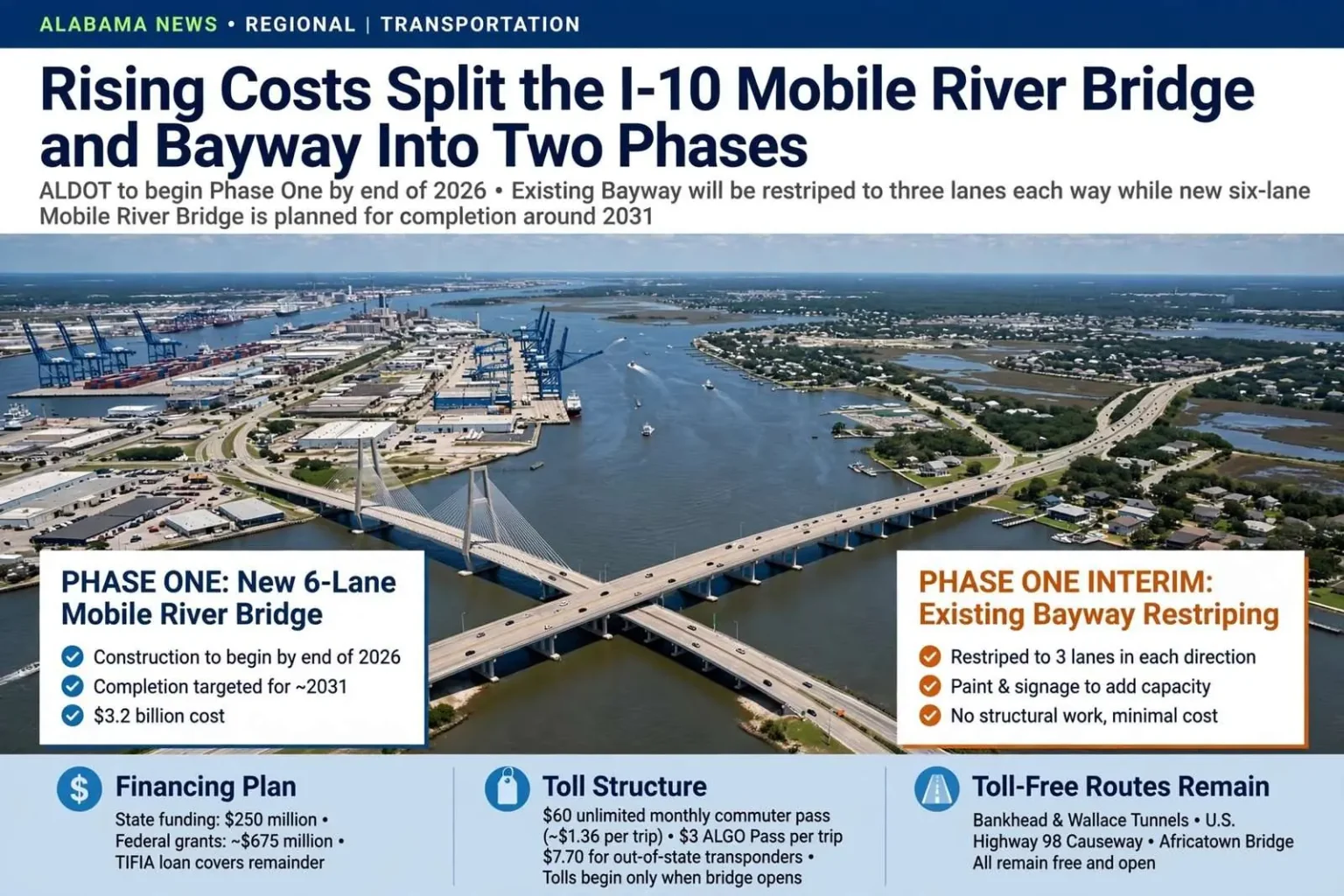
After decades of studies, stalled proposals and public revolt over toll rates, the Interstate 10 Mobile River Bridge and Bayway project has a start date. It also has a fundamentally different shape than the one proposed and repeatedly abandoned over the past twenty years.
The Alabama Department of Transportation announced that the project will be split into two phases, with construction on the first phase set to begin before the end of 2026. The reason is money. Building a new bridge and a new Bayway simultaneously would cost more than the project could bear.
What Phase One Includes
The first phase delivers the Mobile River Bridge, a six-lane span crossing the river well above the shipping channel, along with interchange improvements in both Mobile and Baldwin counties leading up to the highway.
Rather than construct a new Bayway across Mobile Bay at the same time, ALDOT will re-stripe the existing Bayway to carry three lanes in each direction. That is a paint-and-signage solution, not a structural one, but it adds capacity to the crossing at minimal cost while the bridge is under construction.
- Start: By the end of 2026
- Completion: Approximately 2031
- Phase one cost: $3.2 billion
- Interim fix: Existing Bayway re-striped to three lanes each way
“Updated engineering analysis revealed that constructing a completely new bayway structure concurrently with the Mobile River Bridge would cost substantially more than originally anticipated, pushing the total project cost beyond a financially viable level,” ALDOT said in a statement. “Phasing the project, alongside financial and procedural flexibility granted by the Trump administration, will allow the project to move forward. This flexibility allows for the preservation of certain grant funds within a phased approach, reducing costs.”
How It Gets Paid For
The financing is a patchwork. The project currently carries just under $1 billion in firm commitments. The state has pledged $250 million, and the federal government has awarded roughly $675 million in grants.
The balance is expected to come from a federal loan through the Transportation Infrastructure Finance and Innovation Act, or TIFIA. ALDOT said it anticipates receiving that loan and using it to jumpstart construction later this year. A TIFIA loan is not a gift. It is borrowed money, and it has to be repaid, which is where tolls enter the picture.
The Toll Structure
Tolls have been the political third rail of this project. An earlier proposal that would have charged commuters roughly $6 per crossing collapsed under public opposition. The rates announced this time are materially lower.
- $60 unlimited monthly commuter pass – roughly $1.36 per trip for daily users
- $3 per-trip ALGO Pass rate
- $7.70 for users with interoperable transponders issued in other states
Two points are worth emphasizing. First, no tolls will be collected until the Mobile River Bridge actually opens. Drivers will not pay for a bridge they cannot yet use. Second, toll-free alternatives will remain available.
The Bankhead and Wallace Tunnels will stay open with no charge, as will the U.S. Highway 98 Causeway and the Africatown Bridge. Motorists who do not wish to pay a toll will still have a route across the water, which was a central demand of earlier public opposition.
What Happens in Phase Two
The replacement Bayway comes later, financed substantially by revenue collected from tolls on the completed bridge. That structure means phase two’s timeline depends on how much traffic uses the new bridge and how quickly toll revenue accumulates. It also means the Jubilee Parkway, opened in 1978 and long past the point of comfortably handling modern traffic volumes, will remain in service well into the next decade.
The Reaction Around the Bay
Mobile Mayor Spiro Cheriogotis said a number of the city’s forthcoming projects depend on the bridge’s construction. “This project will benefit our city and the entire Mobile Bay region,” he said. “The city of Mobile is committed to working with our partners at the local, state and federal level to get this project across the finish line. The future of Mobile has never been brighter.”
Merceria Ludgood, a member of the Mobile County Commission and current chairwoman of the Mobile Metropolitan Planning Organization, highlighted a benefit central to the project’s justification for the Africatown community. Because most trucking and hazardous-materials traffic will shift to the new bridge once it opens, she said the community founded by descendants of survivors of the Clotilda slave ship “will breathe a sigh of relief.”
That point deserves elaboration. Trucks carrying hazardous materials are barred from the Wallace Tunnel and must instead route through surface streets in and around Africatown. It is a daily reality for residents there, and the new bridge is designed to eliminate it.
State Rep. Sam Jones, a Democrat from Mobile and a former mayor of the city, urged speed. “Any delays will only increase the costs, so I think it’s quite important we get it started and get it done because the cost won’t reduce in the future years,” Jones said.
The Bottom Line for Drivers
Nothing changes immediately. Commuters crossing the bay will contend with the existing Bayway and the tunnels for at least five more years. The re-striping to three lanes in each direction is the only near-term relief on offer, and it comes with the tradeoff of narrower lanes on a structure that already makes many drivers uneasy in high winds.
The payoff arrives around 2031, if the schedule holds. For a project first seriously proposed in the 1990s, that is a long horizon. But it is the first time in years that the horizon has been visible at all.
Why the Bridge Matters to the Gulf Coast
The Mobile River Bridge and Bayway carry the bulk of Interstate 10 traffic across the northern reaches of Mobile Bay, linking the cities of Mobile and Spanish Fort and tying the Alabama Gulf Coast to the Florida Panhandle and beyond. For decades the crossing has been a bottleneck, and the project’s long, contentious history has made it a touchstone in regional transportation debates.
The decision to phase the work reflects the financial reality of megaprojects on the Gulf Coast, where construction costs, environmental requirements, and the need to keep traffic moving simultaneously all shape the final plan. Phasing lets the most urgent span advance while toll revenue from that span helps pay for the rest.
The Mobile River Bridge and Bayway project has been studied, debated and reshaped for more than two decades. Earlier versions of the plan collapsed in 2019 under heavy public criticism of a proposed toll structure that would have charged commuters as much as $6 per crossing, prompting Governor Kay Ivey to shut the proposal down and direct the Alabama Department of Transportation to pursue federal financing instead.
ALDOT’s project area includes not just the bridge and Bayway themselves but a network of interchange and approach-road improvements on both sides of Mobile Bay. The Mobile River crossing, on the western end, ties into the existing Interstate 10 and U.S. 90 connections, while the eastern side connects to the Bayway and to the rapidly growing suburbs of Daphne and Spanish Fort in Baldwin County.
TIFIA, the federal loan program referenced in the project’s financing plan, is administered by the U.S. Department of Transportation’s Build America Bureau. TIFIA loans typically carry favorable terms, with repayment periods that can extend 30 years or more and interest rates tied to the federal Treasury rate. They are widely used for megaprojects that can support debt service from a dedicated revenue stream such as tolls.
The Wallace and Bankhead tunnels beneath the Mobile River, completed in 1973 and 1941 respectively, will continue to carry local traffic free of charge. Combined with the U.S. 98 Causeway across the upper bay and the Africatown Bridge further north, the region retains a substantial network of toll-free crossings even after the new bridge opens.
Africatown, the community founded by descendants of survivors of the Clotilda, the last known slave ship to bring captive Africans to the United States, has long advocated for relief from heavy truck traffic routing through its neighborhood streets. The new Mobile River Bridge is designed to carry hazardous-materials and through-truck traffic on a direct route, bypassing Africatown and the surface streets that currently absorb it.
The toll structure announced by ALDOT includes provisions for a monthly commuter pass designed for drivers who cross the bridge regularly. The pass, priced at roughly $60 a month, equates to about $1.36 per trip for daily users, an order of magnitude below the rates that collapsed the earlier toll proposal in 2019. The structure also accommodates out-of-state transponders, recognizing that a substantial share of the region’s traffic comes from Florida and Mississippi.
Construction of the Mobile River Bridge is expected to generate thousands of direct and indirect jobs over its roughly five-year build, with opportunities for both local subcontractors and major bridge-construction firms. ALDOT has signaled that workforce development and small-business participation will be priorities, given the project’s size and visibility. Major bridge projects of this kind often leave behind upgraded industrial capacity that benefits later projects across the region.