Political Chatter in Mobile: Who’s Running, Who Isn’t, and What the Mayor’s Job Is Really Worth
A shipping executive says no, a police chief eyes the sheriff's office, a businessman mulls a council run, Republicans pick a new county chairman, and Mobile's mayor earns less than the man who books the Senior Bowl.
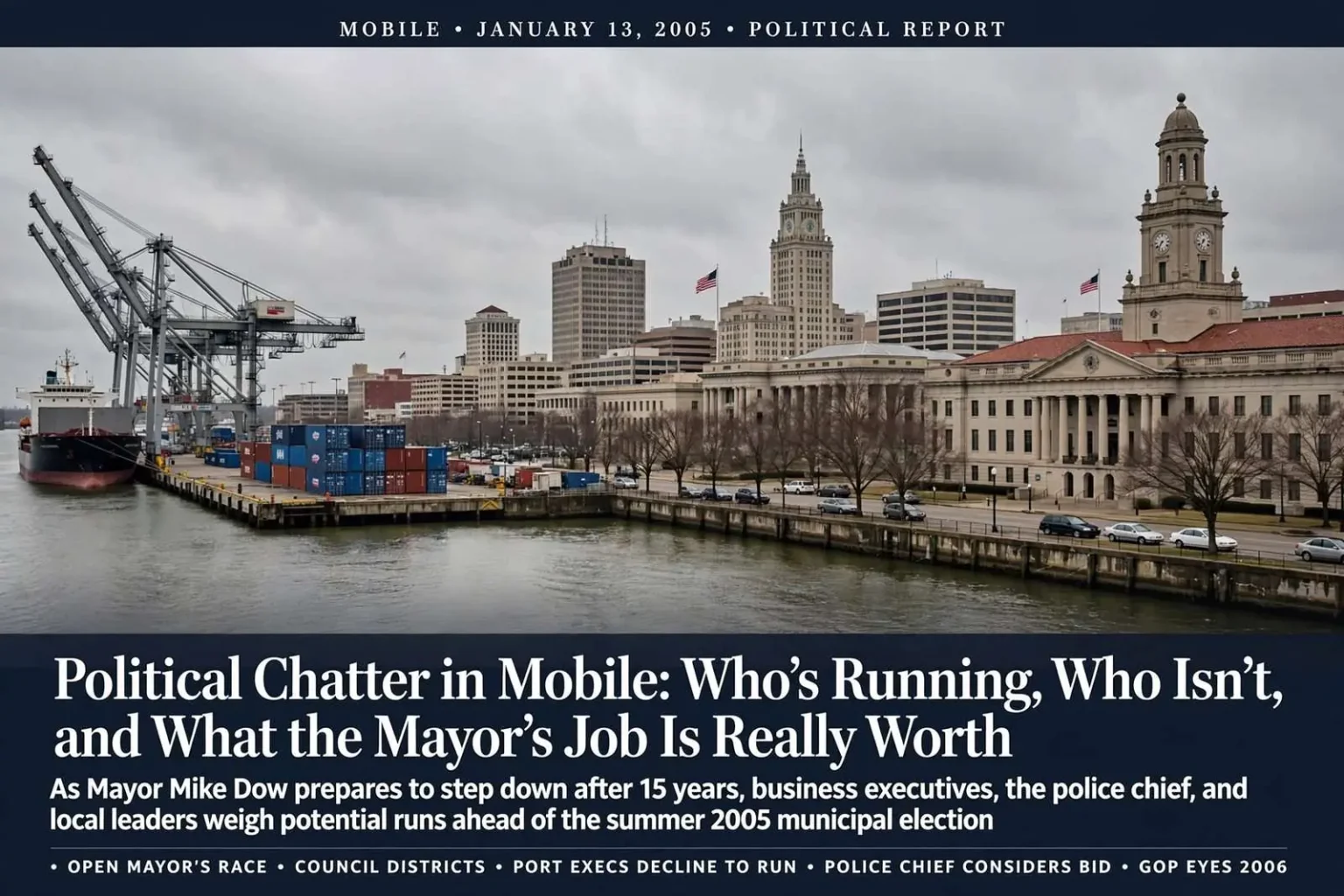
MOBILE — With municipal elections set for the summer and the mayor’s office widely expected to come open, the political telephone lines around Mobile were busy in mid-January 2005. Mayor Mike Dow, completing his third term after more than fifteen years at City Hall, was not expected to seek re-election, and that prospect turned the city’s usual off-season into an open audition: business executives, council members, appointed officials and party activists all took calls, gave interviews and weighed runs they had not seriously considered a year earlier.
Mobile’s strong-mayor form of government concentrates real power in the office — the mayor proposes the budget, runs the city’s departments and sets the tone for economic development — so a wide-open race draws interest from every corner of the community. The people approached in January came from shipping, real estate, law enforcement and the legal profession, and their answers to those calls shaped the field long before anyone filed qualifying papers.
Cooper Takes a Pass
Shipping executive David J. Cooper, president of Cooper/T. Smith, confirmed he had been approached about running for mayor and confirmed just as firmly that he would not. The firm he leads is one of the Gulf Coast’s oldest and largest stevedoring operations, with a footprint across the Port of Mobile’s terminals, and its chief had the name recognition and business résumé that make candidates’ lists. “My time has passed,” Cooper said. “I can be of much more benefit to the city in private business than as an elected official. I’m flattered that some folks would ask me to do that, but I’m more effective behind the scenes. I’m better there. I like to think I’ve made a few contributions.”
He added a caveat with a laugh: “Besides, if I ran for mayor, my wife might leave me. No, she would leave me.”
Cooper’s decision reflected a pattern common in port cities: the executives who run the waterfront usually believe they can shape a city’s future better from the boardroom than from the council chamber, and they are rarely eager to put their companies’ finances, personnel decisions and contracts under the public microscope a campaign would bring.
Praytor Not Running for Council
Residential real estate executive Jamie Praytor said she, too, had been asked — in her case to run for the District 7 seat on the Mobile City Council — and declined. “No. I’ve been asked by some people, but no. That’s not on my agenda,” she said. “I’ll be glad to try to help someone who’s good. That’s just not me,” she said of holding public office.
Praytor’s district question touched the city’s west side, where District 7 stretches through some of Mobile’s fastest-changing residential neighborhoods, the kind of territory a real estate professional knows street by street. Her answer, like Cooper’s, showed that even candidates with obvious district credentials had to weigh a part-time council seat against businesses and families that did not pause for campaign season.
The Chief Keeps the Door Open
Speaking to the Rotary Club of Mobile on Thursday, Jan. 13, Police Chief Sam Cochran said a run for public office was likely somewhere in his future. Asked specifically about the mayor’s race, he did not rule it out. The Rotary luncheon crowd, a cross-section of the city’s business and civic leadership, heard the chief muse openly about his next chapter after three decades in uniform.
Sources close to the chief, however, believed the more probable target for the 30-year law enforcement veteran was the Mobile County sheriff’s office in 2006, should Sheriff Jack Tillman decide to retire. Countywide office suited Cochran’s profile: a career cop with deep contacts in every municipality and unincorporated community in the county, and a natural constituency among deputies, municipal officers and the residents who call on them. (Cochran would in fact go on to be elected sheriff of Mobile County, a post he would hold for years afterward.)
His flirtation with the mayor’s race, meanwhile, highlighted how Mobile’s public-safety leadership had become part of its political class — a chief who commanded broad public respect and whose name drew mention for two different offices in two different years.
Ziegler Eyes State Auditor
Mobile attorney Jim Ziegler, a Republican and a former member of the Alabama Public Service Commission, was reported to be weighing a 2006 run for state auditor. The seat looked likely to open: incumbent Auditor Beth Chapman was expected to seek the GOP nomination for secretary of state, a post then held by Democrat Nancy Worley. A domino like that sets off a chain reaction in state politics — one officeholder moves up, the office below opens, and ambitious figures from around the state begin their calls.
Ziegler, a pugnacious retail politician known around Mobile for colorful commentary as much as legal work, had already held statewide office once and had nothing to lose by keeping his name in the discussion. The state auditor’s office, though modest in day-to-day profile, had become a launching pad in Alabama politics, and Mobile Republicans saw the county’s substantial GOP registration as a base from which to compete.
Gewin “Mulling” a Council Bid
Mobile businessman Logan Gewin, 49, said he was “mulling over” a campaign for the District 5 seat on the City Council. “It’s a little premature, but I’m thinking about it,” Gewin said. “I’ve got some things I’m working on and I’ve got to get those to a more completed stage before I’m in a position to do something.”
Although a council seat in Mobile is formally part-time, Gewin said his temperament would push him to treat it as a full-time commitment — a real obstacle for a man with children in high school and college. “You’ve got to really have your deck clear to go down there and do the job the way you ought to do it,” he said. “It’s hard to drop your life in the business world and go down there to serve your community. And that’s basically what you’re doing: serving the community.”
Gewin described himself as a businessman with strong views on economic development. He had been a leading opponent of the proposed liquefied natural gas plant in south Mobile County, and he argued the area needed to abandon what he called its 1960s-and-’70s, any-job-is-a-good-job attitude, steer clear of heavy-polluting smokestack industry, and chase growth through cleaner industries instead. The LNG fight had made him a public figure in his own right: proposals to build LNG import terminals along Mobile Bay had divided business leaders who welcomed the investment from residents and environmentalists who feared the safety and shipping consequences of tankers delivering supercooled gas through the bay’s busy channels.
Republicans Elect a New County Chairman
Mobile attorney Mark Erwin, 37, was elected chairman of the Mobile County Republican Party. “We’re anxious to build on the momentum of the election in November as we move forward to the ’06 election cycle,” Erwin said. “We’ve got some targets here in Mobile County as far as offices go and we’ll aim to help our statewide officeholders in their bids for re-election.”
Erwin took over a party organization with real leverage. Mobile County, Alabama’s second most populous, had leaned increasingly Republican in statewide races, and the county party’s endorsements, fundraising and get-out-the-vote machinery mattered in contests from county commission seats to the legislative delegation. A young chairman with law practice and political ties signaled a generational handoff in an organization long run by party stalwarts.
His “targets” comment made clear the party intended to contest local offices — sheriff, commission, legislative seats — rather than simply ride statewide coattails in 2006.
Junior Miss in Television Talks
Montgomery-based Raycom Media was in discussions with officials of America’s Junior Miss about producing the pageant, which is staged in Mobile each year in late June. A deal was expected to save the program as much as $200,000 over previous production packages, with a decision anticipated within 60 days.
The program, a scholarship competition for high school senior girls that Mobile has hosted since the late 1950s, had weathered years of declining television exposure and rising production costs. For a civic institution that fills the Civic Center arena each June and pours scholarship money into contestants from all fifty states, a production partner with Raycom’s station network offered both a budget fix and a route back to the airwaves. The talks were another reminder of how much of Mobile’s national visibility — the pageant, the Senior Bowl, the port — depends on arrangements that require constant commercial reinvention.
A Day’s Work, a Day’s Pay
A proposed pay raise for the Mobile City Council had died, and it had drawn plenty of critics. Notably, many of those same critics favored raising the mayor’s salary. The distinction was about workload as much as politics: council members serve a part-time legislative role — meeting in weekly sessions, handling constituent calls and zoning cases — while the mayor runs a full-time executive operation with a budget in the hundreds of millions, thousands of employees and every municipal department under one roof.
The mayor’s post is a full-time job and paid $89,000 a year. For comparison, informed sources put the total compensation packages for the top executives at three of the city’s prominent nonprofits at roughly $200,000 at the Senior Bowl, $150,000 at the Mobile Area Chamber of Commerce, and $140,000 at the Mobile Area Convention and Visitors Bureau — each of them well above what Mobile paid the person running the city.
Those comparisons carried a pointed implication for the upcoming race. If Mobile expected a top-tier executive to quit a comparable position and campaign for City Hall, the pay gap was an argument candidates would raise: the city was asking for Fortune-500-level responsibility at a nonprofit-level salary. Supporters of a raise for the mayor’s office argued that paying the position competitively would widen the field beyond the independently wealthy and the retired; critics of the council raise had argued the legislative seats should stay part-time in pay as well as practice.
By the middle of January, then, the field was forming by subtraction as much as announcement. The city’s most prominent shipping executive had said no. A real estate leader wanted no part of a council race. The police chief kept two doors open, one of them countywide. A state auditor’s race was quietly assembling a Mobile contender. A council hopeful was honest about what the job would cost his family, and a new party chairman was promising a more aggressive local operation.
What every one of those conversations had in common was the expectation that City Hall would be open to a new occupant in the summer election. Mobile’s municipal races are formally nonpartisan, but the behind-the-scenes arithmetic is anything but: business leaders anoint, party organizations organize, and the council districts themselves — seven single-member seats, each anchoring a distinct piece of the city from Africatown and the peninsula to the western suburbs — become the proving ground where future mayors and county officials first learn retail politics.
The coming months would sort it out. Candidates would have to decide before qualifying opened in the summer, and the names who said no in January — Cooper, Praytor — would still be part of the conversation, as kingmakers if not as candidates. The ones who kept their options open — Cochran, Gewin, Ziegler — faced the same calculation every Mobile figure does: whether the office in question, its pay and its demands, fit the life they had built. By summer, the city would know who had decided the answer was yes.