Gulf Shores Weighs Tax Rebates to Draw Restaurants and Boutique Hotels Into Its Walking Districts
After years of investing in parking, sidewalks and drainage near the beachfront, Gulf Shores is considering programs that would rebate up to half of new city taxes to developers who build high-quality projects in two priority districts.
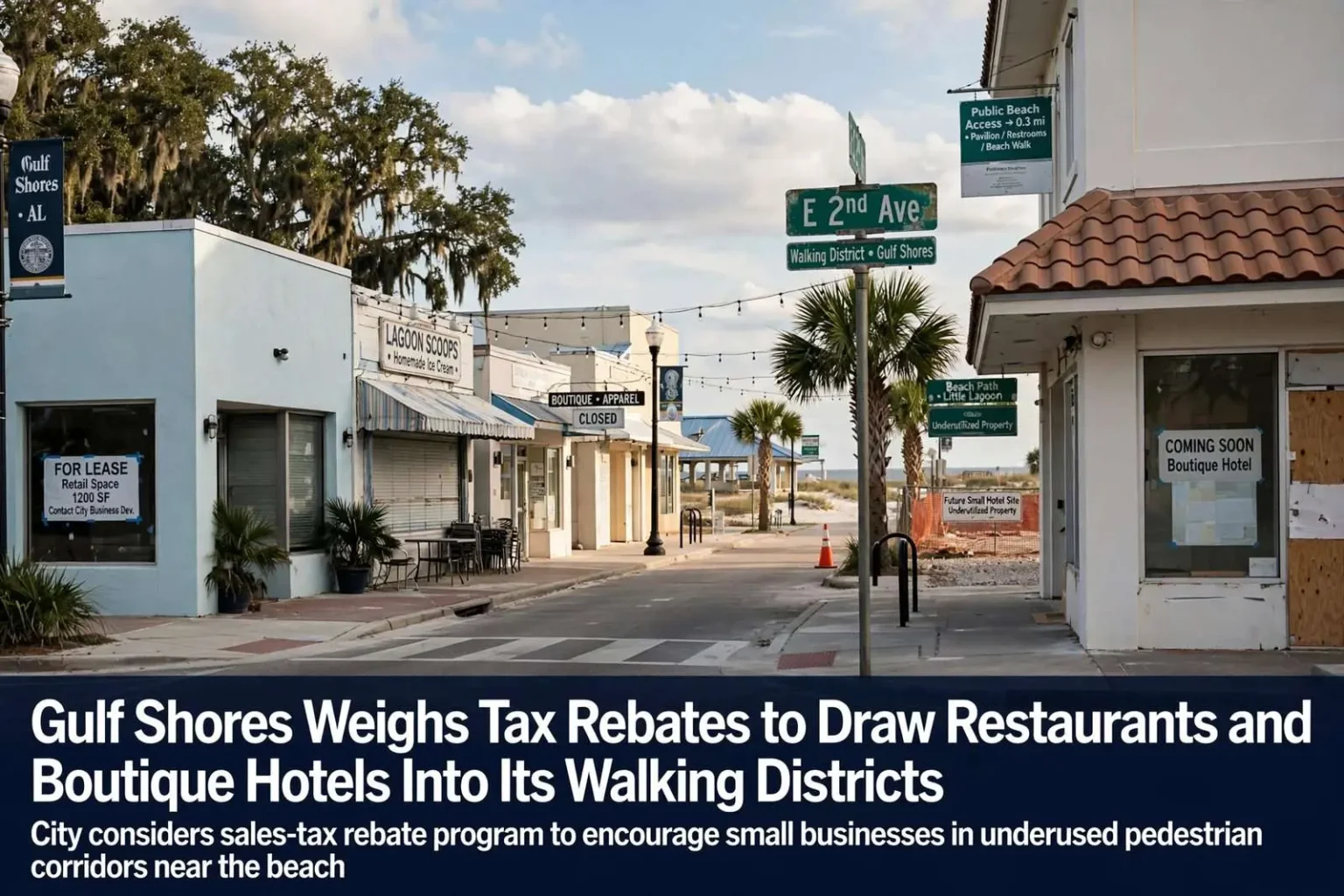
Gulf Shores city officials are weighing whether targeted sales-tax rebates can be the tool that pulls restaurants, boutique hotels and small shops into the city’s pedestrian-friendly districts, where vacant storefronts and underused lots have begun to define the streetscape despite a steady stream of summer visitors.
The proposal, floated at a recent council work session, would set aside a portion of municipal sales-tax revenue collected inside designated walkable zones and return it to the businesses that generated it. The idea is straightforward. A new restaurant that opens on a side street off East Beach Boulevard pays the same 10 percent state and city sales tax as a national chain on the highway. If the city rebates a share of its portion back to the business for the first few years, the math of opening in a less-trafficked corner of the district begins to work.
Why a rebate and not a straight tax cut
A blanket reduction in the city sales-tax rate would benefit every retailer in Gulf Shores, including the big-box stores and the highway pads that already do strong volume. A targeted rebate, by contrast, only reaches businesses that locate inside the boundaries the city draws. That structure lets the council aim the incentive at the walking districts the city has been working to build, rather than subsidize retailers who would have opened anyway.
Similar programs have been used in other Gulf Coast communities. In coastal Mississippi, the cities of Ocean Springs and Bay St. Louis have offered sales-tax rebates to developers willing to build on side streets rather than on the main commercial corridor. In Pensacola, a rebate program aimed at historic downtown buildings helped convert a series of vacant upper floors into apartments and small hotels. The Gulf Shores proposal borrows from those models but adapts them to the beach-resort reality of the city, where the highest foot traffic follows the public beach accesses and the newer pedestrian paths the city has built in recent years.
What the districts look like today
Gulf Shores’ walking districts have grown up along a few corridors that branch off the main beach road. The area around the public beach, with its pavilions, showers and restrooms, draws the largest crowds, but the streets behind the beach, including parts of East First Avenue, East Second Avenue and the smaller alleys that run toward Little Lagoon, hold the kind of small-scale restaurants, ice cream parlors and gift shops that give a beach town its character. Many of those blocks are underused. Buildings that once held seasonal restaurants sit empty for parts of the year. Lots that were intended for small hotels remain gravel or pavement.
The council’s concern is that without intervention, the visible face of the city will continue to drift toward the highway-front national chains, which pay higher rents because they need visibility from the road and which compete with one another for the same drive-by customer. A rebate, the argument goes, would give the small operator a fighting chance by reducing the upfront cost of opening on a side street.
How a rebate would work
The mechanism, as sketched in the work session, would operate in several stages. The council would first designate the walking districts and the boundary of each. Any business that opens inside a designated district after the ordinance takes effect, and that meets the city’s definition of a small-scale restaurant, boutique hotel, retail shop or entertainment venue, would be eligible. The rebate would return a percentage of the city sales tax collected by that business, for a defined period of years, until the business either reaches a revenue threshold or the rebate window closes.
To keep the program from being captured by businesses that would have opened regardless, the ordinance would require a minimum capital investment in building out the storefront or hotel property. That threshold would filter out businesses that simply change addresses. It would also ensure that the rebate is buying new construction or significant rehabilitation rather than subsidizing a relocation from one side of the street to the other.
Costs and safeguards
Any rebate program costs the city the sales-tax revenue it would otherwise have spent on roads, drainage, public safety and beach maintenance. Gulf Shores, like other beach communities, runs a budget that depends heavily on the tourism economy, and a reduction in tax collections during the program’s early years would have to be absorbed by the general fund or offset by other revenue growth. Council members said they want the finance director to model three scenarios before any vote: a small program with a tight boundary, a medium program that covers several corridors, and a larger program that would qualify most of the city’s pedestrian-oriented blocks.
Safeguards would include an annual audit of participating businesses, a hard cap on the total amount rebated in any fiscal year, and a sunset provision that forces the council to revisit the program before renewing it. The intent is to ensure the rebate remains a temporary incentive rather than a permanent subsidy that props up businesses that cannot stand on their own once the city stops writing the checks.
Other Gulf Coast precedent
Downtown districts in Mobile, Fairhope and Foley have each experimented with smaller versions of this idea. Mobile’s LoDa district has used tax abatements for upper-floor housing for more than a decade. Fairhope has worked with property owners on the Section Street corridor to convert vacant buildings into restaurants and small inns. Foley has concentrated its pedestrian improvements along a stretch of Highway 98 that functions as the city’s main street.
Gulf Shores’ version, if adopted, would be larger in scope because the city’s commercial geography is unusually dependent on a single corridor. State Route 59, also known as Gulf Shores Parkway, carries the bulk of the city’s commercial traffic, and the walking districts have to compete with it for tenants. A rebate would not change the underlying geography, but it would shift the math enough to make a side-street address viable.
What the council wants to see
Council members said they want the city planner to draft a boundary map and a rebate schedule before the next budget cycle. The staff was also directed to research what neighboring cities in Baldwin County and across the state have done with similar programs, and to compile a list of vacant or underused properties inside the proposed districts. That information will be the basis for a public hearing later in the year, where property owners and existing businesses will have a chance to weigh in.
The timing matters. Gulf Shores is in the middle of a multi-year push to widen its sidewalks, add crosswalks and build a continuous pedestrian path along the beach. The hope is that the public investment in walking infrastructure will be matched by private investment in the businesses that make walking worthwhile. A rebate program, properly drawn, would help align those two timelines.
What it means for visitors and residents
For visitors, the practical effect of a successful rebate program would be a richer mix of restaurants and shops within walking distance of the public beaches, and a downtown that feels less dependent on the car. For residents, the longer-term hope is that the city’s tax base diversifies beyond the hotel and condominium sectors that have dominated growth in recent cycles, and that the pedestrian districts become a year-round amenity rather than a summer-only attraction.
Residents who have watched the city grow over the past decade will recognize the underlying tension. Gulf Shores has invested heavily in the public beach, in the new municipal complex, in the pathways that connect the beach to the neighborhoods, and in the improvements to Highway 59 that have eased congestion. What it has not yet done is build a downtown in the traditional sense. The rebate program, if it works, would be one of the first serious attempts to nudge the city toward that kind of mixed-use, walkable center.
Next steps
The council is expected to take up the rebate proposal again at its next regular meeting, after the city planner’s draft boundary map is complete. A vote on the ordinance is unlikely before the fall, but the public discussion will give residents and existing business owners a chance to weigh in on the boundaries and the eligibility rules. Whatever the final shape, the council has signaled that the question is no longer whether the city needs a tool to encourage the right kind of development, but which tool, with what strings attached.
A wider view of Baldwin County
Baldwin County’s coastal economy has shifted dramatically over the last twenty years. Condominiums, second-home subdivisions and short-term rental houses have replaced many of the smaller motels and cottages that once defined the lodging market. With that shift has come an erosion of the small commercial tenant base that traditionally occupied the ground floors of beach-adjacent buildings. Gulf Shores’ rebate proposal is one response to that shift. Orange Beach, just to the east, has been pursuing a different mix of incentives, focused on the entertainment district around The Wharf. Foley, inland, has invested in industrial recruitment and in extending its historic downtown south toward the highway.
What unifies all three efforts is the recognition that the Gulf Coast’s commercial geography is being reshaped by larger forces, including the rise of short-term rental platforms, the consolidation of hotel brands and the steady migration of retail toward highway-front pads. Cities that want to preserve a walkable, mixed-use character have to make deliberate policy choices, and a sales-tax rebate is one of the more targeted tools available.
For Gulf Shores, the next several months will determine whether the rebate program moves from the work-session agenda to a public hearing and ultimately to a vote. Whatever the outcome, the conversation has reframed how the council thinks about the pedestrian districts, from a planning concept to a concrete economic-development tool.