Handcuffs and law enforcement equipment, illustrating an arrest by the Mobile Police Department in a brass knuckles assault caseThe suspect was booked into Mobile County Metro Jail on assault and weapons charges.

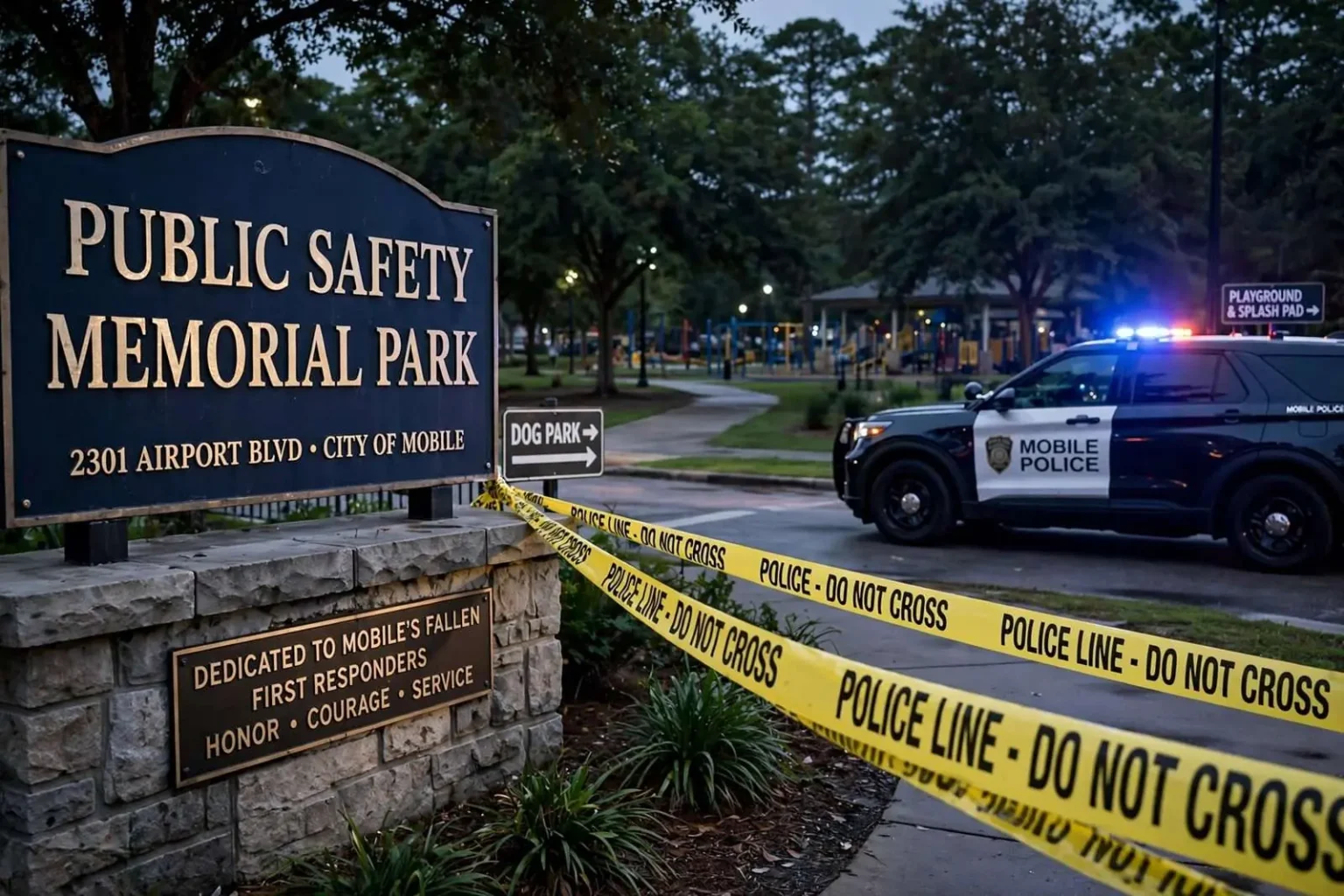
A 33-year-old Mobile man is facing assault charges after police say he struck another man with brass knuckles during a fight at Public Safety Memorial Park on Friday night — a park named, with some irony, in honor of the city's fallen first responders. Christopher Jones was arrested and booked into Mobile County Metro Jail, where he was charged with second-degree assault and possession of brass knuckles, according to the Mobile Police Department. What Officers Found Officers responded to the park at approximately 8:39 p.m. Friday after a physical altercation between Jones and another man.

The victim sustained minor injuries and refused medical treatment when officers arrived on scene. Police say Jones also had an outstanding warrant for his arrest stemming from a 2023 charge of running a stop sign — a reminder that unresolved traffic citations do not simply disappear, and routinely resurface at the worst possible moment for a defendant.

Public Safety Memorial Park: A Community Landmark Public Safety Memorial Park, located in the heart of Mobile, stands as a solemn tribute to the police officers, firefighters, and emergency medical personnel who have lost their lives in the line of duty serving the Mobile community. The park was dedicated to ensure that the sacrifices of these first responders are never forgotten, and it serves as a gathering place for annual memorial ceremonies, particularly during National Police Week and the local Fallen First Responder Memorial events hosted by the Mobile Police Department and Mobile Fire-Rescue Department.

The park features engraved monuments listing the names of Mobile's fallen officers and firefighters, a reflective walking path, and a central plaza where honor guard ceremonies are conducted. For many Mobile residents, the park represents the intersection of public safety and community memory — a place where families of fallen first responders can find solace and where citizens can reflect on the cost of public safety.

That an alleged violent assault involving a prohibited weapon occurred at this specific location adds a layer of grim symbolism to the case, underscoring the very threats that the park's namesake first responders dedicated their careers to confronting. Why Brass Knuckles Are a Separate Charge The second charge in this case is worth understanding, because it is not merely an add-on. Under Alabama law, brass knuckles are treated as a prohibited weapon in their own right.

Background and Context

Alabama Code § 13A-11-54 makes it a crime to manufacture, sell, or possess "metal knuckles," and the offense stands independently of whatever else a person is accused of doing with them. That means a defendant can face a weapons charge for simply having them in a pocket, and a separate assault charge for using them.

Second-degree assault in Alabama is a Class C felony, and one of the ways the state elevates a simple assault to second degree is when the injury is caused by a "deadly weapon or dangerous instrument." Brass knuckles qualify as such an instrument under Alabama appellate precedent, which has consistently held that metal knuckles constitute a deadly weapon per se when used to strike another person. The combination is why an altercation that left a victim with minor injuries — injuries so minor the victim declined treatment — nonetheless produced a felony charge.

See also  Six Months Later: Mobile Family Shares Journey with Baby Born Without a Nose

The law treats the weapon itself as an aggravating factor that transforms what might otherwise be a misdemeanor assault into a felony carrying a potential sentence of one year and one day to ten years in a state correctional facility. Mobile County Metro Jail and the Booking Process Following his arrest, Jones was transported to Mobile County Metro Jail, the primary detention facility for individuals arrested by the Mobile Police Department, the Mobile County Sheriff's Office, and other municipal police agencies within Mobile County.

The jail, operated by the Mobile County Sheriff's Office, processes thousands of bookings annually and serves as the initial holding point for defendants awaiting their first appearance in Mobile County District Court. During booking, defendants are photographed, fingerprinted, and screened for outstanding warrants — which is how the 2023 traffic warrant surfaced in Jones's case. Unresolved traffic citations, even for infractions as seemingly minor as running a stop sign, remain active in the Alabama Law Enforcement Agency's warrant database until resolved, and they routinely lead to additional charges or extended detention when a person is arrested on a new offense.

The Legal Process Ahead Jones has been charged, not convicted, and is presumed innocent unless and until the state proves its case in court. The matter will proceed through Mobile County's district court, where prosecutors must establish probable cause before the case can be presented to a grand jury for indictment. In Alabama, a Class C felony charge like second-degree assault typically begins with a preliminary hearing in district court. If the judge finds probable cause, the case is bound over to the Mobile County Circuit Court, where a grand jury will consider whether to return a formal indictment.

Background and Context

If indicted, the defendant will be arraigned and enter a plea. The prosecution, led by the Mobile County District Attorney's Office, must then prove each element of the charged offenses beyond a reasonable doubt at trial, unless a plea agreement is reached. The separate weapons possession charge under § 13A-11-54 will proceed on its own track, though the two charges will likely be consolidated for trial. A conviction on the weapons charge alone carries its own penalties, independent of the assault conviction.

Community Context and Public Safety in Mobile This case arrives amid ongoing conversations in Mobile about public safety, violent crime, and the resources available to law enforcement. The Mobile Police Department, under the leadership of the Chief of Police and with oversight from the Mobile City Council, has emphasized community policing initiatives, violent crime reduction strategies, and partnerships with federal agencies including the FBI, ATF, and U.S. Attorney's Office for the Southern District of Alabama through programs such as Project Safe Neighborhoods.

See also  Cafe 219, Downtown Mobile Fixture Since 2001, to Close June 16

Mobile County's criminal justice system — encompassing the district attorney's office, the public defender's office, the circuit and district courts, and the sheriff's office — handles a significant caseload each year, with assault and weapons offenses representing a substantial share of violent crime prosecutions. The Alabama Sentencing Commission's guidelines provide a framework for judges, but judicial discretion remains significant in cases involving weapons enhancements.

For residents of Mobile and the broader Gulf Coast region, incidents like this reinforce the importance of situational awareness in public spaces, the legal consequences of carrying prohibited weapons, and the enduring role of the courts in adjudicating allegations of violence. The park where this alleged assault occurred remains open to the public and continues to host community events honoring the first responders for whom it was named. The Presumption of Innocence As with every criminal case in the United States, the constitutional presumption of innocence applies.

Jones will have the opportunity to present a defense, challenge the state's evidence, and, if the case proceeds to trial, require the prosecution to meet its burden of proof before a jury of his peers. The Mobile County Circuit Court will ensure that the proceedings adhere to the Alabama Rules of Criminal Procedure and the protections guaranteed by both the U.S. and Alabama Constitutions. Court records for this case will be accessible through the Mobile County Circuit Clerk's Office once formal charges are filed, and the docket will reflect each procedural step from arraignment through disposition.

Wider Significance for Coastal Alabama

This story is part of a broader set of changes playing out across Mobile, Baldwin and the wider Gulf Coast region. Local residents, businesses and government agencies have been watching developments like this one closely, because decisions made in Mobile and Baldwin counties often ripple outward into neighboring communities across south Alabama, Mississippi and the Florida Panhandle. Public meetings, council work sessions and state legislative hearings have all carried echoes of the underlying concerns, with stakeholders ranging from neighborhood associations to industry groups weighing in on what the outcomes will mean for daily life along the Gulf Coast. Reporters and editors in the region have worked to document how these issues affect ordinary people, from commuters on Interstate 10 to families visiting the public libraries and parks that anchor so many of the Port City’s neighborhoods. The deeper context often emerges over months rather than days, as projects move from announcement to planning to construction, and as the people most directly affected find their voices in the public record. Continued coverage remains important, both for accountability and for the historical record, and the unfolding situation is one that warrants attention from anyone with a stake in the future of south Alabama.

See also  Mobile Fire-Rescue Rescues Woman Trapped by Fallen Tree During Hurricane Sally

Looking ahead, observers across the region expect the conversation to continue evolving. Local officials have signaled their intent to monitor outcomes closely, and community organizations have indicated they will remain engaged as new information becomes available. The intersection of state policy, local implementation and on-the-ground impact is precisely where stories like this one tend to develop their lasting significance. For Mobile and Baldwin residents, the practical effects will play out over time, in everything from tax bills and utility rates to traffic patterns and the availability of public services. Following the developments requires patience and attention to detail, but it is also a reminder of how civic life in coastal Alabama continues to be shaped by decisions that begin far from the neighborhoods they ultimately touch. Residents who want to stay informed can do so by following local government meetings, attending public hearings when significant issues arise, and reading the regional reporting that tracks how these stories progress from one phase to the next.

Local news organizations continue to follow this story closely, and updates are expected as more details emerge. The developments have generated discussion across the region, with attention from both longtime residents and newcomers who are following the issue for the first time. Community leaders have emphasized the importance of staying engaged with local government and participating in public meetings when significant decisions are being made. As the situation continues to unfold, residents are encouraged to remain informed through reliable local reporting and official city and county communications channels. The story remains active, and additional information is anticipated in the coming days and weeks as the relevant agencies and stakeholders complete their work.