Small Talk in Daphne: The Quiet Newcomer Who Toppled a Political Regime
Daphne's new mayor runs a convenience store, quietly bankrolls a Catholic school, kept every city official he inherited and says his only agenda is controlling the growth barreling toward the Eastern Shore.
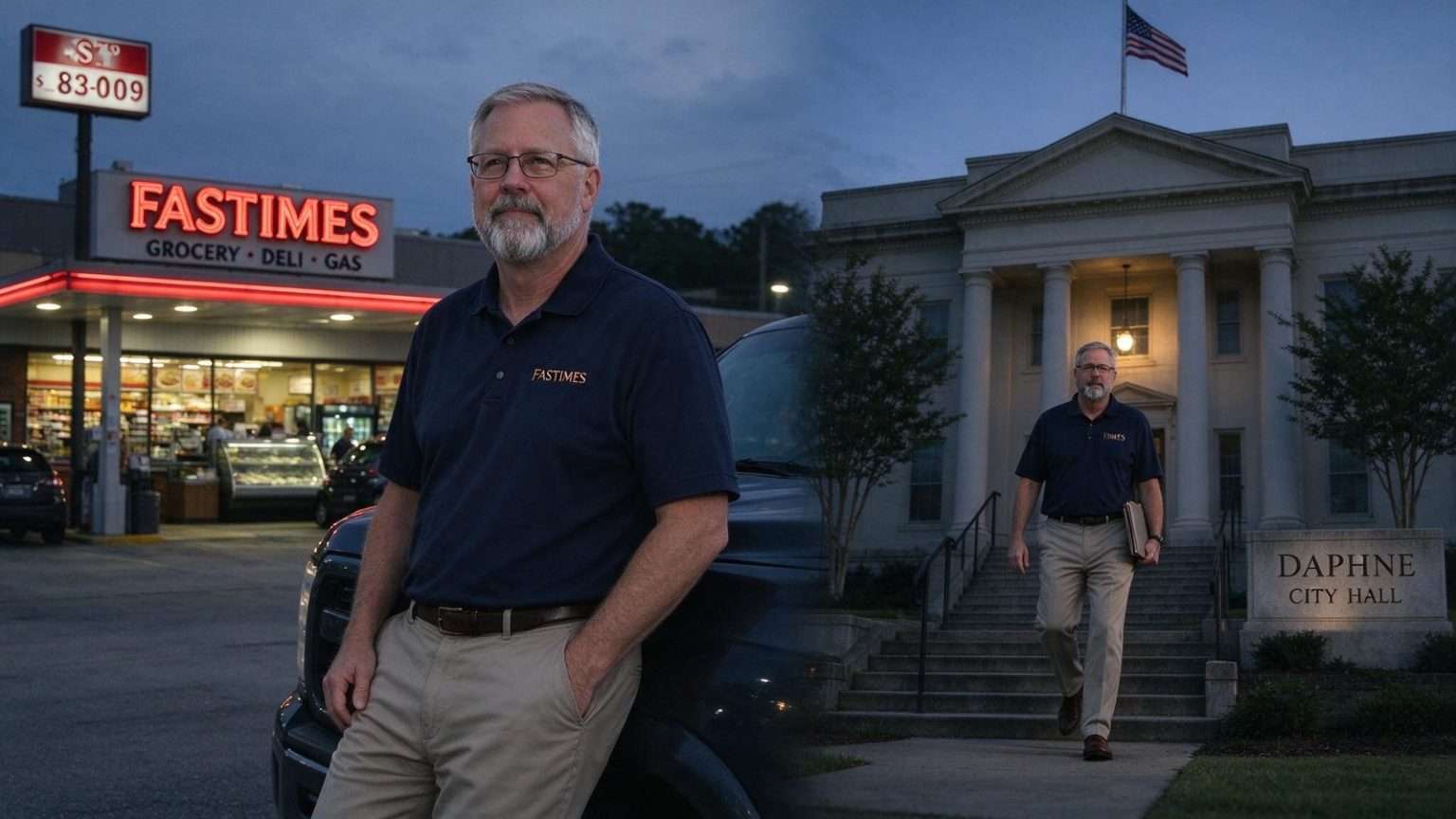
DAPHNE — The new mayor of Daphne remains something of an enigma to the region’s political handicappers, and the puzzle begins with his day job. Mayor Fred Small’s long-running business, Fastimes, is a convenience store, deli and gas stop — and it is not an ordinary one. On a recent visit, the man working behind the cash register turned out to be Johnny Walsh, a prominent Mobile stevedoring and insurance executive who is reputed to have once reigned as “Little Eva,” queen of the Comic Cowboys mystic society.
“Fred’s a great guy and hunting season hasn’t started, so I thought I’d help out for a while,” Walsh explained.
The scene says a great deal about the mayor and the circle he moves in. Fastimes has been a fixture of the Daphne business landscape for years, the kind of neighborhood store where regulars are known by name and the counter doubles as the community’s informal gathering spot. In smaller Baldwin County cities, the local convenience store owner occupies a particular kind of civic position: he is on hand before daylight and after dark, hears every complaint about traffic, potholes and utility bills without ever asking for them, and is trusted precisely because he is not part of the political class. Small built that trust over years behind the counter, and it carried him into City Hall in a way that no carefully engineered campaign could have.
Walsh, for his part, is a familiar figure in Mobile business circles, with interests in stevedoring and insurance along the working waterfront. The Comic Cowboys, for the uninitiated, are one of Mobile’s oldest and most irreverent Mardi Gras societies, famous for satirical floats and parodies that puncture local pomposity every carnival season. That a man reputed to have once been the society’s queen — a role in the society’s own comic tradition — was stocking the till for the mayor of Daphne on an ordinary weekday tells observers something else: Small’s friendships run across the bay, into the old-line Mobile establishment, without any apparent calculation of what those friendships might be worth to him politically.
The Charity He Doesn’t Advertise
Then there is the matter of Fastimes’ annual giving. The store is a significant benefactor of Christ the King Catholic School, likely the largest private school within the mayor’s jurisdiction — an institution capable of delivering a substantial bloc of votes. Politicians donate to such causes all the time. What makes Small unusual is that his campaign literature and photo opportunities contained no trace of it. There were no beaming shots of the candidate shaking hands with Father Timothy Deasy, the school’s beloved pastor.
Asked about his philanthropy, the mayor shrugs, says it is simply something he likes to do, and changes the subject.
In an era when even modest donations are photographed, posted and recited back to voters as evidence of character, that silence is almost impossible for professional observers to interpret. Christ the King Catholic Church and School sit at the heart of old Daphne, serving families from across the Eastern Shore, and support from a local business like Fastimes matters to a private school’s budget in ways that go well beyond the ceremonial. The school’s enrollment draws from Daphne, Spanish Fort, Malbis and the surrounding unincorporated areas of south Baldwin County, and its presence shapes the city’s identity as much as any municipal amenity.
The political arithmetic is obvious to anyone who studies Baldwin County. Catholic parishes anchor much of the Eastern Shore’s social infrastructure, and their schools produce engaged, reliable voters — the kind of bloc that decides close municipal elections. Had Small wanted to convert his generosity into votes, the path was well worn: pose with the pastor, sponsor the gala, list the school among his endorsements. He did none of it. Voters who learned of his support did so after the election, if at all, which is exactly the point his admirers make when they describe him as uncalculating — and exactly the puzzle his critics cannot resolve, since a politician who hides his generosity is either genuinely indifferent to credit or simply playing a deeper game.
A Different City Hall
Small unseated the multi-term administration of Harry Brown, and the change is audible the moment one walks into Daphne City Hall. It is quiet. This is the same building that not long ago housed one of the noisiest mayor-versus-council feuds on the Eastern Shore, and it now feels about as contentious as a family homeplace.
The mayor arrived at the interview a few minutes late and without a tie or jacket, fresh from a civic meeting. Asked why he ran for office at all, he gives an answer of almost defiant simplicity: “I thought we needed a change.”
What change, exactly? A new city attorney? The reader half expects a purge. Instead, Small waves it off.
The contrast with his predecessor’s tenure could hardly be sharper. Under the prior administration, Daphne’s council chambers were a regular stop for residents of the Eastern Shore who wanted to watch local government in its rawest form — budget fights, disputes over the city attorney’s role, and friction between the mayor’s office and individual council members that spilled into the pages of the Baldwin County press week after week. Municipal government in a growing bedroom community is never entirely placid, of course. Daphne has spent two decades absorbing the growth that followed the completion of the Highway 98 corridor and the spread of subdivisions from the bluff to the interstate, and growth always produces disagreement over zoning, traffic and the cost of services.
But the tone set from the mayor’s chair matters. Cities along the Eastern Shore — Daphne, Spanish Fort, Fairhope, Loxley — all compete for the same new rooftops, the same commercial development, and the same state and federal grants, and a city that spends its energy on internal warfare tends to lose ground to quieter neighbors. The hush that has settled over City Hall since Small took office is being read two ways. Supporters see a mayor who has stopped performing conflict and started letting the staff work; skeptics note that quiet can also mean that hard questions are simply not being asked aloud. Which reading proves correct will depend on how the city handles the expensive decisions that are coming regardless of who holds the office.
What Daphne Faces Next
Those decisions are substantial. Daphne is one of Baldwin County’s largest cities, and the county as a whole has been among the fastest-growing in Alabama for years, fed by the migration of families and businesses out of Mobile across the Bayway and by the continued expansion of the Gulf Coast economy. Every new rooftop in Daphne demands water and sewer capacity, road maintenance, police and fire coverage, and school seats — and every one of those demands eventually arrives at the mayor’s desk as a line item or a bond question.
Infrastructure pressure is not theoretical on the Eastern Shore. The corridors that carry the city’s daily traffic — U.S. 98 along the ridge, Old U.S. 98 through the historic district, and the connections to Interstate 10 — have been the subject of local debate for years, as commuters from Fairhope, Point Clear and Silverhill funnel through Daphne on their way to Mobile. The city also sits directly across Mobile Bay from Alabama’s only major port city, which means its economy is tied to the comings and goings of the Bayway, the causeway along the northern edge of the bay, and the ferry crossing at the southern end that links the Eastern Shore to Dauphin Island.
A mayor who spent decades running a convenience store approaches those problems the way he approached the counter: he knows his customers, he knows what they complain about, and he knows the difference between a complaint that matters and one that merely needs to be heard. Whether that sensibility translates into governing a city of Daphne’s size and budget is the question the region’s political watchers will be living with for the next four years.
There is also a practical school of thought that the puzzle itself is the answer. Baldwin County elections have a way of rewarding candidates who do not resemble politicians, and Daphne’s electorate — a blend of lifelong Eastern Shore families, Mobile transplants and retirees drawn to the bay — has grown increasingly resistant to polished campaigns. A store owner who does not advertise his charity, who dresses without ceremony, and who answers the question of why he ran with six plain words is, in that environment, not an enigma at all but simply the kind of candidate Baldwin County voters have learned to choose.
The Puzzle Continues
For now, the enigma holds. A mayor who lets an insurance executive run his register, who funds a Catholic school without claiming credit for it, and who took City Hall’s temperature down a dozen degrees in a matter of weeks is either a genuine civic oddity or a very skillful performer. The Eastern Shore has produced mayors of both kinds before. What it has rarely produced is one so difficult to sort.