At Daphne Fish Fry, Tuberville Says Guard Isn’t the First Step on Mobile Crime, Previews Conecuh Storm Visit
At a Baldwin County GOP Daphne fish fry, Tommy Tuberville said there is 'no reason to jump the gun' on sending the National Guard to Mobile, discussed Hurricane Isaias damage in Escambia County and previewed a Conecuh County farm visit.
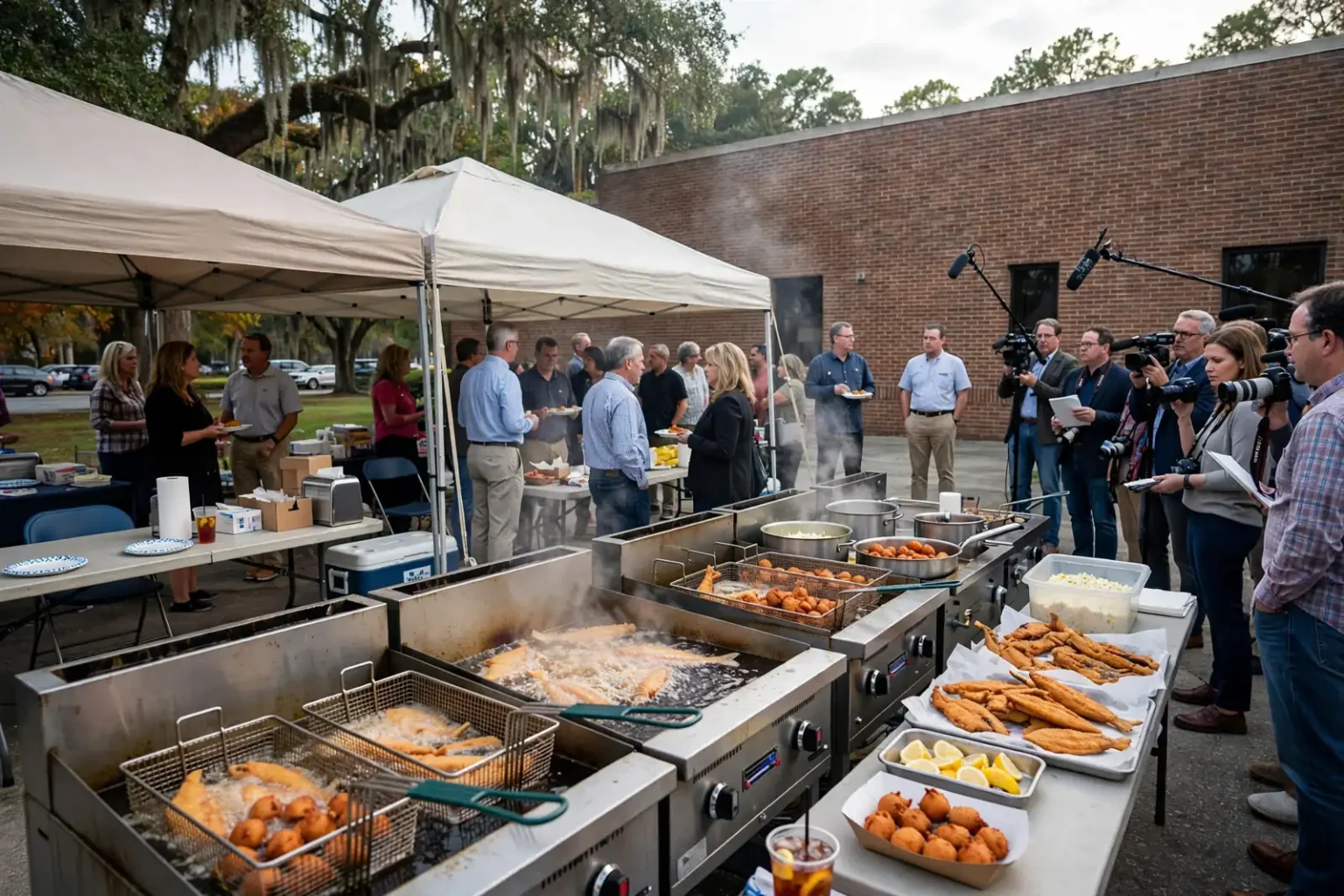
DAPHNE, Ala. — U.S. Sen. Tommy Tuberville used a Baldwin County Republican Party Daphne fish fry on Tuesday, Oct. 13, to defend his pledge to use the National Guard against crime if he is elected governor, while telling reporters that sending troops to Mobile would not necessarily be his first move. Before the event, the Republican nominee for governor also talked about the damage Hurricane Isaias left behind in Escambia County and previewed a trip to Conecuh County later this week to look at crop and timber losses.
The event, billed as “The Fellowship and Freedom Fish Fry & Rally,” was held at the Daphne Civic Center and hosted by the Baldwin County Republican Party. It is an annual gathering for local Republicans, and this year it came three weeks before the Nov. 3 general election, in which Tuberville faces Democratic nominee Doug Jones in the race to succeed term-limited Gov. Kay Ivey.
Questions about Mobile and the National Guard
Reporters at the fish fry asked Tuberville about a recent campaign ad in which he called Mobile “dangerous.” In the ad, Tuberville said sending in the National Guard would be among his first priorities as governor, and he also pointed to Montgomery and Birmingham as cities where he would target crime.
Tuberville said public safety would be at the top of his agenda.
“That will be one of our first priorities. If you don’t have safe streets and neighborhoods, then you don’t live a life that you should be living here on the greatest country on the face of the Earth,” Tuberville said.
Asked specifically about deploying the Guard in Mobile, he suggested troops would not be the opening step.
“There is no reason to jump the gun on the National Guard part, but as I said, if that’s what it takes, then we are going to do it,” he said.
Tuberville did not directly answer whether he stands by his description of Mobile as dangerous, instead returning to the broader goal of keeping communities safe. He said his plan would also involve recruiting and training more law enforcement officers and giving more support to local police departments and sheriff’s offices.
“We have to add to that. We have to train more. I want to help the sheriff department. I want to help the city police,” Tuberville said.
Tuberville has not laid out the specific circumstances that would lead him to send the Guard to Mobile, or explained how a deployment would work alongside local law enforcement.
Mobile’s mayor has pushed back
The questions followed a public response from Mobile Mayor Spiro Cheriogotis, who said after the ad began airing that his city does not need the National Guard on its streets. “No, Mobile is nowhere near a place I believe the National Guard is needed,” Cheriogotis said on Sept. 30. He also said, “Mobile is not a dangerous place,” and pointed to what he described as five straight years of double-digit drops in the most serious categories of crime.
At the same time, the mayor said he did not want a feud with Tuberville and would welcome state help. “If Senator Tuberville and potentially Governor Tuberville is willing to work with cities like Mobile to truly affect crime in our streets, I’m all for it,” Cheriogotis said. Read our earlier coverage of the mayor’s response.
The ad itself also promises to recruit what Tuberville calls a “new generation” of law enforcement officers, impose tougher penalties on people who abuse children and bring accountability to judges and district attorneys.
How a governor can use the Guard
Alabama’s governor is commander in chief of the Alabama National Guard when it is not under federal control and can call Guard members to state active duty. Governors most often use that authority after hurricanes, floods and other disasters, a role familiar to Gulf Coast residents, rather than for day-to-day policing.
Most Guard members are part-time soldiers who hold civilian jobs and train periodically. Supporters of using the Guard against crime argue that troops can free up police officers and deter crime through their presence, while critics, including the mayors of Mobile, Montgomery and Birmingham, have said lasting reductions in crime depend on policing, prosecution and prevention programs.
Isaias damage in Escambia County
Before the fish fry, Tuberville spoke about Hurricane Isaias, which made landfall near Destin, Florida, on the night of Oct. 9 as a Category 2 storm and then raced north through South Alabama. State and local officials have described Brewton, the Escambia County seat, as the hardest-hit community in Alabama.
“Escambia County was really bad. And I’ve talked to the sheriff several times. We’ve worked with the co-ops. We’ve worked with Alabama Power. There’s over 100 people, 1,000 people down there right now in Escambia County that works for Alabama Power and other power sources around our states that come in and help out. We lost over 200 light poles that actually absolutely just broke in half. And so we’ve got most everybody back with power,” Tuberville said.
Alabama Power has said crews in the hardest-hit areas are rebuilding parts of the electric system rather than making routine repairs, including replacing large numbers of broken poles. On Monday, Oct. 12, the company reported about 4,600 customers in Brewton still without service, with full restoration expected by the end of Wednesday. Read more about recovery efforts in Brewton.
Conecuh County visit planned Thursday
Tuberville plans to travel to Conecuh County on Thursday, Oct. 15, to look at crop and timber damage from the hurricane. He is expected to meet with farmers and forest landowners to talk about relief options, including U.S. Department of Agriculture programs, crop insurance and disaster funding.
Conecuh County, whose county seat is Evergreen, is a largely rural county where timber and agriculture are major parts of the economy. Along with Escambia and Monroe counties, it was among the places where power outages lingered longest after Isaias moved through.
Farmers and landowners dealing with storm losses generally start by contacting their local USDA Farm Service Agency county office and their crop insurance agent. Depending on the type of loss and whether disaster designations are made, USDA programs that may apply include:
- Emergency Forest Restoration Program: cost-share help for private forest landowners restoring land damaged by natural disasters.
- Emergency Conservation Program: help repairing farmland damaged by disasters, including debris removal and fence repair.
- Tree Assistance Program: help for orchardists and nursery tree growers replanting trees, bushes and vines lost to disasters.
- Livestock Indemnity Program: payments for livestock deaths caused by eligible weather events.
- FSA emergency loans: low-interest loans available in counties covered by a disaster designation.
Producers are encouraged to document damage with photos and records as soon as it is safe and to report losses promptly, because many programs have filing deadlines.
The race for governor
Tuberville, a former Auburn University head football coach, was elected to the U.S. Senate in 2020 and is running for governor this year. He has made public safety and support for law enforcement a centerpiece of his campaign. Jones, a former U.S. senator and U.S. attorney, has called for more resources for police training and has rejected attempts to tie him to the “defund the police” movement. Independent Ronald Brunette Jr. is also on the ballot.
Tuberville’s public safety proposal is likely to remain a topic on the campaign trail in the final weeks of the race. Alabama’s general election is Tuesday, Nov. 3. The deadline to register to vote or update voter information is Monday, Oct. 19.