

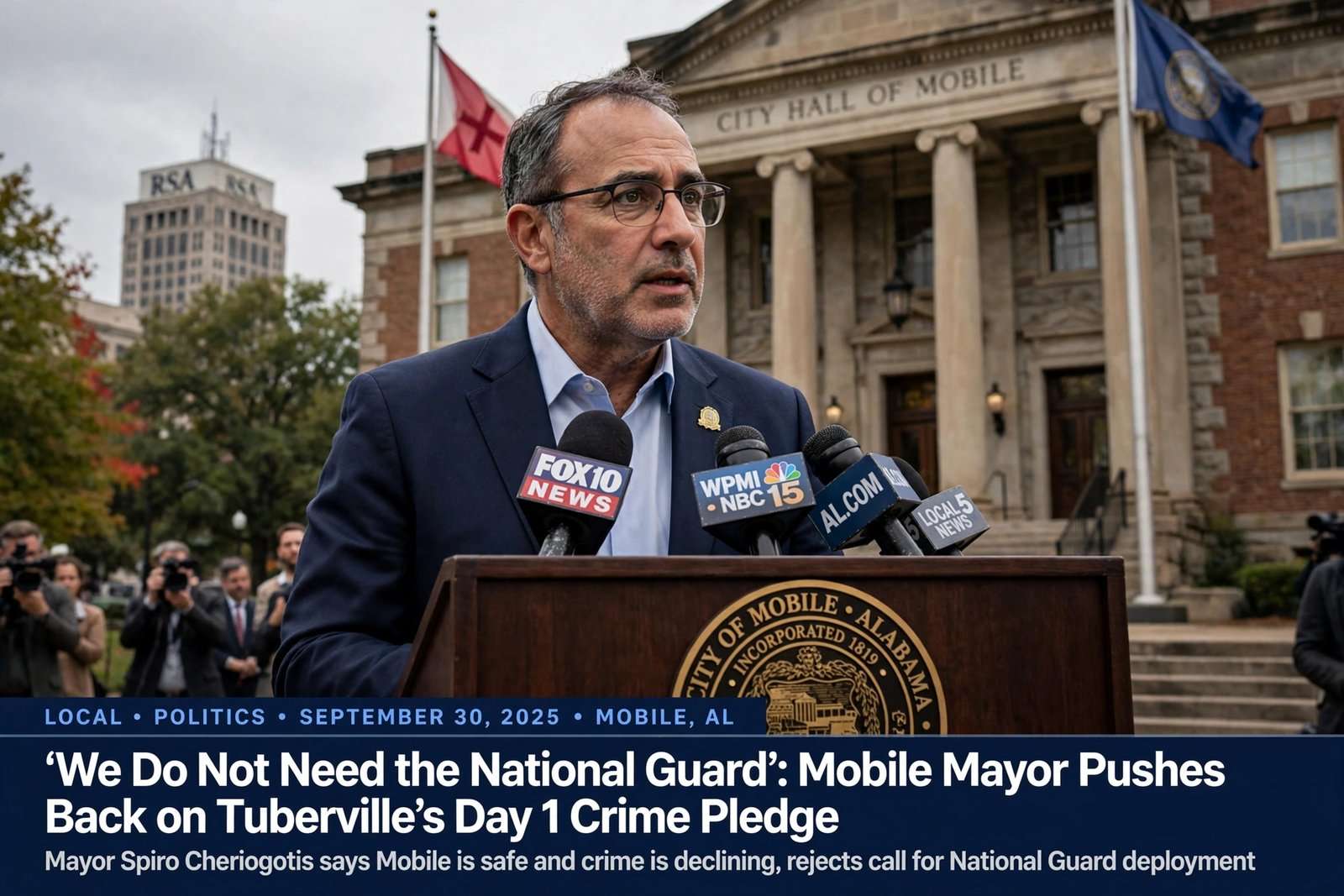
MOBILE, Ala. — Mobile Mayor Spiro Cheriogotis has a short answer for the suggestion, raised in a new campaign ad from U.S. Sen. Tommy Tuberville, that Alabama’s largest cities could see National Guard troops on their streets: not here.
“No, Mobile is nowhere near a place I believe the National Guard is needed,” Cheriogotis said in an interview Wednesday, Sept. 30. “No, we do not need the National Guard policing our streets.”
The mayor’s comments came in response to a Tuberville television ad that describes Montgomery as “a war zone” and calls Mobile and Birmingham “dangerous” before the Republican nominee for governor warns, “Don’t think I won’t send in the National Guard on Day 1.” The ad does not say which city, or cities, Tuberville has in mind, and it does not explicitly name Mobile as a destination for troops.
‘I’ll show him exactly what we are doing’
Cheriogotis, who took office in November 2025, framed his response as an invitation rather than a fight. “If he becomes Governor Tuberville, I’ll show him exactly what we are doing in Mobile to keep our people safe,” he said.
The mayor has described himself as an “apolitical” officeholder who prefers to avoid national talking points, and his reply to the ad stuck to local crime trends and the city’s reputation rather than the governor’s race itself. Tuberville faces Democratic nominee Doug Jones and independent Ronald Brunette Jr. in the Nov. 3 general election.
What the ad promises
Beyond the National Guard line, the ad lays out several public safety pledges that Tuberville says he would pursue as governor:
- Recruiting what he calls a “new generation” of law enforcement officers.
- Imposing what he describes as the toughest penalties in the nation on people who abuse children.
- Holding judges and district attorneys accountable.
- Being willing to deploy the National Guard on his first day in office.
As governor, Tuberville would be commander in chief of the Alabama National Guard when it is not under federal control, giving the office the authority to call Guard members to state active duty. Governors most often use that power for hurricanes, floods and other emergencies, a role familiar to residents of the Gulf Coast, rather than for routine street patrols.
A ranking Mobile still can’t shake
Cheriogotis said much of the perception that Mobile is unsafe traces back to a single national ranking that he and other city leaders have long argued was wrong.
In early 2023, a report from a personal finance website, later republished by a national business magazine, ranked Mobile as the second-most-dangerous city in the country, behind only St. Louis, with Birmingham third. The study relied on 2021 FBI crime data and assigned a dollar value to different categories of crime to produce its rankings.
Leaders in both Alabama cities objected. Then-Birmingham Police Chief Scott Thurmond and other officials criticized the methodology, and Mobile and Birmingham leaders said the FBI data behind the study contained errors. By the summer of 2023, Mobile officials said the FBI had corrected the data and that the city no longer ranked near the top of the list. A corrected version of the report placed Birmingham, not Mobile, in the second spot.
The original ranking has proved hard to bury. “We’ve suffered from that for so long,” Cheriogotis said. “It was inaccurate. I see that article get posted once a year, at minimum.”
The episode illustrates a broader problem with city crime rankings. The FBI itself has long cautioned against using its data to rank cities, because differences in population, reporting practices and local conditions can make simple comparisons misleading. Ranking methods that weight crimes by estimated cost, as the 2023 report did, can also be swayed heavily by a small number of the most serious offenses.
Other Alabama mayors have said no, too
Cheriogotis is not the first Alabama mayor to push back on the idea of using the Guard to fight crime.
Montgomery Mayor Steven Reed rejected calls to bring in the National Guard following a mass shooting in the capital city last year. Birmingham Mayor Randall Woodfin has also opposed the approach, saying in 2024, “National Guard are civilians. We’re not putting civilians on our streets to address this issue.”
Woodfin’s point reflects the makeup of the Guard: most members are part-time citizen-soldiers who hold civilian jobs and train periodically, and they are not trained as local police officers. Supporters of deployments argue that troops can free up police for investigations and deter crime through visibility, while critics contend that long-term reductions in violence depend on policing, prosecution and community programs.
A national trend reaches the governor’s race
Tuberville’s pledge echoes one of the defining moves of President Donald Trump’s second term. The Trump administration has sent National Guard troops into several American cities, including Memphis, Tennessee, where Guard members began supporting a federal crime task force in the fall of 2025, and New Orleans, where Trump approved the deployment of 350 Guard troops in December 2025 at the request of Louisiana’s governor. Those missions have drawn both praise from supporters who credit them with reducing crime and legal and political challenges from critics elsewhere in the country.
No Alabama city has had a comparable federal National Guard deployment. Tuberville is a close ally of the president, who is scheduled to headline a rally at the University of South Alabama’s Mitchell Center in Mobile on Friday, Oct. 2, with Tuberville set to introduce him.
Crime is trending down
The debate comes as crime in Alabama’s three largest cities has generally declined in recent years. Violent crime and homicides are down so far this year in both Birmingham and Montgomery compared with the same point a year ago. In Mobile, violent crime has fallen significantly from the levels reported two years ago.
That trend gives mayors like Cheriogotis a talking point as public safety becomes a larger theme in the campaign. Jones has called for more resources for police training and has rejected attempts to tie him to the “defund the police” movement, while Tuberville has made law enforcement support a centerpiece of his pitch to voters.
Latest developments: ‘Mobile is not a dangerous place’
In further comments Wednesday, Cheriogotis pushed back more directly on the ad’s description of Mobile, while making clear he does not want the disagreement to become a political feud with the senator.
“I’ve seen stories that are trying to pit me against a political candidate, our sitting senator,” Cheriogotis said. “I’m excited to work with any governor who is willing to apply state resources to the crime that we face in Mobile.”
The mayor pointed to what he described as five consecutive years of double-digit declines in Part One crimes, the FBI’s category of the most serious offenses, which includes homicide, rape, robbery, aggravated assault, burglary, larceny and motor vehicle theft.
“Mobile has experienced double-digit crime drops, Part One crimes, year over year for the last five years,” he said. “We’ve done that through collaboration with the state, with our federal partners, with our local partners.”
He was equally clear that the city’s work is unfinished. “While crime has drastically improved in Mobile over the last five years, not enough,” Cheriogotis said. “We are not done. We are always seeking constant improvement.”
An open door to state help
Rather than rejecting help outright, the mayor said Mobile would welcome additional state resources aimed at reducing crime.
“If Senator Tuberville and potentially Governor Tuberville is willing to work with cities like Mobile to truly affect crime in our streets, I’m all for it,” he said. “We need all the help we can get.”
Cheriogotis listed the pieces of the city’s public safety strategy: a fully staffed police department, technology, cooperation among law enforcement agencies and crime prevention efforts. “I welcome any governor, any state official who wants to help us do that,” he said.
He also said he has had a strong working relationship with Tuberville during his time as mayor and expects to continue it if Tuberville becomes Alabama’s next governor.
Worries about reputation
Still, the mayor said labels like “dangerous” risk reinforcing an outdated image of the city, again citing the national ranking that he said wrongly tripled Mobile’s homicide count.
“Mobile has suffered from a false story for many years,” Cheriogotis said. “Mobile is not a dangerous place. It’s a wonderful place to live. It’s a wonderful place to visit.”
The rest of the ad, and the other mayors
The full ad casts the plan as a crackdown. “I’m going to make sure Alabama’s communities are safe,” Tuberville says in the spot. “These criminals will pay the price for hurting our cities. As your governor, I’ll personally recruit a new generation of law enforcement officers, institute the nation’s harshest penalties for child abusers and bring accountability to judges and district attorneys.”
The mayors of all three cities named in the ad have now rejected the idea of sending the Guard to their communities. Woodfin, asked about Tuberville’s plans in January, said, “I’m not sure what the guard will be needed for.”
What comes next
Whether Tuberville would actually deploy the Guard, and where, is a question that may not be answered unless he wins in November. For now, the ad has given city leaders an opening to argue their own records. Cheriogotis said he would welcome the chance to make that case directly to whoever wins the governor’s race.
Alabama’s general election is Tuesday, Nov. 3. The deadline to register to vote or update voter information is Monday, Oct. 19.