St. Louis Street Rebuild Passes the Halfway Mark as Downtown Mobile Corridor Takes Shape
The $16 million St. Louis Street reconstruction has reached block eight of 17, rebuilding one of downtown Mobile's busiest business corridors from the water mains up while keeping traffic moving.
Downtown Mobile’s most closely watched construction project has crossed its halfway mark.
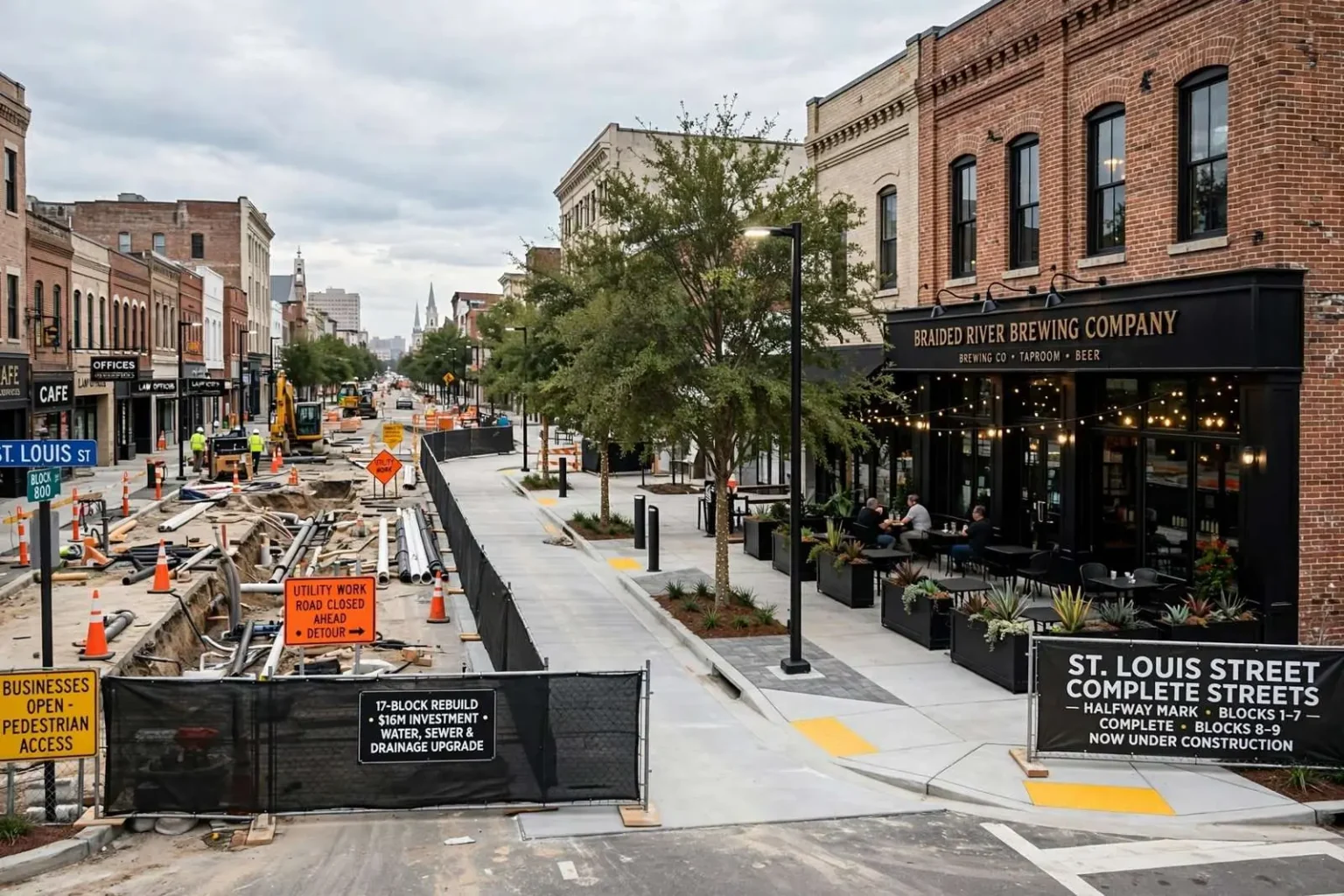
The St. Louis Street “Complete Streets” reconstruction, a 17-block rebuild of one of the city’s busiest business corridors, is now moving into blocks eight and nine, and city leaders are preparing to brief the public on what has been finished and what still lies ahead.
Mayor Spiro Cheriogotis will deliver a public update on Friday, July 10, at 6 p.m. at Braided River Brewing Company, a fitting choice given that the brewery sits along the corridor the project is remaking. The venue is one of the businesses whose street frontage has lived through months of cones, trenches and detours, and choosing it for the public briefing put the mayor’s podium directly in front of the project’s most affected constituency.
More than a repaving job
It would be easy to mistake the work for routine street resurfacing. It is not.
The $16 million investment reaches well below the asphalt, and much of what the money buys will never be visible to a driver passing through. The scope includes:
Water, sewer and gas line improvements beneath the roadway, replacing utility infrastructure in a corridor where some systems long predate the businesses now operating above them. Stormwater drainage upgrades, a meaningful consideration in a city that regularly absorbs heavy Gulf Coast rainfall. ADA-compliant crossings, making the corridor genuinely navigable for residents using wheelchairs, walkers and strollers. New street lighting and landscaping, intended to make the street feel safer and more inviting after dark. Utility relocation, with Alabama Power and other overhead providers moving power lines and fiber off the street to open up pedestrian space and clear sightlines.
That last item deserves attention. Pulling overhead lines off a downtown street is expensive, slow and largely thankless work, but it changes the character of a corridor permanently. It widens the usable sidewalk, removes visual clutter and eliminates the tangle of poles and wires that has defined the streetscape for generations.
Buried utilities also change a street’s relationship with storms. Overhead lines across the Gulf Coast are the first casualties of every hurricane and severe thunderstorm, and every downed feeder along a business corridor means days of lost power for the shops and restaurants beneath it — exactly the kind of interruption a downtown trying to grow an evening economy cannot afford. The relocation work is coordinated with Alabama Power and the fiber providers whose lines share the same poles, which is one reason the schedule advances block by block rather than all at once.
The corridor being rebuilt
St. Louis Street runs through the heart of downtown’s northern business district, paralleling Dauphin Street — the entertainment spine most visitors know — and connecting the historic residential and commercial blocks that line it. The corridor carries a mix of restaurants, breweries, offices, churches and institutions, and its reconstruction touches the frontage of every one of them. Seventeen blocks is the length of a walk most downtown workers make several times a week, which is why the project has been followed as closely as any single piece of infrastructure in the city.
The Complete Streets label carries a specific meaning in transportation planning: a street designed for everyone who uses it — drivers, transit riders, cyclists and pedestrians — rather than engineered around vehicle throughput alone. The national movement behind the term grew out of decades of streets built to move cars quickly and little else, and its checklist shows up concretely in this project’s scope: the compliant curb ramps and crossings, the widened pedestrian space created by burying the lines, the lighting that makes the sidewalk usable after dark. A street rebuilt to that standard is a street intended to hold more businesses, more foot traffic and more events than the one it replaces.
Building without shutting anyone down
Anyone who has watched a downtown business struggle through a long construction closure knows why the project’s phasing has drawn as much attention as its engineering. A restaurant can absorb a slow week; it cannot absorb a season of blocked entrances and erased parking. The difference between a corridor project that kills businesses and one that businesses survive is usually the sequencing — work done block by block, access maintained in front of every open door, and communication between the contractor and the merchants who are losing customers to the fences.
The halfway mark is the natural moment to take that question’s measure. Blocks one through seven are behind the corridor’s businesses now; blocks eight and nine are under construction; the remainder of the 17 blocks is scheduled ahead. Every merchant on the street has lived through one phase or another by now, and the update event at the brewery — in the evening, on the corridor itself — was framed for exactly that audience: what has been done, what comes next, and what the finished street will look like when the last block closes out.
The mayor’s decision to hold the briefing at a business on the street rather than at Government Plaza also reflected the project’s civic positioning. The rebuild is being presented as an economic development investment — the kind of work that determines whether a downtown corridor attracts tenants or loses them — and the audience for that case is the people who already bet on the corridor: the restaurateurs, brewers and shop owners who signed leases on a street that was, for the past year, a construction zone.
What the money actually buys
Public-works budgets are usually judged by what can be seen from a car, and by that measure a $16 million street project would look extravagant. The accounting changes when the scope is read in full. Water, sewer and gas lines that predate the surrounding businesses are liabilities: a main failure under a busy block shuts the whole corridor for days and tears up pavement that was just rebuilt. Replacing them while the street is already open — instead of waiting for a failure — is the cheaper of the two outcomes by a wide margin.
Stormwater drainage is the Gulf Coast’s permanent infrastructure problem. Mobile’s annual rainfall is among the heaviest of any American city, and downtown’s low-lying blocks flood when systems designed generations ago reach capacity. Upgraded drainage under the rebuilt roadway is the unglamorous component that determines whether the corridor’s businesses can operate through a heavy afternoon storm, and it is the part of the budget that no ribbon-cutting will ever photograph.
The ADA-compliant crossings answer a simpler standard: a downtown that older residents, wheelchair users and parents with strollers can actually move through. Curb ramps built to code at every corner, crossings timed and marked for pedestrians and smooth connections between sidewalk sections are the details that decide whether the corridor functions as public space or merely as a road with buildings beside it.
What comes next
With blocks eight and nine underway, the project’s remaining mileage runs through the balance of the corridor’s 17 blocks, and the pace from here depends on the same variables that governed the first half: weather, utility coordination and the contractors’ ability to keep multiple crews from stepping on each other in a narrow right-of-way. Downtown construction moves at the speed of its slowest constraint — usually the buried utilities and the traffic control around them.
The finished street, when it arrives, will be measured against the promises made at the project’s start: safer crossings, more usable sidewalk, better drainage, buried lines and a corridor that draws more evening activity rather than less. Those are also the metrics by which downtown’s business community will judge it, because the merchants’ original support for the project rested on the argument that two years of pain buys decades of a better street.
The broader downtown picture
The St. Louis Street project fits into a larger arc of downtown Mobile’s redevelopment — the reinvestment in the historic core that has added housing, restaurants, venues and institutions along the bayfront and into the surrounding districts over two decades. Corridor rebuilds are the ground floor of that arc: the utilities, drainage and streetscapes that everything built above them depends on. A city that wants restaurants and apartments on a street has to first make that street’s infrastructure equal to the buildings going in.
It also reflects a shift in how American cities treat their older commercial streets. The complete-streets standard — pedestrian space, lighting, compliant crossings, buried utilities — is now the default template for downtown rebuilds across the country, and the projects are consistently judged by what happens to the storefronts afterward. The evidence from other cities is that the investment pays back in tenancy and foot traffic when the construction period is managed well and in losses when it is not, which is why the phasing discipline on this project has mattered as much as the engineering.
For now, the corridor is halfway transformed: half rebuilt to a standard the street has never met, half waiting for the same treatment. The July update was the public’s checkpoint on both halves — what a $16 million investment has bought so far, and what the businesses that have endured it can expect from the rest.