The Bottom Came in December: A Mobile Broker on the 1974 Crash, Recovery, and a Diagnosis He Did Not Expect
In the gloom of late 1974 a Mobile stockbroker drew up two models of the future and labeled them Doom and Boom. The market gave him his answer on December 6. Then his doctor gave him another.
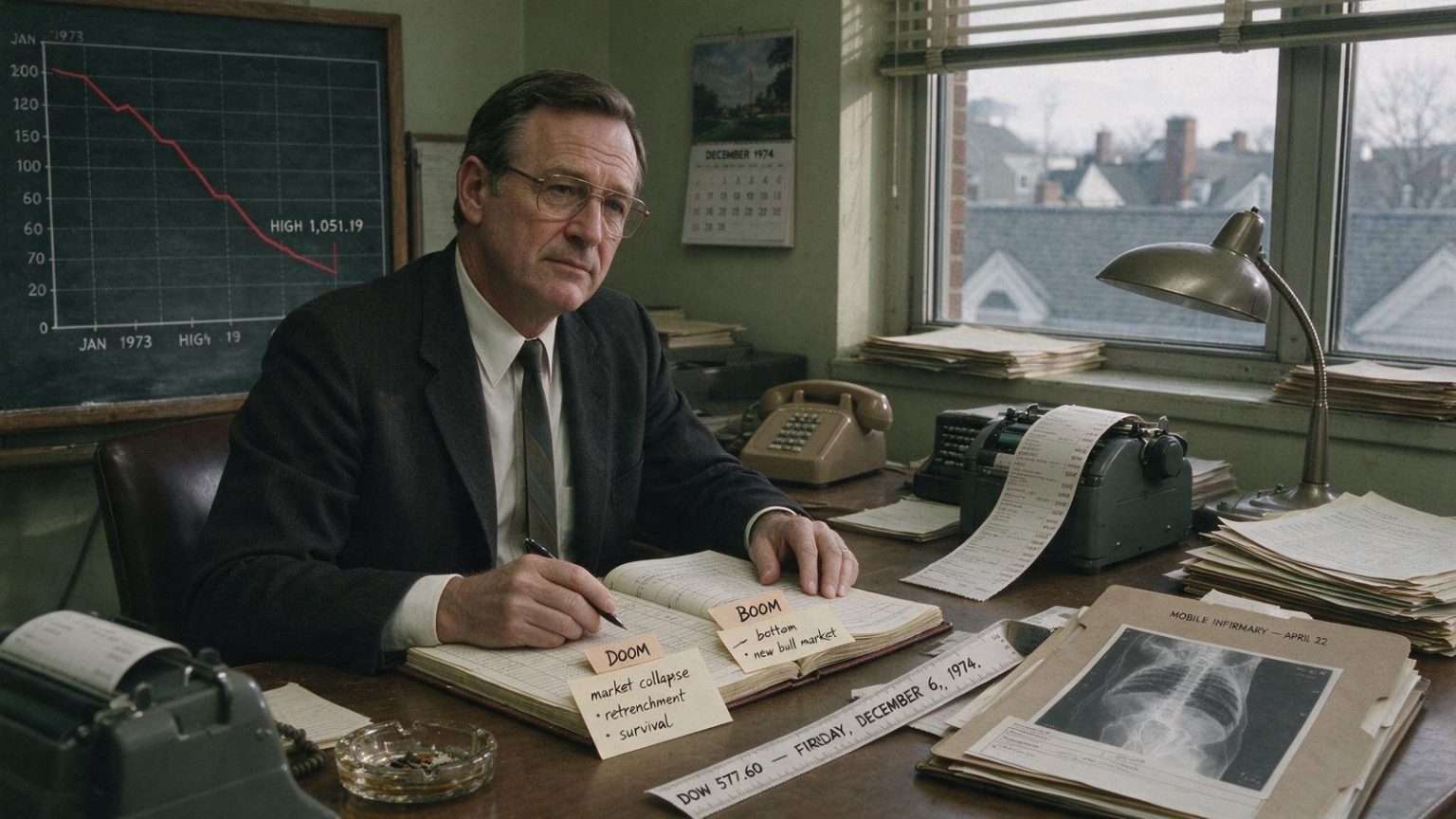
In the autumn of 1974, with the stock market in free fall and the brokerage industry contracting around him, a veteran Mobile stockbroker sat down and did what men in his line of work do when they have run out of comfort: he built two models of the future and gave them names. He called them Doom and Boom.
He admits the terms were hardly original, but they suited the times.
Doom
In the first scenario, the entire elaborate machinery of the market collapsed, with the Dow Jones Industrial Average sinking toward 300.
The brokerage business retrenched to perhaps half a dozen surviving national firms, and the branch office population shrank from roughly 5,000 to a thousand or so. He was, by his own account, prepared for it.
He had always believed he could go back to living on cabbage and collard greens, and he expected he would be doing just that. He borrowed his consolation from Porgy: I got plenty of nothin’, and nothin’s plenty for me.
Boom
In the second, the market found its floor soon and a new bull market began — one that, precisely because the preceding bear market had been so long and so savage, would run long and reward handsomely anyone with the nerve to ride it. The market delivered its verdict on Friday, Dec. 6, 1974, when the Dow closed at 577.60 — a thundering 45 percent below its January 1973 high of 1,051.19. That was the bottom.
His portfolio finished 1974 well below the prior year’s close, though he notes the comparison is unfair: he had drawn out a considerable sum along the way, most of it to cover college expenses for his children. His production that year cratered, leaving his earnings at their lowest level since 1964.
Then the bulls came back. Despite pulling out another large sum during 1975, his portfolio reached a new high by year-end.
Production shot up. Earnings returned to something like their accustomed level.
All of which he managed while gravely ill.
A Routine Physical
A light case of pneumonia in late January 1975 put him in bed at home for a few days.
Having gone years without a checkup, he asked his physician to give him a full physical once the pneumonia had cleared. The exam came back clean but for a urinary tract infection.
Antibiotics did not resolve it, and he was referred to a urologist. The specialist ordered a thorough workup, and the broker checked into Mobile Infirmary on April 22 for what he expected would be a two-day formality — a contrast dye sent through the urinary system, x-rays taken, a bottle of pills prescribed, life resumed.
He felt fine. He had no complaints at all.
He was going through the exercise chiefly to satisfy the doctor who had referred him. The following afternoon, the urologist arrived with the films and did not soften the news: a giant stone was blocking the exit from the right kidney.
It had to come out. They could try to save the kidney, but he doubted they could.
Was it serious? “It’s a major operation,” the surgeon answered, “and any major operation is serious.”
The Decision
For the first time, he writes, he actually felt sick.
He checked out of the hospital without committing to anything. A day or two later he called back to ask what would happen if he simply declined.
The answer: perhaps one chance in 200 that nothing would happen. Far more likely, sooner rather than later, an emergency — sudden and severe pain, surgery performed in a hurry under, as the doctor put it, less than satisfactory conditions.
Not necessarily fatal. But grim.
He agonized for days, then scheduled the operation for May 20, the earliest date the surgeon could both operate and remain available afterward. The weeks before were, he writes, sheer misery.
He counted the hours until surgery, then counted the same number of hours backward into his own past and wished he could simply blank out the interval. He nearly called it off several times.
He was 54, overweight, a smoker who took little exercise, and he had real doubts he would survive major surgery. What made the choice unbearable was the absence of pain.
Had he been suffering, the decision would have been easy. A second opinion, he reasoned, would only cost time and money and deliver the same verdict — and he would have to agonize all over again.
The Complication
He went through with it. Surgeons removed the entire kidney and, in the recovery room, proudly showed him the stone — one of the largest they had ever taken out, they told him.
He was too dazed to remember its shape and never thought to keep it. Recovery went smoothly until the end of the second day, when a severe chest pain struck.
He feared a heart attack. Doctors gathered around the bed, plainly concerned, and none seemed able to say what was happening.
Finally his internist went off in search of another specialist and returned with a question that would become the punch line of the next installment: “Is Bodet okay?”