Mobile Sports Authority Weighs BP Claim for Lost Bass Tournament
The Mobile Sports Authority prepared to consider filing a claim against BP after the Gulf oil spill forced the cancellation of a major bass fishing tournament projected to bring more than a million dollars to the area.
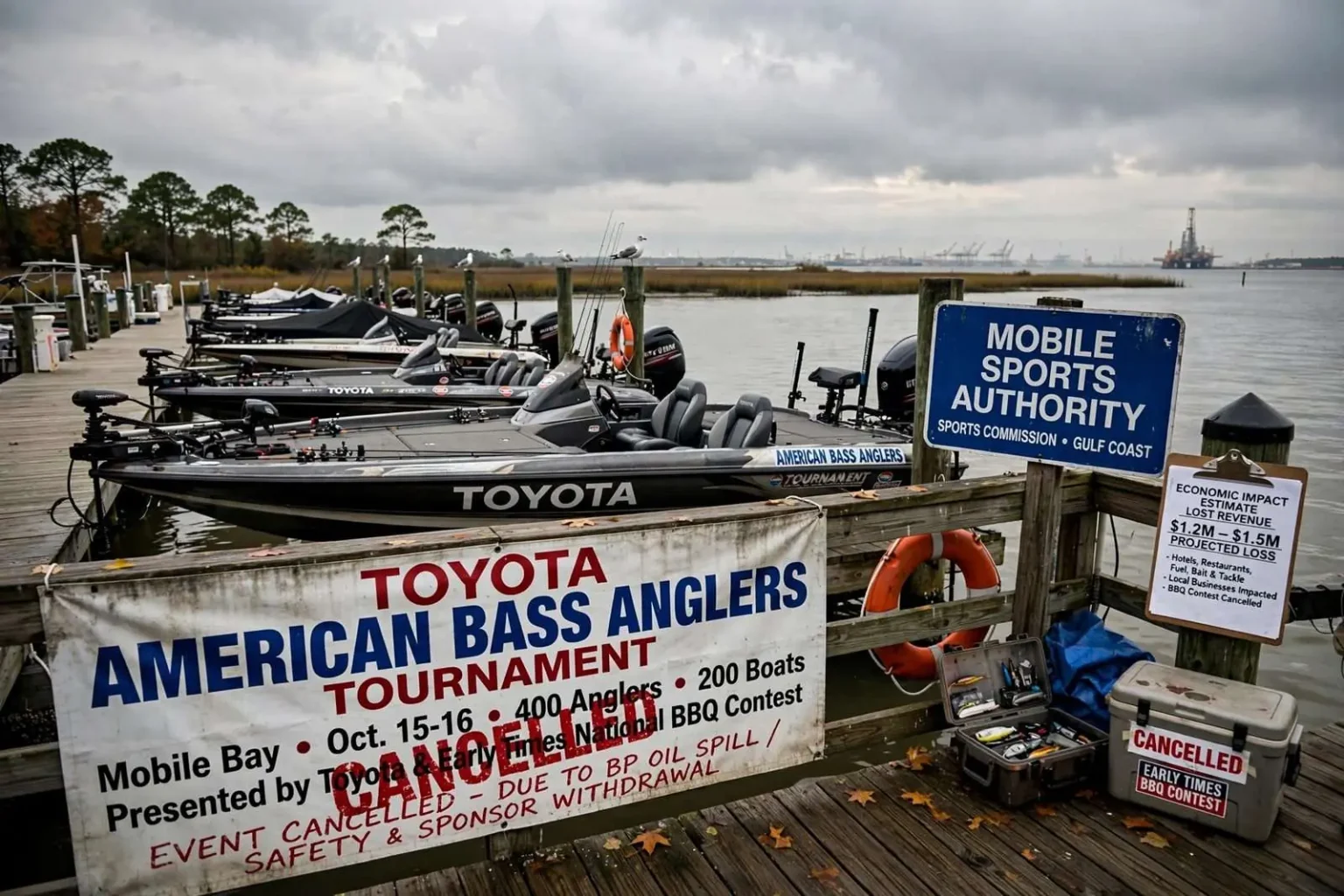
The Mobile Sports Authority was preparing to weigh whether to file a claim against BP over revenue lost when the Gulf oil spill forced the cancellation of a major bass fishing tournament that had been set for the fall. The question of a BP claim was one item on the agenda as the sports authority’s board members prepared to meet the following week.
At issue was the Toyota American Bass Anglers Tournament, which had been scheduled for Oct. 15-16 in the Mobile area before being scuttled specifically because of concerns stemming from the BP oil spill. According to Bud Ratliff, executive director of the sports authority, the tournament had anticipated about 400 fishermen aboard 200 boats. A national barbecue contest sponsored by Early Times had been planned in advance of the fishing competition as well.
“Those are two pretty good sponsors, Toyota and a major bourbon company,” Ratliff noted, underscoring the caliber of the event that had slipped away.
The tournament’s cancellation was not the result of oil on the tournament waters themselves so much as the uncertainty that hung over everything that autumn. Sponsors and organizers plan events months in advance, and with oil sightings shifting week to week and images of oiled shoreline on every newscast, no one could promise in good faith that a October tournament on Mobile Bay’s connected waters would come off as planned. The organizers’ caution, and the sponsors’ reluctance, took the event away before anyone could prove it would have been affected.
Counting the cost, the projected economic impact of the tournament and its associated events was $1.2 million to $1.5 million, Ratliff said, money that would have flowed to hotels, restaurants and other businesses across the area during the two-day competition and the barbecue contest that preceded it.
The estimate reflects how a single weekend of competitive fishing ripples through a host city. Four hundred anglers and their families fill hotel rooms for multiple nights, occupy restaurants, buy fuel and tackle and bait, and rent boats and vehicles — spending concentrated into a fall weekend that local businesses had counted on. The barbecue contest added its own footprint: competitors, vendors and crowds gathered ahead of the fishing, extending the economic window beyond the tournament itself.
A tournament scuttled by the spill
The loss was emblematic of the spill’s reach. The Deepwater Horizon disaster had fouled Gulf waters and rattled confidence in the region’s fishing and tourism economy, and events built around the water, from angling tournaments to beach vacations, were among the casualties. Even competitions on inland and bay waters were not immune, as organizers and sponsors grew wary of staging high-profile events amid the uncertainty.
The Deepwater Horizon rig had exploded on April 20, 2010, killing eleven workers and beginning the largest marine oil spill in history. Over the spring and summer, as oil moved into Gulf waters and approached the coastline, the spill reshaped the region’s economy in ways far beyond the areas where oil actually came ashore. Fishing grounds closed, bookings evaporated, and the perception of a fouled coast did damage in places that never saw a tar ball.
For the Mobile area, whose economy is tied to the bay and the Gulf through tourism, sportfishing and the maritime industries, that perception gap became the story of the summer. Events scheduled months ahead — tournaments, festivals, regattas — faced a decision in the weeks before their dates: proceed and risk embarrassment on the water, or cancel and absorb the loss. The American Bass Anglers event, like others around the Gulf that season, chose cancellation.
The Mobile Sports Authority exists to bring exactly this kind of event to the area. As the region’s sports commission, its work is to attract and support sporting competitions — from youth championships to national tournaments — that fill hotel rooms and restaurants and put Mobile on the national sporting calendar. A national bass fishing tournament with Toyota’s sponsorship was precisely the sort of win the organization exists to deliver, which is why its loss rose to the level of a claim rather than a shrug.
Bass fishing’s national circuit matters to Gulf Coast host cities for reasons beyond the anglers themselves. Competitive bass fishing draws a devoted following — participants who travel with their boats, families who accompany them, spectators and sponsors’ staff — and tournaments are awarded to host communities through competition among destinations. A city that loses an event to force majeure does not automatically get it back the next year; the industry’s calendars fill with other hosts, and rebuilding the relationship takes seasons of effort.
The barbecue contest layered a second kind of event onto the same weekend. National barbecue competitions bring their own circuit of competitors and followers, with sponsorships — Early Times among them — that treat the events as brand showcases. Losing both the fishing tournament and its companion contest in the same cancellation multiplied the loss beyond the entry fees and prize money into the whole weekend’s tourism economy.
Where any recovery would go
Ratliff outlined how the authority would handle any money it might recover. If the sports authority sought compensation from BP and its petition were granted, he said, its directors would likely devote all of the revenue to enhancing the authority’s work bringing sporting events to the Mobile area.
That intended use frames the claim as an investment in the region’s event economy rather than a windfall for the organization. The authority’s board — volunteers drawn from the community’s business and civic leadership — would direct recovered dollars back into the mission: attracting future tournaments, supporting the events already on the calendar and building the facilities relationships that make the area competitive for national competitions.
The claim itself would enter the process BP established for spill losses. In the summer of 2010, the company set up an independent claims facility to compensate businesses and individuals whose losses stemmed from the spill, and organizations across the Gulf Coast filed claims covering lost revenue, canceled events and diminished business. A claim by the sports authority would document the canceled tournament — the contracts, the sponsor commitments, the projected economic impact — and seek recovery of the losses the cancellation produced.
The board meeting the following week was to decide whether to file. The consideration reflected the authority’s particular position in the spill’s ledger: it had suffered a real, documentable loss, but one measured in projected economic impact rather than direct oil damage. Whether the claims process would compensate an organization for an event that never happened — a tournament scuttled by perception and precaution rather than by oil on its waters — was the question the board would weigh.
The spill’s shadow over the event economy
The tournament’s story played out across the Gulf that year. Destination marketing organizations, sports commissions and event promoters from Texas to Florida watched their calendars wobble as the spill stretched through the summer. Some events proceeded without incident; others were relocated, postponed or canceled outright. The uncertainty itself was the costliest force, because event organizers plan on certainty — signed contracts, confirmed dates, guaranteed waters — and the spill denied them that certainty even where the water stayed clean.
Mobile Bay and the Delta waters that the tournament would have used remained open to fishing through much of the period, and the area’s inland and brackish fisheries were never the poster image of the disaster. But a national tournament is not decided by water quality alone: it is decided by sponsors who buy signage and hospitality, by anglers who book rooms months ahead and by the broadcast and media attention that turns a competition into an advertisement for the host city. Every one of those decisions was made harder by the phrase “Gulf oil spill” attached to the region’s name.
For the authority, the cancellation also carried a lesson about diversifying its calendar. An organization that builds its year around a single flagship weekend is exposed when that weekend disappears, and the loss of the October tournament — with its $1.2 million to $1.5 million footprint — gave the board a concrete case for broadening the portfolio of events it pursues.
The board’s decision
The meeting ahead would settle three questions: whether the authority had a claim worth filing, whether the projected losses could be documented to the claims facility’s standard and whether pursuing recovery served the organization’s mission or distracted from it. Ratliff’s comments ahead of the meeting suggested the board leaned toward filing — the loss was real, the sponsors were national names, and the recovery, if granted, would be reinvested in the area’s event economy rather than absorbed into operations.
Whatever the board decided, the episode fixed a measure of the spill’s true cost to Mobile. The disaster’s accounting eventually ran to billions of dollars in penalties, settlements and restoration funding, but the losses that individual communities felt first were of this scale: a tournament here, a festival there, a season of bookings that never materialized. The Mobile Sports Authority’s $1.2 million to $1.5 million weekend was one entry in that ledger — four hundred anglers and two hundred boats that never came, and a city that lost the chance to show a national audience what its waters could host.
The authority’s preparation to weigh the claim, a year into the spill’s aftermath, also showed how long the reckoning would take. Claims, counterclaims and recovery programs would stretch across years, and organizations like the sports authority — small staffs with board members who volunteer their time — would spend a portion of that period documenting what was lost. The October weekend of 2010 was gone either way; the question before the board was whether its value could be recovered and turned toward the next tournament, the next barbecue contest and the next chance to bring the Gulf Coast’s sporting economy back to the Mobile area.