Airbus Euphoria Meets Hard Numbers as Mobile Budget Standoff Drags On
Mayor Sam Jones cast Mobile's budget fight in a brighter light after the Airbus announcement, but Councilman John Williams said the good news changed nothing about the city's need to live within its means.
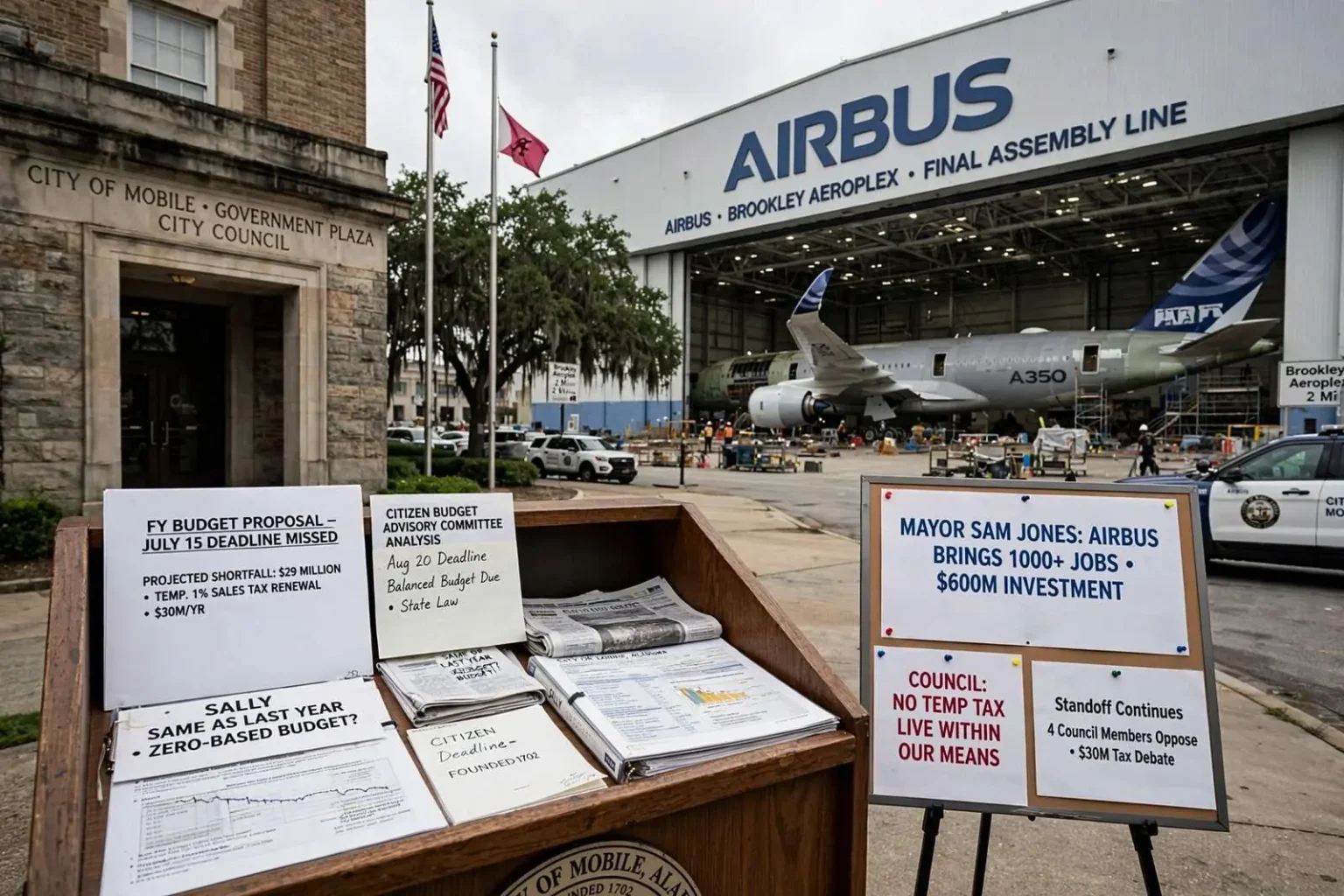
Even as Mobile celebrated the arrival of Airbus, a stubborn standoff over the city’s budget showed no sign of breaking. Mayor Sam Jones and a bloc of skeptical City Council members remained at odds over whether the city needed to reinstate a temporary tax increase, and the euphoria over new jobs had not yet translated into a deal.
A missed deadline, a bigger promise
In a newsletter to “my fellow Mobilians” captioned “Mobile’s Future Outlook,” Jones explained that he had missed his self-imposed July 15 deadline for submitting a balanced budget. He cited the implications of the anticipated Airbus announcement and a desire to let the council’s Citizen Budget Advisory Committee finish its analysis of city finances. He assured residents he would meet an Aug. 20 deadline for submitting a balanced budget as required by state law.
The newsletter implied that the Airbus news might help break the deadlock with four or so council members over the necessity of temporarily reinstating a $30 million annual tax increase — the equivalent of an additional one percent sales tax in the city. A one-cent sales tax in a city of Mobile’s size generates roughly that sum each year, and the question of whether Mobile could afford to forgo it had become the central dispute of the budget season: the administration argued the revenue underwrote basic services, while a council majority argued the tax was sold as temporary and the city had an obligation to let it lapse.
Airbus had announced plans to build a $600 million assembly line at Brookley Aeroplex, employing more than 1,000 workers to build the A350 commercial jet, with as many as 3,000 to 4,000 additional jobs anticipated as suppliers flocked to the central Gulf Coast. The announcement — the largest industrial recruitment prize in the city’s history — transformed the fiscal conversation in principle, but not yet in practice. Assembly line construction takes years, payrolls ramp up slowly, and property tax abatements and incentive packages mean that the first years of a mega-project often cost a city money before they generate it. The mayor’s argument was that the city needed bridge revenue until the Airbus economy arrived; the council’s argument was that the promise of future growth was precisely why the city could not keep taxing at emergency rates.
The mayor’s optimism
“The old adage, ‘What a difference a day can make,’ is so appropriate for Mobile,” Jones wrote. “In this time of global economic crisis where cities across the country are grappling with a dwindling tax base, Mobile stands at the brink of economic success.”
Just a month earlier, before the Airbus announcement, Jones had warned that the budgeting process might produce a future many citizens would find unrecognizably spartan.
“Though we are still confronted by extraordinary budgetary challenges that require us to come together, as a community, to reconfirm our priorities and define the kind of City we want to be — Mobile’s future is brighter, thanks to Airbus,” Jones wrote.
The two passages, a month apart, trace how quickly the fiscal narrative had turned. In one, Mobile was a city facing the same recession-battered arithmetic as every other municipality in the country — sales tax receipts depressed, property values softened, state funding falling. In the other, Mobile was the exception, a city with a generational economic engine arriving at the moment of maximum need. The budget dispute was, at bottom, an argument about which of those two cities was the real one: the council skeptics saw the Airbus headline as no reason to abandon discipline, while the administration saw it as evidence that the city’s finances were fundamentally sound and merely needed time.
‘Same as last year’
Councilman John Williams welcomed the Airbus news but insisted it changed nothing about the proper approach to city finances, which he summarized as living within your means and setting priorities. Williams argued that Airbus would be pleased to partner with a fiscally conservative city that managed its money soundly rather than one that clung to a tax-and-spend mentality.
“Sally” had ruled the city’s budgeting process for far too long, Williams said, explaining that “Sally” was his acronym for “same as last year.” He described a zombie-like approach to the budget, trudging along its well-worn path, straying only slightly to reward a “good” department with a five percent increase or punish a “bad” one with a five percent cut.
The critique went to the way municipal budgets are actually built. Most city departments submit requests by adjusting the previous year’s figures, and most councils amend the mayor’s proposal at the margins. The result is a budget that reflects institutional momentum more than current priorities — and, in Williams’s telling, a process that never asks whether a program should exist at all, only whether it should grow by five percent or shrink by five percent. Zero-based budgeting, in which every expenditure must justify itself from scratch each year, has its own costs in staff time and disruption, but the “Sally” complaint gave voice to a council faction that believed Mobile’s structural deficit was being papered over with the tax increase rather than examined.
A dispute over the numbers themselves compounded the standoff. Williams took exception to the mayor’s claim of collaboration.
“He met with me but I don’t think collaboration is any part of this administration’s M.O.,” he said. “They scheme and — I don’t use this word very often — strategize to position themselves to some advantage and proclaim dire circumstances.”
He noted that the mayor had roughly 200 city employees supplying financial information, while the council had little access except through the mayor. That asymmetry is structural in Mobile’s strong-mayor government: the administration controls the finance department, the revenue projections and the professional staff, and council members — even those with long tenures and sharp eyes for a spreadsheet — must depend on the executive branch for the numbers they are asked to vote on.
Symptomatic of the impasse, officials could not even agree on the size of the shortfall — the mayor asserting $29 million, various council members closer to a third of that. When the parties to a budget negotiation disagree about the size of the gap by a factor of three, the dispute is not really about arithmetic. It is about assumptions: revenue forecasts, the savings available from attrition and hiring freezes, and whether one-time measures count as solutions. “It’s scary that we can’t say where we stand to the dollar,” Williams said.
Jones, for his part, pledged to run the city in a fiscally responsible way, insisting, “Airbus will transform our character and strengthen the city’s future.”
The mayor’s position carried its own logic. Cities do not get to choose their timing, and Mobile’s came to its Airbus moment at the bottom of the worst municipal revenue environment in a generation. Sales tax receipts — the city’s dominant revenue source — had fallen with retail spending, and the costs of basic services had not fallen with them. If the city cut its way to balance in that environment, the administration argued, it would be cutting police protection, street repairs and the very services that make a city capable of absorbing the growth Airbus promised. A temporary tax, on this view, is not a philosophy; it is a bridge.
The council skeptics answered with the history of temporary taxes, which in city after city have proved anything but. A one-cent sales tax justified as an emergency measure creates constituencies for every dollar it funds, and repealing it requires a council majority willing to tell those constituencies no — a vote few bodies ever take. From that perspective, the Aug. 20 deadline was less a calendar date than a test: whether the arrival of 1,000 direct Airbus jobs and thousands more from suppliers would be treated as Mobile’s reward for fiscal discipline or as its excuse to postpone it.
The standoff also reflected the composition of the council itself. Seven districts, seven distinct agendas: some members represented neighborhoods where city services were visibly thin and where a one-cent tax on groceries and school clothes is a regressive burden; others represented districts whose business communities viewed the tax as a competitive disadvantage against unincorporated areas and neighboring suburbs. Any final vote would require the mayor to assemble four of those seven, and the Airbus announcement gave each of them a different reason to move — or to hold firm.
What made the moment unusual was the collision of two of Mobile’s oldest narratives: the city that must tighten its belt, and the city on the verge of arrival. Both were true at once. The Citizen Budget Advisory Committee’s analysis, the administration’s revenue figures and the council’s skepticism were all working from the same ledger — one showing a city that had received the largest economic development prize in its history while still unable to say, to the dollar, how large its shortfall was. The budget that emerged by the state deadline would settle which narrative governed, and the fight over “Sally” made clear that at least one member of the council intended to find out whether the city’s budgeting habits could survive the good news.