Mobile Lawyer Leads Oil Spill Claims Fight as Justice Department Opens Criminal Probe
Class action attorney Rick Kuykendall, a Mobile native, drew national notice for his work on Deepwater Horizon claims, as federal prosecutors opened a criminal investigation and BP agreed to fund the closing of Katrina Cut.
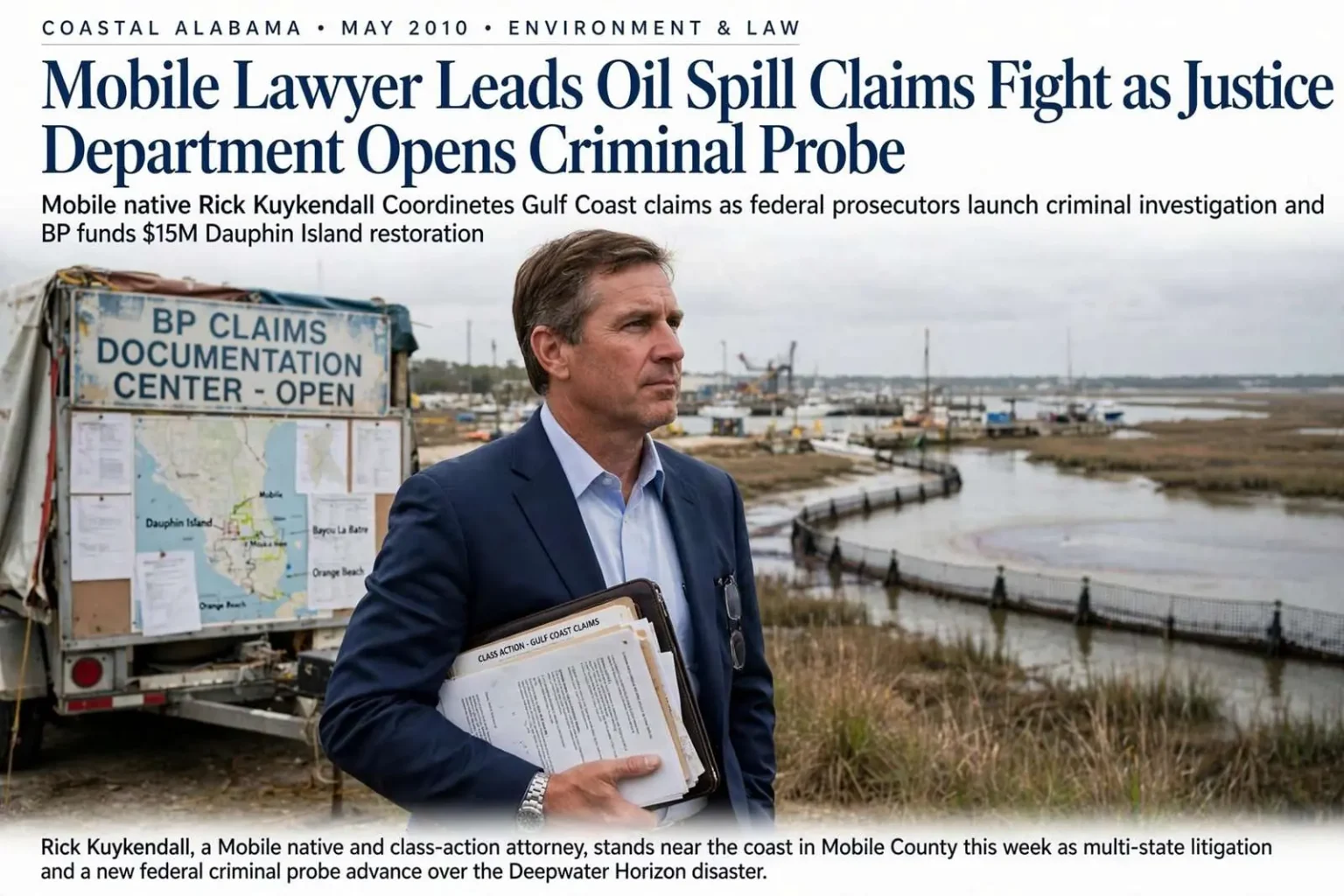
The legal and regulatory response to the Deepwater Horizon disaster moved into a new phase this week, with a Mobile native taking a leading role in the fight over compensation, federal prosecutors opening a criminal investigation, and BP agreeing to pay for a coastal restoration project off Dauphin Island. Three separate threads of the same catastrophe — private litigation, criminal enforcement, and emergency environmental work — advanced at once, and each of them passed through coastal Alabama.
A Mobile Native at the Center
Rick Kuykendall, a Mobile native and class action attorney, topped a national news network’s list of “Friday’s most intriguing people.” The 55-year-old lawyer was working with attorneys from Louisiana, Alabama, Texas, Pennsylvania, Mississippi and Florida to prosecute claims on behalf of those harmed by the spill. The coalition mirrored the geography of the damage: five Gulf states and beyond, every one of them with residents whose livelihoods depended on waters the oil had not yet reached or had already fouled.
“I have prepared my entire professional life for this,” Kuykendall told the network. “But I never expected it to happen in my back yard.” Since 1995, Kuykendall said, his cases have produced verdicts and settlements totaling more than $2 billion. Class action work on that scale is rare, and lawyers who practice it spend careers waiting for the case that defines them. For a Mobile native, the defining case arrived at home — in the bays, bayous and beaches he had grown up around.
The claims landscape was, at that point, only beginning to take shape. Shrimpers, oystermen, charter captains, rental agents, restaurant owners and hotel operators from Bayou La Batre to Orange Beach were documenting losses from a season that had been erased before it began, and the question of who would pay, how much, and how quickly would occupy the courts for years.
The damage was different in kind for each of them. A shrimper lost the season’s catch and the market that would have bought it; a charter captain lost bookings from anglers who would not fish waters shown on television streaked with oil; a rental agent lost a summer of reservations in a single news cycle. Proving those losses — separating the spill’s effect from bad weather, bad economy and ordinary seasonality — was the work that lay ahead of the attorneys assembling in Mobile.
Justice Department Opens a Criminal Investigation
U.S. Attorney General Eric Holder announced that the Justice Department had launched a criminal investigation into the well blowout. Holder emphasized that 11 workers died in the rig explosion and said the government intended to prosecute anyone found responsible. The statutes he identified as potentially in play included the Clean Water Act, the Oil Pollution Act, the Migratory Bird Treaty Act, and other federal environmental criminal provisions.
Each statute carried its own theory. The Clean Water Act attaches penalties per barrel discharged; the Oil Pollution Act governs liability for cleanup and damages; the Migratory Bird Treaty Act criminalizes the killing of protected birds, which oiled marshes and waters were producing in unknown numbers. A criminal case would turn on what companies knew before the blowout and whether their decisions in the well’s final hours crossed from negligence into something a prosecutor could charge.
The announcement had an immediate practical side effect on the coast, where residents and reporters had grown accustomed to a steady flow of technical information from BP about the containment effort. That flow slowed noticeably once criminal exposure entered the picture. Companies under investigation — and their lawyers — say less. Every statement, email and measurement became potential evidence, and the daily briefings that had framed the disaster’s first weeks grew thinner.
The move drew mixed reactions along the Gulf. “Whether or not you agree with the political implications of Holder’s threats, this seems to be a strange point in the oil spill mitigation process for the Federal government to be threatening the very people who are controlling the operations,” one coastal resident observed. “We can only hope that the oil industry executives can stay focused on the emergency.”
The worry was practical, not sentimental. Fifty days into the disaster, the well was still leaking, and the men and women managing the containment effort were the same people the criminal case would eventually scrutinize. Some residents feared that prosecutors, however justified, might slow the very response the coast depended on; others answered that accountability was the only thing that would keep the next well from failing the same way. Both camps were watching the same news with the same oil offshore.
Closing Katrina Cut
BP agreed to fund the $15 million closing of Katrina Cut, the breach that Hurricane Katrina tore through the western end of Dauphin Island in 2005. The cut had left a gap in the island’s barrier, and closing it was intended both to restore Dauphin Island closer to its more recent natural state and to reduce a pathway through which oil could move into Mississippi Sound and the marshes and oyster reefs behind the island.
The engineering logic was straightforward. With the cut open, tidal currents and the coming summer’s winds could carry oil through the breach and into the sound, where it would reach the seagrass beds, oyster leases and marsh shorelines that are far harder to clean than a sand beach. Filling the cut built sand where the island had been whole before 2005 and, at the same stroke, put a barrier between the open Gulf and the waters behind it.
For Dauphin Island, a community of a few thousand permanent residents that depends on tourism and fishing, the project represented one of the few pieces of good news in a bleak spring. The town had spent five years arguing with state and federal agencies about how, whether and at whose expense the cut should be closed. The spill settled the argument overnight — by creating a funding source with an urgent reason to close it.
It also raised a question that would recur repeatedly along the coast in the months ahead: how much of what BP was funding constituted genuine environmental restoration, and how much constituted emergency defense of a shoreline the company’s well had put at risk. The distinction mattered for the record, for the eventual legal accounting, and for a public trying to judge whether the company’s spending reflected responsibility or strategy.
The Wider Stakes
Fifty days into the spill, coastal Alabama was absorbing damage on several fronts at once — closed fishing grounds, cancelled beach reservations, oiled marsh, and a claims process that thousands of families would be forced to navigate. The season that was supposed to sustain Bayou La Batre’s docks, Orange Beach’s marinas and the island’s summer rentals had instead become a season of filings, estimates and waiting.
The legal machinery now assembling in Mobile and along the Gulf would determine, over years rather than months, how much of that damage would be made whole. Federal court in Mobile would sit at the center of it — the natural venue for a disaster whose epicenter lay just south of the bay and whose plaintiffs lived along every road from the Causeway to the coast. The criminal case, the private claims, and the restoration spending that had begun with Katrina Cut were separate tracks. For the people of coastal Alabama, they added up to a single question, asked daily in the spring of that year: who pays, and when.
How a Claims Fight Actually Works
The claims process that residents faced in those first weeks was run by BP under pressure from the government, and it paid out on documented losses while the larger legal structure took shape around it. Shrimpers and charter captains carried stacks of paperwork — licenses, landing records, booking calendars, tax returns — to trailers set up along the coast, and many were asked to accept quick payments in exchange for signing away future claims. Whether those early settlements were fair became one of the central fights of the years that followed, and the class action attorneys assembling in Mobile were the counterweight to the fine print.
Class actions exist for exactly this situation: thousands of small claimants, each with a loss too modest to litigate alone, facing a defendant with unlimited resources. Kuykendall’s coalition of Gulf Coast and national plaintiffs’ firms pooled the cases, the evidence and the costs. The specialist work — economists modeling a fishery’s lost seasons, marine scientists tracing where the oil actually went, accountants reconstructing a restaurant’s summers — would be shared across the entire class rather than duplicated client by client.
The venue mattered too. Mobile’s federal courthouse had handled the region’s major maritime and environmental litigation for generations, and the judges there were practiced in managing cases involving the port, the shipyards and the offshore industry. A disaster of this size would generate thousands of filings, consolidated proceedings, and years of pretrial work — all of it close to the communities whose losses were at stake.
What the Coast Was Watching
Through it all, the well itself remained the clock every other question ran on. Until it was capped, each day added barrels, each barrel extended the cleanup, and each week of bad television footage erased another month of the tourism calendar. The criminal investigation, the civil claims and the restoration spending all fed on the same uncertainty — which is why the slowing flow of technical information from BP irritated people so much. Information about the well was the closest thing the coast had to a forecast of its own future.
Kuykendall’s comment that he had prepared his whole life for a case he never expected in his back yard captured the strangeness of the spring. The attorneys, the prosecutors, the engineers and the fishermen were all working, in their separate ways, on the same event — an event that had turned a stretch of the Gulf they knew intimately into a legal and scientific case study. The verdicts, settlements and restoration projects that would follow were years away. The losses they were meant to answer were accumulating by the tide.