Connie Hudson’s $7 Million ‘Pay As You Go’ Program Spreads Paving Across Mobile County
Mobile County Commissioner Connie Hudson's 2012 'Pay As You Go' road program totaled $7 million, with nearly $3 million directed to projects inside the city of Mobile, including a new roundabout.
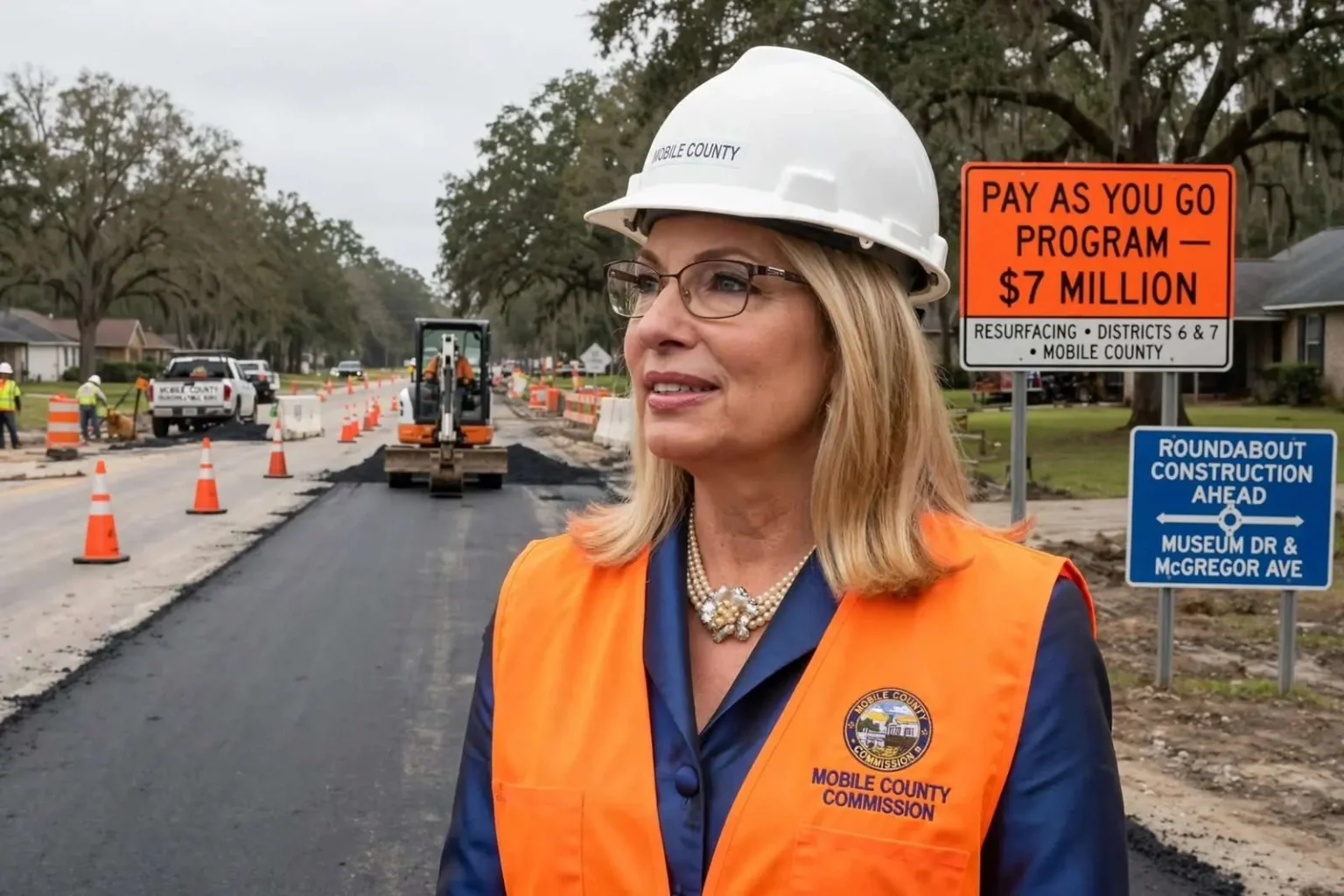
Mobile County Commissioner Connie Hudson’s 2012 “Pay As You Go” road paving program totaled $7 million, including almost $3 million for projects inside the city of Mobile, spreading resurfacing work and a marquee intersection project across several city council districts.
The program stood out for both its size and its structure. Seven million dollars is serious money for road work even in a county as large as Mobile County, and directing nearly half of it into the city limits — where the county commission does not control the streets but partners with municipal governments — made the initiative visible to commuters who might otherwise never notice county government at work. For the neighborhoods whose streets made the list, the program promised something tangible: fresh pavement after years of patching.
Where the Money Went
The biggest winners in the city allocation were Mobile City Council Districts 6 and 7. District 6 received $872,750 for 33 different projects, a sum spread across a long list of streets in need of attention. District 7 was awarded more than $1.4 million, nearly half of which was earmarked for a single, high-visibility undertaking: the installation of a “roundabout” at the intersection of Museum Drive and McGregor Avenue.
Both districts cover some of the city’s most heavily traveled residential territory in the western and southwestern parts of Mobile, where decades of growth have left neighborhoods with long inventories of aging streets. Thirty-three separate projects in District 6 meant the money reached deep into the district — short segments of residential street rather than one long corridor — the kind of work residents judge the fastest, since it is visible at the end of the driveway.
The remaining districts drew smaller shares. District 5 received $160,000 and District 4 received $125,000. A complete list of the funded projects accompanied the announcement, giving residents a street-by-street view of where the paving dollars would land.
That transparency was itself part of the program’s design. Road funding decisions invite suspicion — every neighborhood believes its street is the worst in the county — and publishing the project list allowed council members, neighborhood associations and individual residents to see the allocations and hold them up against the paving needs they had reported. In a county where paving requests routinely exceed available money by a wide margin, the published list doubled as a public accounting of what a $7 million program can and cannot do.
The Logic of ‘Pay As You Go’
The program’s name pointed to its underlying philosophy. Rather than borrowing against future revenue to fund road work all at once, a “pay as you go” approach directs available cash toward projects as the money comes in, avoiding the long-term debt and interest costs that can accompany bond-financed construction.
The tradeoff is speed versus flexibility. Bond issues let a government resurface hundreds of miles in a single ambitious program, but they mortgage a decade of revenue to lenders and commit future commissions to repayment schedules regardless of what the economy does. Pay-as-you-go programs move slower — each year’s work limited to that year’s cash — but every dollar goes to asphalt rather than interest, and the county retains the freedom to redirect money when priorities change. For a county juggling many demands on limited funds, the model offered a way to keep chipping away at a perpetual backlog of deteriorating roads.
Road maintenance is among the most tangible services county government provides. Potholes, crumbling shoulders and worn pavement touch nearly every resident’s daily commute, and the allocation of paving dollars is watched closely by neighborhoods that have waited years for their turn.
A Roundabout in the Spotlight
The single largest item, the Museum Drive and McGregor Avenue roundabout, stood out both for its cost and its design. Roundabouts had been gaining favor among traffic engineers as a way to keep vehicles moving while reducing the severity of collisions, and the decision to devote a substantial portion of District 7’s allocation to the project signaled confidence in that approach at a busy Mobile crossing.
The intersection sits in the heart of west Mobile’s traffic grid, where McGregor Avenue carries commuter volumes through a corridor lined with schools, churches and medical offices, and Museum Drive connects the Spring Hill area to the arterials that funnel traffic toward Airport Boulevard and Interstate 65. Crossings like that one see the collisions roundabouts are designed to prevent: T-bone crashes at signalized intersections, the kind that send drivers to emergency rooms and tie up traffic for an afternoon. By replacing signal cycles with a circulating yield, a roundabout trades the worst crash types for fender-benders at low speeds, while eliminating the idling that comes with waiting through red lights.
Their adoption has been slower in the South than in other parts of the country, where drivers sometimes greet the first roundabout in their area with confusion. Engineers counter with the data: modern roundabouts move more traffic per hour than signals at the same volumes, cut injury crashes dramatically, and cost less to maintain than signal equipment over a lifetime. Once the first roundabout in a community operates smoothly, public resistance typically fades — which is why communities that build one often keep building more.
A Countywide Reach
By pairing routine resurfacing across dozens of streets with a headline intersection improvement, Hudson’s program tried to balance breadth and impact — fixing many small problems while tackling a larger one. The distribution across multiple council districts also reflected the political and practical realities of dividing finite dollars among competing needs.
That balancing act defines county commission work everywhere, but it carries particular weight in a county as sprawling as Mobile’s. The county covers territory from the Mississippi line to Dauphin Island, taking in unincorporated communities, small towns and the state’s second-largest city, each with distinct infrastructure needs. Rural roads face different failures than urban ones — drainage, shoulders, low-traffic pavement that ages slowly but expensively — and commissioners must weigh city-partnership projects like these against the unincorporated roads their own districts count on them to maintain.
Cooperative projects inside the city also illustrate how the layers of Alabama local government interlock. Cities own and maintain their streets, but county governments control substantial road funds, and agreements that direct county money to municipal resurfacing stretch the value of both budgets. The arrangement requires the commission, the city council and the mayor’s administration to coordinate project lists and schedules — a negotiation that succeeds most often when the benefits, as here, spread across several council districts rather than clustering in one.
For the drivers who navigate Mobile County’s roads every day, the $7 million program promised smoother pavement in the near term and, in the case of the roundabout, a rethinking of one intersection’s flow. It was the kind of local investment whose value is measured less in speeches than in the daily experience of getting from one place to another.
The program also set a template for later years. By publishing a complete project list, concentrating enough money on a single transformative intersection to make a real engineering difference, and holding the line on debt, the 2012 pay-as-you-go effort gave Mobile County a working model: modest, patient, transparent — and, for the neighborhoods that finally saw their streets repaved, exactly the government service they had been asking for.
What Paving Dollars Actually Buy
Residents sometimes underestimate what resurfacing costs and why backlogs stretch for years. Paving is priced by the mile and by the condition of the road beneath: a street that only needs an overlay of fresh asphalt costs a fraction of one whose base has failed and must be rebuilt. Deferred maintenance compounds the problem — a road left too long degrades from cheap repair to expensive reconstruction — which is exactly the cycle pay-as-you-go programs are designed to interrupt. Spreading $7 million across dozens of small projects reflects that arithmetic, targeting streets while they still qualify for the cheaper fix.
The work also ripples through local commerce. Delivery trucks, school buses and commuter traffic all pay the cost of rough pavement in vehicle repairs and lost time, and real estate agents hear the question “how are the roads?” from buyers comparing neighborhoods. Cities that visibly maintain their streets send a signal of stability that supports property values, which is why paving lists are as closely read in Realtor offices as in city halls.
The County-City Partnership Factor
Directing county funds into city projects also required the kind of intergovernmental goodwill that pays dividends beyond any single program. Mobile County and the City of Mobile share roads, drainage systems, bridges and emergency services across jurisdictional lines, and a commission willing to invest in city streets builds the trust that later cooperation depends on. For their part, city council members who steer county money into their districts can point to results their constituents feel under their tires.
Programs like the 2012 effort also illustrate the quiet importance of the county commission in city residents’ lives. Many voters cannot name their county commissioner, yet the commission’s decisions shape their commutes, their storm preparedness and their tax bills. A $7 million paving program that shows up on dozens of familiar streets makes the county’s role concrete — asphalt, it turns out, is one of the most effective forms of civic explanation.
When the resurfacing crews moved from the list to the neighborhoods in the years that followed, the measure of the program was simple: streets that no longer rattled, corners that no longer flooded with every rain, and an intersection at Museum Drive and McGregor that moved traffic the way engineers had promised. For a program built on paying its own way, those were the returns that mattered.