A Greased-Pig Chase: Making Sense of Mobile’s Slippery Budget Fight
As dueling committees, a $29 million disputed deficit and shifting council alliances collided, Mobile's budget saga looked to many residents like a greased-pig chase with the numbers impossible to pin down.
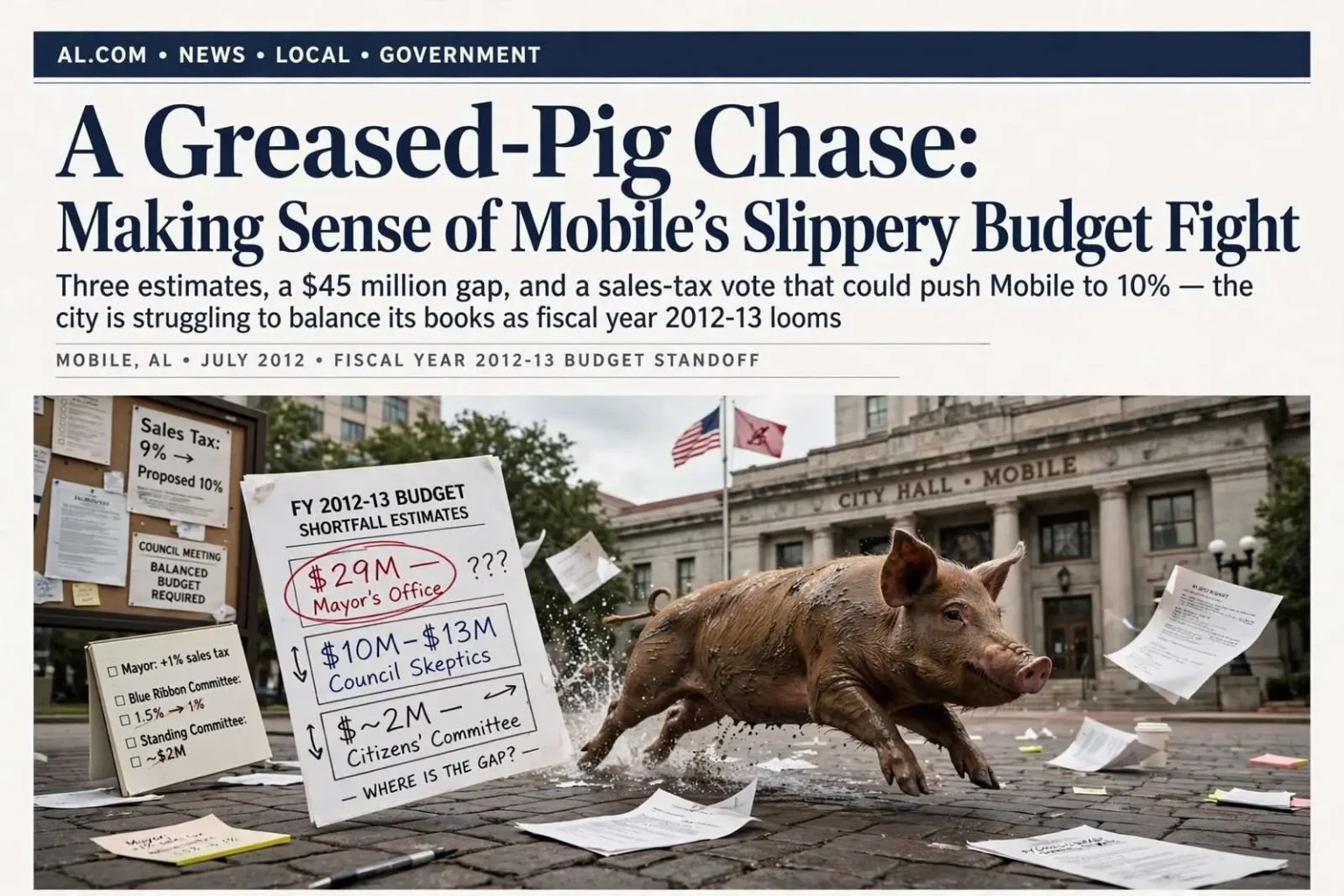
To the average citizen, the city of Mobile’s production of “As the Budget Turns” must have seemed like a greased-pig chase — the numbers so slippery that nobody could get a grip. As the new fiscal year approached, elected officials and respected community leaders found themselves disagreeing by tens of millions of dollars over how much money the city actually needed.
The disagreement was not a dispute over a rounding error. Depending on which estimate one accepted, Mobile faced either a crisis demanding a major tax increase or a modest gap manageable through trims — and the people offering the two answers were the mayor and council on one side and a series of citizen committees on the other, all reading the same ledgers.
The Mayor’s Position
The logical place to begin was the mayor’s office, since Mayor Sam Jones was responsible for presenting a balanced budget for the City Council’s approval. Jones’ administration said it had cut, conserved and delayed as much as it could and still faced a projected $29 million shortfall for fiscal year 2012-13. His remedy was a temporary reinstatement of an additional one percent sales tax, which would have lifted the total tax on purchases within the city to 10 percent, a rate consistent with many municipalities across Mobile and Baldwin counties.
The administration’s case rested on the arithmetic of its own budget review: after years of holding the line on spending, the remaining gap could not be closed without new revenue. The one-percent proposal was framed as temporary, tied to the shortfall rather than made permanent, and the mayor’s office pointed to the surrounding region — where 10 percent combined rates were already common — as evidence that the increase would not price Mobile’s retailers out of the market.
Counting the Votes
Most council members began as skeptics of the mayor’s doom-and-gloom forecast. Over time, Council President Reggie Copeland and William Carroll eased close to the Jones camp and its call for the tax. Joining the mayor’s most ardent allies, Fred Richardson and Jermaine Burrell, those moves advanced Jones to within a single vote of the $30 million annual boost the tax represented.
But the last mile can be the hardest. Councilwoman Bess Rich was never in play. That left Councilman John Williams, who signaled he was even further out of reach than Rich, and Councilwoman Gina Gregory, whose earlier turn as the “swing vote” was probably not her fondest memory. The skeptics, lacking the mayor’s resources, pegged the deficit closer to the $10 million to $13 million range — a gap of $16 million to $19 million from the administration’s figure that many households would find less than confidence-inspiring.
The arithmetic of the council made the standoff durable. Four votes for the tax, three firm against, and three members whose positions would decide the question — with each deciding vote carrying its own political cost, given that municipal elections were less than a year away.
Committees Upon Committees
At the impasse, Copeland appointed a blue-ribbon committee of community leaders to study city finances. That Copeland alone named all its members immediately drew suspicion of a rubber stamp. Instead, the panel did not simply endorse the one percent tax; it initially recommended a temporary 1.5 percent increase — $45 million a year — to address both the near-term shortfall and long-deferred infrastructure needs, before ultimately settling on the more muted $30 million figure in line with the mayor.
Then a second, standing committee was suggested and adopted by most council members, excluding the mayor’s amen corner. Its members — Page Stalcup, Paul Wesch, Bill Ishee, Ken Germany, John Thompson, C.J. Small and Richardson, who appointed himself — carried real credentials. The early word was that there was no real deficit at all, or one so small as to be negligible, perhaps $2 million.
Two committees, two directions, and a third number — roughly $2 million — that contradicted both. By the time the standing committee’s early findings circulated, the city had three credible estimates of its own shortfall: the mayor’s $29 million, the council skeptics’ $10 million to $13 million, and the citizens’ panel’s barely-there $2 million.
The Politics of It All
So the city arrived at a remarkable spread: elected officials and experienced men and women of business disagreeing by as much as $45 million on the revenue needs for a fiscal year just weeks away. Complicating matters, Wesch, who chaired the standing committee, had advocated a half-percent sales tax over three years to generate $45 million dedicated to economic development incentives — money to help Mobile compete for as many as 10 major employers expected to supply Airbus, with rivals from Pensacola to Biloxi also in the hunt.
Wesch’s position made the debate doubly confusing for the public: the same chairman questioning the deficit was also proposing a tax of his own, but for growth rather than gap-filling. The distinction mattered to the parties involved — one tax would backfill the operating budget, the other would seed an incentive fund aimed at the supplier boom expected to follow the Airbus assembly line — but to a taxpayer hearing “one percent” and “half a percent” from competing camps, the effect was of a city that wanted more money and could not agree on why.
With municipal elections less than a year away, every vote carried political risk, and Gregory again loomed as the likely swing vote. Her earlier stint as the decisive vote on a contentious issue had left a mark, and council watchers speculated that the budget fight would end not with a bold swing but with the smallest workable agreement.
In the end, the saga boiled down to the same thing legislative politics always does: compromise. Whether the parties could find middle ground — perhaps splitting a three-year, half-percent tax between economic development and the city’s capital needs — remained the open question as the council prepared to meet.
What the Fight Was Really About
Beneath the numbers, the dispute was a fight over credibility and control. A mayor who inherited a budget strained by recession-era revenue losses argued that only the administration had tallied the true cost of deferred maintenance, understaffed departments and drained reserves. Council skeptics countered that a projected deficit is not a discovered fact but a forecast, and that administrations facing tax votes have every incentive to present the gloomiest plausible number. The citizen committees — one appointed by the council president, one adopted by the council itself — existed precisely because neither branch’s numbers could be taken on faith by the other.
The Airbus stakes sharpened the argument. The decision to bring the aircraft maker’s first U.S. assembly line to Mobile had set off a scramble to prepare the region for the employers and workers expected to follow, and every municipality from Pensacola to Biloxi was courting the same suppliers. A dedicated incentive fund, in Wesch’s telling, was how Mobile avoided losing those plants to a competing Gulf Coast address — and the half-percent tax was how the fund got financed. The council skeptics, focused on the operating shortfall, worried about layering a new tax for development on top of a debate about whether the city needed one for basics.
The fiscal year deadline imposed its own discipline. Whatever the true number, the city could not begin a new budget year without a balanced plan, and the council’s scheduled meeting represented the last practical opportunity to pass one. That arithmetic — not the committees, not the forecasts — would force the votes to be counted.
For residents, the practical stakes were printed on every receipt: whether Mobile’s combined sales tax rate would rise from 9 percent toward the 10 percent that surrounding municipalities already charged, and if so, for how long, and for what. The greased-pig chase of estimates would end one way or another at the council table — with a tax, a trimmed budget, or the kind of split-the-difference deal that municipal politics usually delivers when the calendar runs out.
A City and Its Budget, Line by Line
Part of what made the budget fight so hard to follow was the structure of the document itself. A city budget is hundreds of line items — salaries, fuel, contracts, debt service, capital projects — and a dispute over totals can hide a dozen smaller disputes inside it. The mayor’s $29 million figure reflected not a single hole but an accumulation: revenue that had not recovered from the recession, expenses that had grown with the city’s obligations, and years of one-time fixes that had pushed the problem forward rather than solved it.
The council skeptics, in pressing their $10 million to $13 million estimate, were making a point about method as much as magnitude — that a forecast built by the branch asking for the tax deserves independent scrutiny, and that the difference between $29 million and $12 million is the difference between a tax increase that is unavoidable and one that is merely convenient. The standing committee’s near-zero estimate pushed that argument to its logical extreme, and in doing so made compromise harder, not easier: it is difficult to meet in the middle when the middle itself is contested.
The 10 percent comparison carried its own political weight. Retailers along the state line and in the suburbs watch tax rates closely, and a Mobile rate matching the region’s ceiling was framed by the administration as competitive neutrality — shoppers were already paying it elsewhere in the two counties. Opponents treated the same fact in reverse: that Mobile’s slightly lower rate was one of the city’s remaining retail advantages, and that surrendering it to fill a deficit that might not exist was a trade the council had no business making on the mayor’s forecast alone.
As the council prepared to meet, the City of Mobile’s summer-long budget serial had already delivered its lessons: that the council president’s blue-ribbon panel would surprise the people who expected it to rubber-stamp, that a citizens’ committee could undercut both branches at once, and that the true size of the city’s deficit would remain, to the end, a matter of whose numbers one believed. What remained was the vote — and whatever compromise the calendar forced before the new fiscal year began.