Shelby Says Water War Talks Yielded Progress as Drought Grips the Southeast
U.S. Sen. Richard Shelby said a Nov. 1 meeting with governors and federal officials eased the immediate threat to Alabama's downstream water supply, including cooling water for the Farley Nuclear Plant.
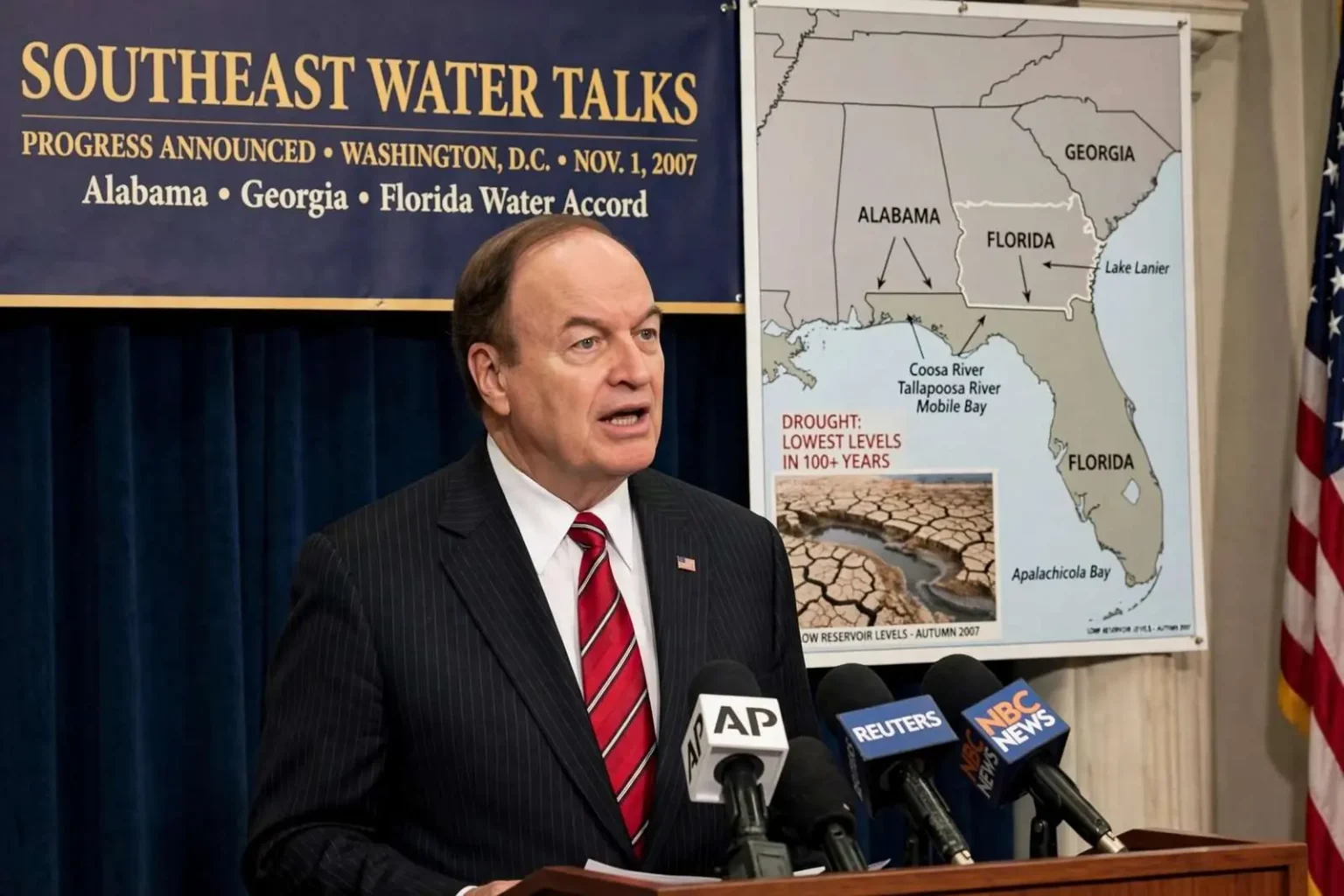
With the Southeast in the grip of what he called the worst drought in more than a century, U.S. Sen. Richard Shelby said talks he convened in Washington had produced the first real movement toward an accord in the long-running “water wars” among Alabama, Georgia and Florida. Following a summer of record heat and a crippling lack of rain, reservoirs and lakes across Alabama, Florida, Georgia and other southeastern states had fallen to extraordinarily low levels. The shortage battered businesses, agriculture, tourism and recreation, and it sharpened an interstate dispute that had been simmering for decades.
The drought that autumn was not an abstraction for anyone living in the Mobile Bay region. Water levels on Alabama Power’s lakes along the Tallapoosa and Coosa rivers, on the Tombigbee, and in the streams feeding the Mobile-Tensaw Delta dropped to levels residents had rarely seen. Boat ramps dangled above dry ground, shallow-draft routes turned treacherous, and wells ran low in rural parts of south Alabama. Georgia communities faced strict outdoor watering bans, while Florida watched with alarm as freshwater flows into the Apalachicola River system dwindled.
Shelby, who was then Alabama’s senior senator, treated the gathering crisis as more than a weather story. In his view, the drought had exposed a structural flaw in how the Southeast shared its water — a flaw written into federal decisions made decades earlier and never fully reconciled with the growth of metropolitan Atlanta.
The dispute in brief
For years, the three states had fought over the flow of water out of federal reservoirs around Atlanta. Those reservoirs were built by the federal government to serve citizens along the waterways in all three states. But as metropolitan Atlanta boomed, Georgia reallocated water toward its own needs. Georgia asked the U.S. Army Corps of Engineers, which manages the reservoirs, to sharply limit water releases from Lake Lanier — one of the impoundments that feeds downstream Alabama — despite the fact that Atlanta-area water supply was never among the authorized purposes for which the reservoirs were built.
Lake Lanier, impounded in the 1950s by Buford Dam on the Chattahoochee River northeast of Atlanta, was conceived in an era when the Corps of Engineers’ mission was flood control, navigation, hydropower and recreation. City water supply was added only as a secondary accommodation over the years, a point Alabama officials had pressed in courtrooms and hearing rooms for a generation. As Atlanta’s suburbs spread north and east toward the lake, the demand placed on Lanier and neighboring reservoirs grew far beyond what the original project documents contemplated.
Two river basins anchored the fight. The Alabama-Coosa-Tallapoosa system, known as the ACT, carries water from the north Georgia mountains down through the Coosa and Tallapoosa rivers into the Alabama River, which joins the Tombigbee near Calvert to form the Mobile River. The Apalachicola-Chattahoochee-Flint system, the ACF, runs along the Georgia-Alabama border, feeds the Farley plant’s reach of the Chattahoochee near Dothan, and ends in Apalachicola Bay, Florida, where oyster harvests depend on the freshwater balance of the estuary.
Shelby said he opposed the request outright. “I understand the needs of the citizens of Atlanta, but I cannot support any changes that adversely impact our residents, who are clearly in a similar position,” he said. Alabama’s position, in his telling, was not a rejection of Atlanta’s growth but a demand that the federal government hold the reservoir system to the purposes Congress actually authorized when the dams were built.
‘People versus mussels’ — and a nuclear plant
Georgia had framed the fight as a choice between people and endangered mussels and sturgeon downstream. Shelby rejected that framing, pointing to consequences that had nothing to do with wildlife. The Farley Nuclear Plant near Dothan, he noted, depends on water flowing in the Chattahoochee River for adequate cooling. “If Farley shut down, the region’s power grid would be at risk.”
The Farley plant, a two-unit nuclear station operated by Alabama Power on the Chattahoochee in Houston County, had been part of the state’s generating mix since the 1970s and 1980s, and it supplied a substantial share of the electricity used across the Wiregrass and the Florida Panhandle. A sustained reduction in river flow could force output curtailments at the very moment an overheating, drought-stressed region was running air conditioners around the clock. Shelby’s argument gave Alabama’s position a hard, industrial edge in a dispute often reduced to environmental abstractions.
That edge resonated in south Alabama, where freshwater matters to more than power plants. The flow running down the Alabama and Tombigbee systems into the Mobile-Tensaw Delta and Mobile Bay shapes salinity, oyster reefs, shrimp and the estuary that underwrites the coastal economy. In dry years, saltwater pushes farther up the bay and into the delta, stressing the oyster beds that centuries of harvests have depended on and altering the nursery conditions that shrimp and many sport fish require. Commercial fishermen in Bayou La Batre and Coden, and the processors and dealers who depend on their landings, had long argued that upstream decisions made in Atlanta were felt most sharply at the end of the pipe.
Downstream in Florida’s panhandle, the same argument applied with even greater force. Apalachicola Bay had built its reputation — and much of its economy — on oysters harvested where the river meets the Gulf, and biologists there had warned for years that reduced freshwater flows would push salinity into a range unfavorable to the reefs. The “people versus mussels” slogan, critics said, conveniently ignored that the endangered species at issue were indicators of river health that all three states shared.
Alabama’s case also carried a navigation component. The Corps of Engineers was charged with keeping the Alabama River navigable for barge traffic serving ports and industries in Selma, Montgomery and points beyond, and with maintaining depths that shippers had planned around for decades. Reducing releases from upstream reservoirs to stretch Atlanta’s supply threatened that mission, Alabama officials argued, just as surely as it threatened farms and power generation.
The Nov. 1 meeting
Shelby said he hosted a meeting on Nov. 1 with the senators and governors of both Georgia and Alabama to address the Corps’ pending decision and other disputes inflamed by the drought. The governors then met with Florida’s governor and the leaders of several federal agencies to take up the specific question of how much water should flow to Alabama and Florida from federal reservoirs such as Lakes Allatoona and Lanier.
Lake Allatoona, a Corps reservoir on the Etowah River northwest of Atlanta, had become a secondary battleground in the drought. Birmingham’s water supply, drawn from the Locust Fork and the Cahaba River system, stood apart from the immediate dispute, but the Coosa River’s flow into Alabama depended on how much the Corps released from Allatoona and the upstream dams of the ACT basin. Every gallon Georgia held back north of the state line was a gallon not available to Weiss Lake, the Coosa’s hydropower operations, and the municipalities along the river in east Alabama.
Afterward, Interior Secretary Dirk Kempthorne announced that while flow from Lake Lanier would be reduced, the cut would not be deep enough to disrupt downstream activities. The Corps also acknowledged that Atlanta’s withdrawals from Lake Allatoona had exceeded its allowed amount.
“This decision will allow Farley Nuclear Plant to remain operational, and the recognition of Atlanta’s excessive water use will allow the Corps to determine a short term solution to relieve Alabama,” Shelby said, adding that he hoped the Corps would correct the Allatoona overdraw in the near future.
The announcements did not settle anything permanently, but they changed the tone. For the first time in the drought, the federal agencies managing the reservoirs had publicly conceded that Georgia’s consumption had outrun its entitlement, and the reduction in Lanier releases was calibrated to keep downstream users — including Farley, municipal intakes, and the oyster industry’s estuary — inside workable limits. Alabama officials described the outcome as evidence that sustained, high-level engagement could extract concessions that years of paperwork and formal comment periods had not.
The meeting also demonstrated the political weight Alabama could bring to the table. With Shelby chairing a powerful Appropriations subcommittee, the Corps of Engineers and the Department of the Interior were institutions whose budgets and leadership his committee touched directly, and Georgia’s senators and governor understood that the state’s complaints would be heard in rooms where funding decisions are made. That leverage, aides acknowledged, mattered as much as any legal argument in moving the Corps to act.
No quick fix
Shelby was careful not to declare the conflict resolved. “It is unrealistic to believe this problem will be solved tomorrow,” he said. But with the region suffering through its worst drought in more than 100 years, he argued, neighboring states had no choice but to work together. “Alabama’s farmers, residents and business are just as much in need of that water as are people and industry in Atlanta,” he said.
Framing the issue as a shared regional hardship rather than a zero-sum fight, he suggested, offered the best chance of avoiding “the kind of heated rhetoric we have seen in recent weeks.” The rhetoric had, in fact, been heated. Georgia’s governor had pressed the federal government for maximal conservation of reservoir water, Alabama’s governor had demanded compliance with the reservoirs’ authorized purposes, and Florida had threatened litigation to protect Apalachicola Bay. Editorial pages in all three states traded accusations, and the word “water war” — coined decades earlier when the states first tried to negotiate compacts — returned to everyday conversation.
Alabama’s drought conditions that season went well beyond the headline reservoirs. Pastures had browned across the Black Belt, hay supplies for winter cattle feeding had thinned, and farm agencies in south and central Alabama reported crop losses in fields planted with no reasonable expectation of the rain that never came. Water utilities in fast-growing suburbs north of Birmingham and along the I-65 corridor issued conservation advisories. Lake levels on the Tennessee-Tombigbee waterway affected barge drafts, and marina operators across the state watched their businesses dry up along with the shorelines.
Ultimately, he conceded, only rain would end the hardship. “However, if we fairly allocate the water we have now, we can minimize this drought’s effect on everyone. Furthermore, if we can arrive at an equitable distribution of the rain that eventually falls, we can hopefully negate the effects a future drought might have on future generations.”
That argument — that allocation rules written in a crisis would outlast the crisis itself — became the core of Alabama’s long-term position. The state’s officials argued that the Southeast could not afford to treat each drought as a fresh emergency negotiated from scratch, with the outcome dependent on whoever held the microphone that year. A durable framework, grounded in the authorized purposes of the federal reservoirs and in the water needs of the entire basin, was the goal the talks in Washington pointed toward.
The tri-state water dispute would continue in federal court and in negotiations for many years after 2007, but the autumn drought marked the moment it moved from a lawyers’ argument to an immediate crisis for utilities, farmers and coastal fisheries alike. For Alabama, the episode established two principles its officials would carry into every later round: that the federal reservoirs around Atlanta were built for purposes that did not include unlimited suburban water supply, and that the state’s downstream needs — from Farley’s cooling water to the oyster reefs of Mobile Bay — were economic facts, not environmental footnotes.