Sales Tax Hike Falls 3-3-1 as Mobile Council Rejects Jones, and Layoffs Loom
Buried under hundreds of angry emails and calls, Mayor Sam Jones's penny sales tax died in a 3-3-1 vote on Tax Day. As many as 300 city jobs are now in question.
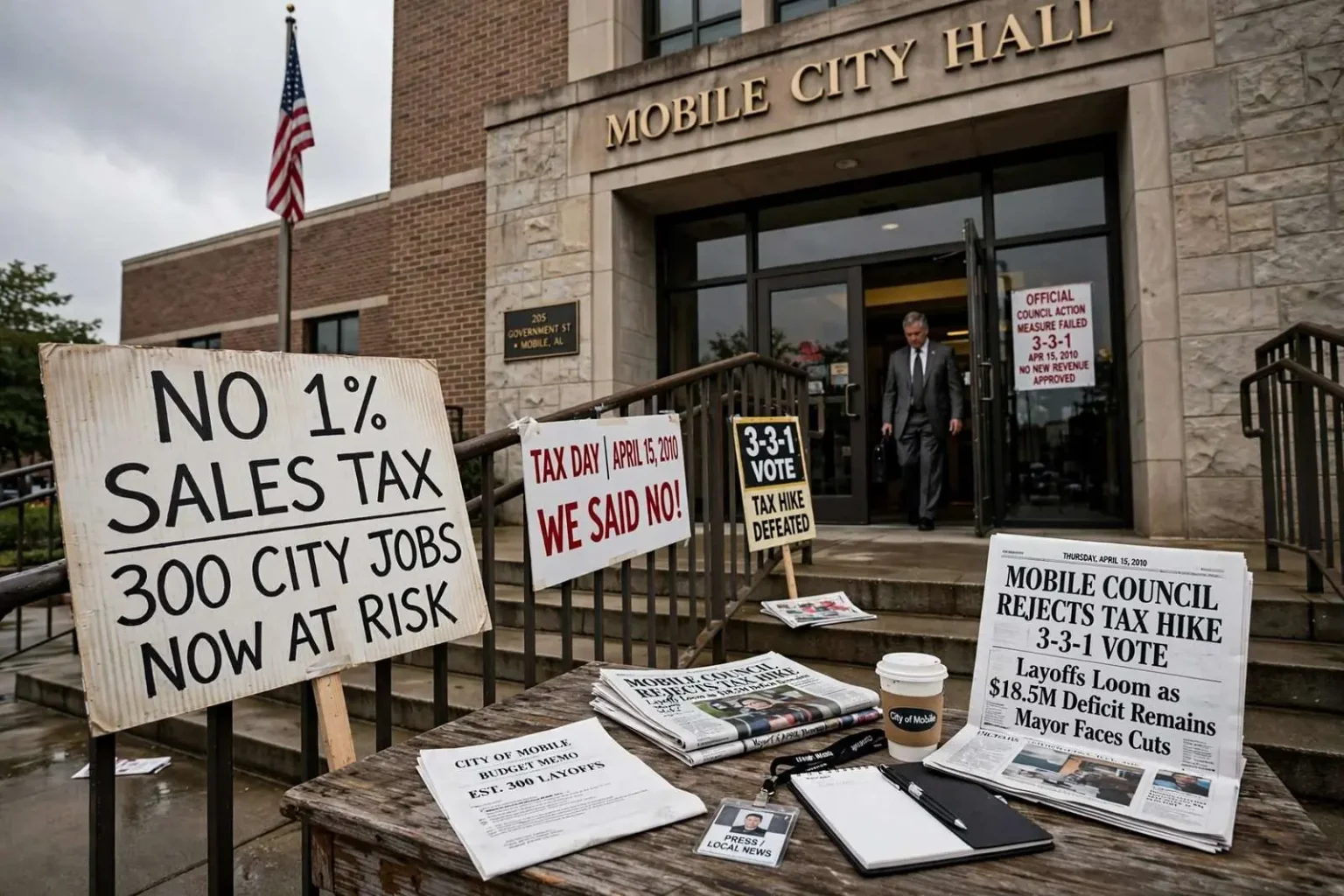
Mayor Sam Jones’ proposed one-percent sales tax increase failed Thursday in a 3-3-1 vote of the Mobile City Council, drowned in a red-hot flood of opposing emails and telephone calls. The defeat leaves the city facing an $18.5 million deficit in its $205 million fiscal 2010 budget with no new revenue, no approved cuts and, by the mayor’s own accounting, no option left but layoffs — as many as 300 from a workforce of about 2,550.
The swing vote hears from home
Councilwoman Gina Gregory, who had emerged as the pivotal vote as the debate progressed, said the backlash was “overwhelming.” Hundreds upon hundreds of calls and messages arrived, she said, and “99.9 percent” of them opposed raising the city sales tax from four percent to five percent. It was not physically possible to answer them all before the council’s specially called 8 a.m. vote Thursday. But, she said, she got the message.
Council President Reggie Copeland believed he had the five votes required under Mobile’s super-majority rule when he called the meeting. Anti-tax residents organized like minutemen, firing off emails and phone calls in a counterattack that repelled the increase — on Tax Day, April 15, appropriately or ironically.
How it broke down
But for the super-majority requirement, the tax would have passed on a simple 4-3 majority: Copeland, William Carroll, Jermaine Burrell and Fred Richardson in favor; Gregory, Connie Hudson and John Williams opposed. In the event, Carroll abstained once it became clear his vote would not be decisive.
He said he wanted the sunset provision to repeal the tax entirely on Sept. 30, 2011, rather than roll it back to a half-percent for another year with the council revisiting it later.
An irony in the charter
Mobile’s present form of government was created 25 years ago as a strong council and weak mayor. In practice it has functioned the other way around for most of that time. Thursday was an exception.
The super-majority requirement — five of seven votes for nearly everything — was written in to protect the interests of a minority. In 1985 that minority was understood to be Mobile’s black community and the three black council members; the rule guaranteed that no measure could pass without at least one of them. On Thursday the minority protected by that clause was a different one entirely: the taxed-enough-already faction, whether card-carrying tea partiers or simply residents who had had enough.
Many of today’s anti-tax voters were once critics of the super-majority provision. Politics can be funny that way.
Where now?
Copeland has suggested a blue-ribbon committee of business leaders to study the problem. The assignment is daunting: close an $18.5 million gap without increasing revenue or reducing expenses. Barring magic, any such committee would almost certainly return with some combination of cuts and new revenue — the same menu the council just rejected.
The likeliest survivor of the wreckage is the garbage collection fee. Carroll had previously advanced a $17.53 monthly charge, only to see it discarded as insufficient financially and politically. Copeland, oddly, seems nearly as opposed to a garbage fee as Jones is to layoffs. The last time Mobile charged one, for about six months in the mid-1990s, exemptions were granted widely enough to reduce the revenue and to spark grumbling about favoritism. Copeland is the only current council member who was there. Without him, a garbage-fee proposal would likely meet the same fate as the sales tax.
The mood at City Hall
Whatever Jones’ expression conveyed Thursday morning — anger, disappointment, disgust, or all three — his abrupt exit conveyed finality. He has now seen both of his proposals rejected: first to cut expenditures, then to raise revenue. His body language placed the blame on the council. The council would not agree.
Councilwoman Hudson noted that she had said last summer the city should face financial reality rather than confront a fully involved budget fire in the spring. City workers, facing deep operating cuts and having narrowly escaped a 10-percent pay cut, are angry.
Residents are on high alert about City Hall reaching deeper into their pockets during a recession. The relationships among the council members and the mayor’s office are, in the language of the bomb squad, several unexploded devices sitting in the same room.
Most likely, after a break for wound-licking, the parties will reconvene and agree to another budget operation performed with a scalpel rather than an axe. If Thursday’s demeanor was not a passing pique but a sign of hardball to come, Mobile could be in for an ugly stretch.
Two precincts close as the cuts begin
The fallout from Thursday’s vote arrived almost immediately. Effective 5 p.m. Friday, April 16, the Mobile Police Department closed its Fourth Precinct and the Martin Luther King Mini Precinct, city officials confirmed, the first concrete service reduction tied to the budget standoff.
In a statement issued the day before the closures, Jones said he had tried to avoid forced layoffs of hundreds of city employees and cuts to city services, but that without the additional revenue the sales tax increase would have provided, both were now unavoidable.
On the day of the vote, Fire Chief Stephen Dean said he had sent home 19 employees who were working overtime, ended firefighters’ food allowance, took engines 18, 20 and 21 and ladder truck 24 out of service, and closed Station 21 on Stimrad Road, which he said averaged about 25 runs a month. Police Chief Micheal Williams said that to avoid layoffs and pay cuts he was looking first at giving up leased space and moving roll call for the Fourth Precinct on Moffett Road and the MLK mini-precinct to the Second Precinct off Airport Boulevard.
What happened next
The standoff lasted less than three weeks. On May 4, 2010, after Gregory agreed to support the increase in exchange for a council resolution calling for an outside efficiency review of city operations, the council approved the one-cent tax 5-2, with Williams and Hudson opposed. The increase took effect June 1, 2010, and was scheduled to expire Sept. 30, 2011.
The “temporary” penny outlasted that deadline. The council extended it more than once, and in 2018 voted to keep it in place through 2023, with the money directed largely to road repairs, drainage and parks.