Council Votes 5-2 for Sales Tax Increase, Ending Six Weeks of Political Theater
Mobile's council approved a one-cent sales tax increase on a 5-2 vote. An analysis of how Mayor Sam Jones got what he wanted, what Gina Gregory extracted in return, and what might have been.
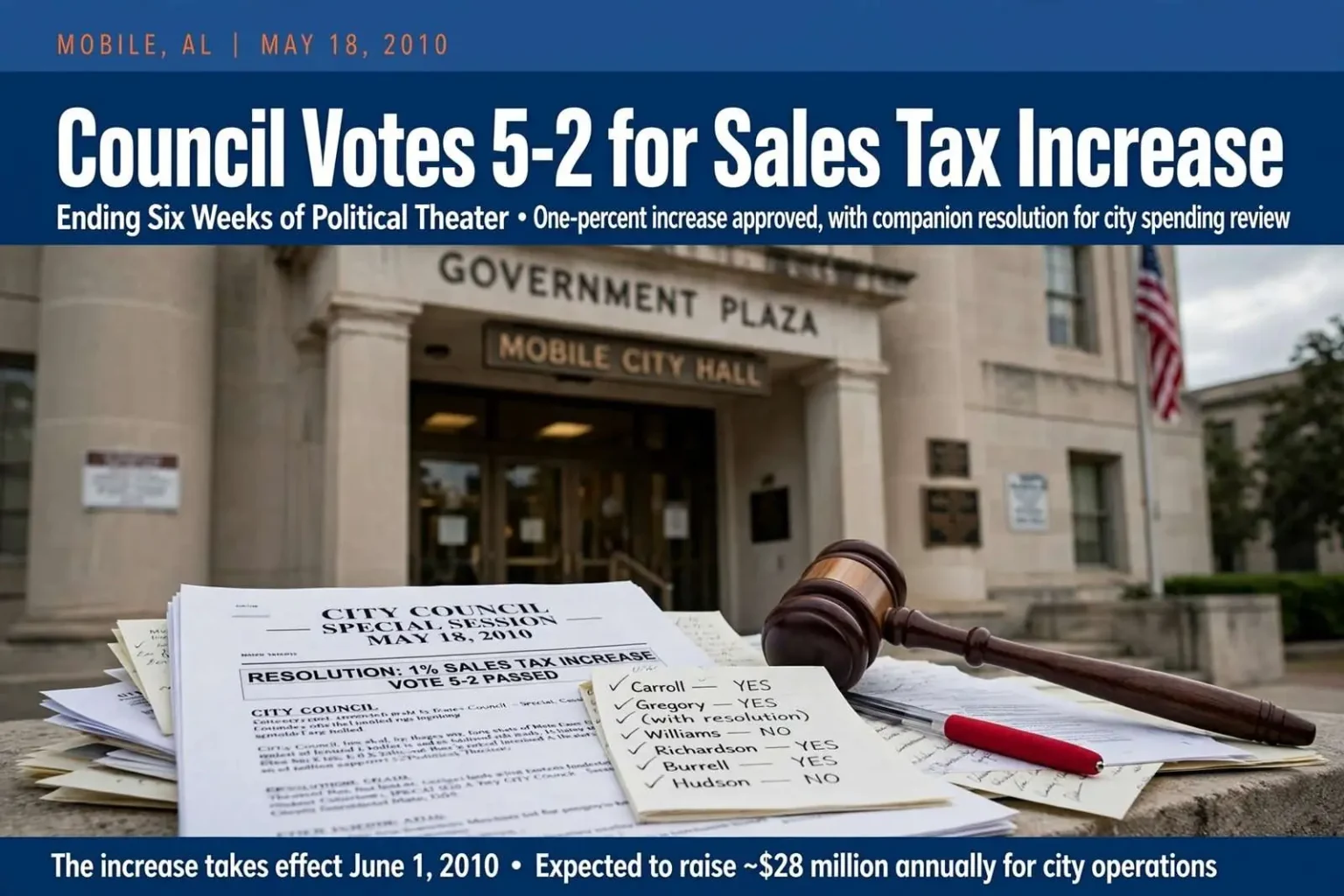
When it was over, the result was exactly what the shrewder observers at Mobile’s City Hall had expected all along: the mayor’s call for a full one-percent sales tax increase — roughly $28 million a year — carried the City Council on a 5-2 vote. Six weeks of political theater, and no charge for admission.
The Room
Councilman John Williams was disappointed — in leadership at City Hall at every level, in the anonymous emails that arrived because he would not go along, and in his inability to persuade colleagues that a large sales tax increase would ultimately harm the city, city workers included.
Councilman Fred Richardson was disappointed too, but for the opposite reason: the $35-40 million, 16-month increase was not the $65-70 million, 28-month version he preferred. Still, he said, it was a start toward the city getting its house in order.
Councilwoman Gina Gregory urged residents to understand that the companion resolution — a hard look at city spending — signaled that business as usual at City Hall was ending.
Others spoke at length, with varying purposes: concern, nostalgia, humor. A tip of the hat is owed to Councilman Jermaine Burrell, uncommonly succinct on this occasion. His remarks in their entirety: “Let’s vote.” Mayor Sam Jones said nothing at all.
How the Mayor Got There
The play was obvious, and artfully executed. The budget “crisis” was not, to the people on the upper floors of Government Plaza, much of a surprise. Only the naive failed to suspect as far back as last summer that it was coming; the budget adopted then simply did not add up.
Councilwoman Connie Hudson called it at the time what it turned out to be: “a prelude to a tax increase.” Jones opened not with the tax but with a 10 percent across-the-board pay cut for city employees. That proposal did two things. It was a genuine austerity measure, and it delivered hundreds of police officers, firefighters and their families to City Hall to participate, vigorously, in the political process. Having awakened that constituency, the mayor then announced that a one-cent sales tax increase would do the job instead. He was transformed from villain to hero in a twinkling — and the decision, he noted, belonged to the council. The mayor proposes; the council disposes.
The Vote Count
The council members were then caught between city workers on one side and taxpayers and the business community on the other. Hudson was a known quantity at one end of the spectrum, Richardson at the other. Williams, temperamentally and philosophically, was unlikely to support a tax increase, particularly with recent annexations giving his District 4 a tea party tint. Finance chairman William Carroll was a wild card, though few believed he would ultimately defy Jones. Council President Reggie Copeland quarterbacked for the mayor. The rookie Burrell was glad to be there. That left Gregory, exactly where the nose-counters had placed her.
Who Blinked
The consensus reading is that Jones won and Gregory gave way. Inside City Hall, some saw the reverse. Jones balked — and was animated in his objection — at Gregory’s insistence on a written resolution setting out a plan to study, assess and tighten city operations.
A written document was unnecessary, the mayor argued, since he already agreed with the substance. Gregory’s position was take-it-or-leave-it: there would be a resolution adopted by the council to memorialize a plan for bringing city spending to heel, or there would be no fifth vote.
The mayor ate his vegetables before he got his dessert. He got the $36 million; she got a public, written commitment to an efficiency review. That he regarded the study as an offensive concession suggests the council’s super-majority requirement may yet be a burr under his saddle.
What Might Have Been
There is an old maxim in politics: figure out early where you are going to land on a hard vote, and get there. Don’t play Hamlet. Gregory’s marathon of deliberation left her with political work to do, though few doubt she is equipped to do it, and she is likely a shrewder and tougher politician for the experience.
Had she held, the outcome might have looked different. The administration’s fallback, most believed, was a genuine compromise: a temporary half-cent increase paired with a 5 percent employee pay cut and a 10 percent reduction in compensation for the council, the mayor and senior administrators. That would have been a setback for Jones, but a survivable one. The layoff threat — 300 or more of the city’s roughly 2,500 employees — functioned as leverage, and possibly as bluff.
The council’s anti-tax bloc may not have fully grasped that the leverage was theirs. Political damage from mass layoffs would have fallen on every elected official at City Hall, but it would have fallen hardest on the mayor. More than half of those laid off would have been city residents and voters, with families and neighbors, and no amount of deflection would have made the explanation ring true a second time. At several points in the negotiations Jones dropped his poker face long enough to suggest, in word and body language, that layoffs were not truly on his table. Had Gregory called him, the city might have found out.
What Now
The tax takes effect and, as approved, expires Sept. 30, 2011. Whether it actually does — or whether the city returns to the same argument next summer — depends on an economy nobody at City Hall controls, and now on the unknown reach of an oil spill in the Gulf.
What happened next
The increase took effect June 1, 2010, raising the sales tax inside the city limits to 10 cents on the dollar, with 5 cents going to the city, 4 to the state and 1 to the county. The companion resolution Gregory insisted on passed 7-0, calling on Jones to work with the Mobile County Personnel Board on rules giving the city more flexibility with its workforce and to bring in an outside group to evaluate the efficiency of city operations.
The Sept. 30, 2011, sunset did not end the tax. The council extended the “temporary” penny more than once, and in 2018 voted to keep it through 2023, with the money directed largely to road repairs, drainage and parks.