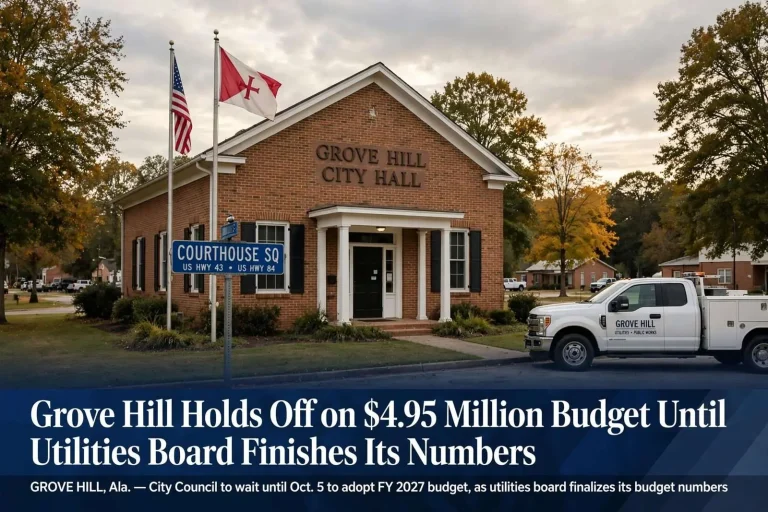
Grove Hill Revives a Forgotten Truck Ordinance as Council Pursues Street and Water Grants
Grove Hill will again enforce a long-dormant ordinance barring through-truck traffic on city streets, while the council pursues nearly $900,000 in grants for street resurfacing and replacement of aging lead water lines.
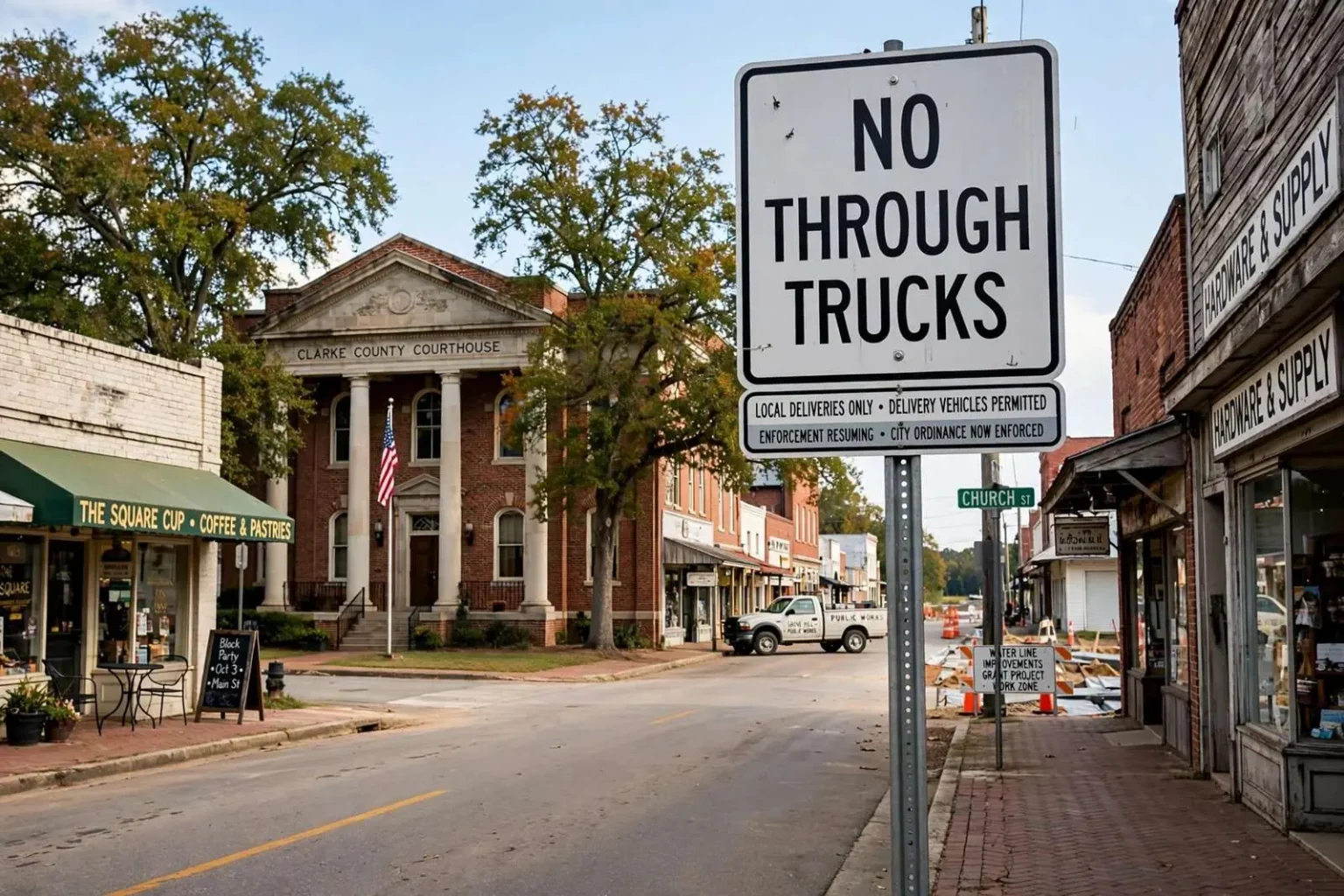
An ordinance that has been on the books in Grove Hill for years – but that had quietly fallen out of use – is about to have teeth again. The Clarke County seat will resume prohibiting through-truck traffic on its city streets, restoring an enforcement practice that appears to have lapsed when the warning signs came down several years ago.
How the Ordinance Resurfaced
The matter came before the city council at its Monday meeting, raised jointly by Mayor Ross Wood and Police Chief Daniel Gibson. A review prompted by inquiries from residents established an unusual situation: the law prohibiting truck traffic still existed, but the signage that made it enforceable and visible had apparently been removed at some point in the past, and the ordinance had been largely forgotten or ignored ever since.
Signs will now be erected and enforcement of the ordinance will begin.
What the Rule Actually Covers
Mayor Wood was careful to define the scope narrowly. The prohibition targets through-truck traffic – that is, trucks that have no business in Grove Hill itself but are using city streets as a shortcut, or in some cases as a means of evading law enforcement and weigh stations.
Critically, the ordinance excludes delivery vehicles. Trucks with a legitimate destination inside the city – serving stores, restaurants, construction sites and residents – are not affected.
“We are not trying to limit anyone from working,” Wood said, adding that heavy trucks damage city streets that were never engineered to carry the loads that state highways and interstates are built to handle.
The engineering point is not trivial. Pavement damage rises steeply with axle weight, and a single fully loaded tractor-trailer can impose the equivalent stress of thousands of passenger cars. Municipal streets, typically built with thinner base layers than state routes, deteriorate quickly under repeated heavy loads. Rerouting through-traffic onto highways designed for it is one of the least expensive things a small city can do to protect its paving investment.
Two Major Grant Applications
In other business, the council reported that the city is pursuing substantial outside funding for infrastructure.
Street resurfacing. Grove Hill is applying for a $500,000 Delta Regional Authority grant to resurface Church Street from DuBose Avenue northward to B Street. The city’s required match would be $31,300 – a favorable ratio for a municipality of Grove Hill’s size. Rebuild Alabama funds will separately pave Church Street from B Street northward to A Street, meaning the two funding streams together would address a continuous stretch of the corridor.
Water lines. The city and the utilities board are jointly applying for $400,000 in grants to improve water lines in the Wilson Hall area, including 4-H, Ezell, Portis and Ray streets. The project would:
- Replace older lead piping with PVC
- Increase the diameter of the water lines
- Install fire hydrants in the area
The utilities board has agreed to cover the local match of $118,575. Replacing lead service lines has become a national priority as federal rules tighten around lead in drinking water, and the added benefit of larger-diameter mains is improved fire flow – which is precisely why new hydrants are part of the same package. Fire protection in a neighborhood is only as good as the water volume the mains can deliver.
Other Council Actions
Approved the permanent hiring of Jeffery Roberts in the public works department.
Approved the promotion of Grove Hill Police Department Cpl. Haley Horton to sergeant.
Agreed to comply with a recently passed state act allowing retired state, county and municipal employees to receive a one-time lump sum payment. For Grove Hill’s retirees, that amounts to $3,211 each.
Approved a request from The Square Cup, a Main Street business, to hold its annual block party on the street on Oct. 3. The street will be closed to through traffic for the event.
Approved $4,200 for repairs to the senior center.
Discussed reducing pool hours on weekdays once schools resume in early August. Weekend hours will remain unchanged, and the pool will stay open through Labor Day.
Complimented Grove Hill Chamber of Commerce Director Laken Nix for coordinating the city’s America’s 250th celebration.
What Comes Next
Residents should expect new signage to appear at the approaches to town, marking the truck restriction and giving drivers notice before enforcement begins in earnest. Truckers accustomed to cutting through Grove Hill will need to find another route.
The next Grove Hill City Council meeting is scheduled for Aug. 3.
The Broader Context for a Small City
Grove Hill, as the county seat of Clarke County, carries responsibilities that smaller towns in the region do not. The courthouse, the utilities board and the cluster of county offices concentrate traffic and services in a compact downtown, which makes the condition of city streets a direct concern for both residents and the institutions that serve them. Restoring the truck ordinance is a low-cost way for the city to protect that core infrastructure.
The grant pursuits reflect a common strategy for rural Alabama municipalities: leveraging federal and state programs to fund work that local tax bases could not comfortably cover alone. The Delta Regional Authority, which supports communities across the Mississippi Delta and adjacent regions including parts of Alabama, is a frequent source of such assistance, and the favorable local-match ratios make the applications attractive even for small cities.
Why Water-Line Work Matters
The proposed water-line improvements touch on a national conversation about lead in drinking water. Older service lines containing lead are present in communities across the country, and replacing them is both a public-health measure and, increasingly, a federal compliance requirement. By pairing the lead-line replacement with larger mains and new hydrants, Grove Hill is addressing drinking water and fire safety in a single project – a practical alignment of two needs that often compete for the same dollars.
Civic Life in Grove Hill
The council’s agenda also illustrates the texture of small-town governance, where infrastructure, personnel, celebrations and a single Main Street block party all share the same meeting. The America’s 250th recognition, the senior center repairs and the pool schedule are the everyday items that, taken together, define the quality of life in a place like Grove Hill. Residents who want a voice in any of them can do so at the next council meeting, where public comment remains part of the process.
Grove Hill, the county seat of Clarke County in southwest Alabama, sits at the intersection of U.S. 43 and Alabama 84. The town of roughly 1,300 residents serves as the commercial and governmental center for the surrounding rural county, with the Clarke County Courthouse and a cluster of small businesses anchoring the downtown.
The Delta Regional Authority is a federal-state partnership that supports economic development in counties across the Mississippi Delta and adjacent regions, including parts of eight states. Alabama has received DRA funding for road, water and community development projects in qualifying counties, with grant sizes often in the range of several hundred thousand dollars for infrastructure improvements in smaller municipalities.
Rebuild Alabama is the state’s infrastructure program funded by the gasoline tax increase enacted in 2019. The program distributes funds to cities and counties for road and bridge projects using a formula that considers population, road mileage and other factors. Many smaller Alabama municipalities rely on Rebuild Alabama allocations as a steady source of road funding.
Lead service line replacement has become a national priority as federal drinking water rules have tightened. The U.S. Environmental Protection Agency’s Lead and Copper Rule revisions require water systems to inventory lead service lines and replace them on accelerated schedules. The work is expensive, and many small water systems depend on grant funding to make it feasible.
The Square Cup, the Main Street business referenced in the council’s approval of the October 3 block party, is one of several locally owned shops and restaurants that anchor Grove Hill’s small downtown. Block parties and street closures have become a familiar tool for Main Street communities seeking to draw visitors and create a sense of place. The October date positions the event to capitalize on cooler weather and the broader fall festival calendar across southwest Alabama.
Pool hours at municipal pools in small Alabama towns often follow the local school calendar, with reduced weekday hours once summer break ends and full weekend hours through Labor Day weekend. The arrangement reflects both operating budgets and the reality that families rely on public pools more during the day when school is out. The council’s decision to maintain weekend hours gives residents continued recreational options into early fall.
Clarke County, in southwest Alabama, has been one of the slower-growing counties in the region, with population trends reflecting the broader rural Alabama experience of modest decline or stable population in many communities. Grove Hill’s investments in infrastructure and amenities reflect an effort to maintain quality of life and attract new residents despite the demographic headwinds. The combination of state and federal grants that the council is pursuing will help stretch local dollars further.