

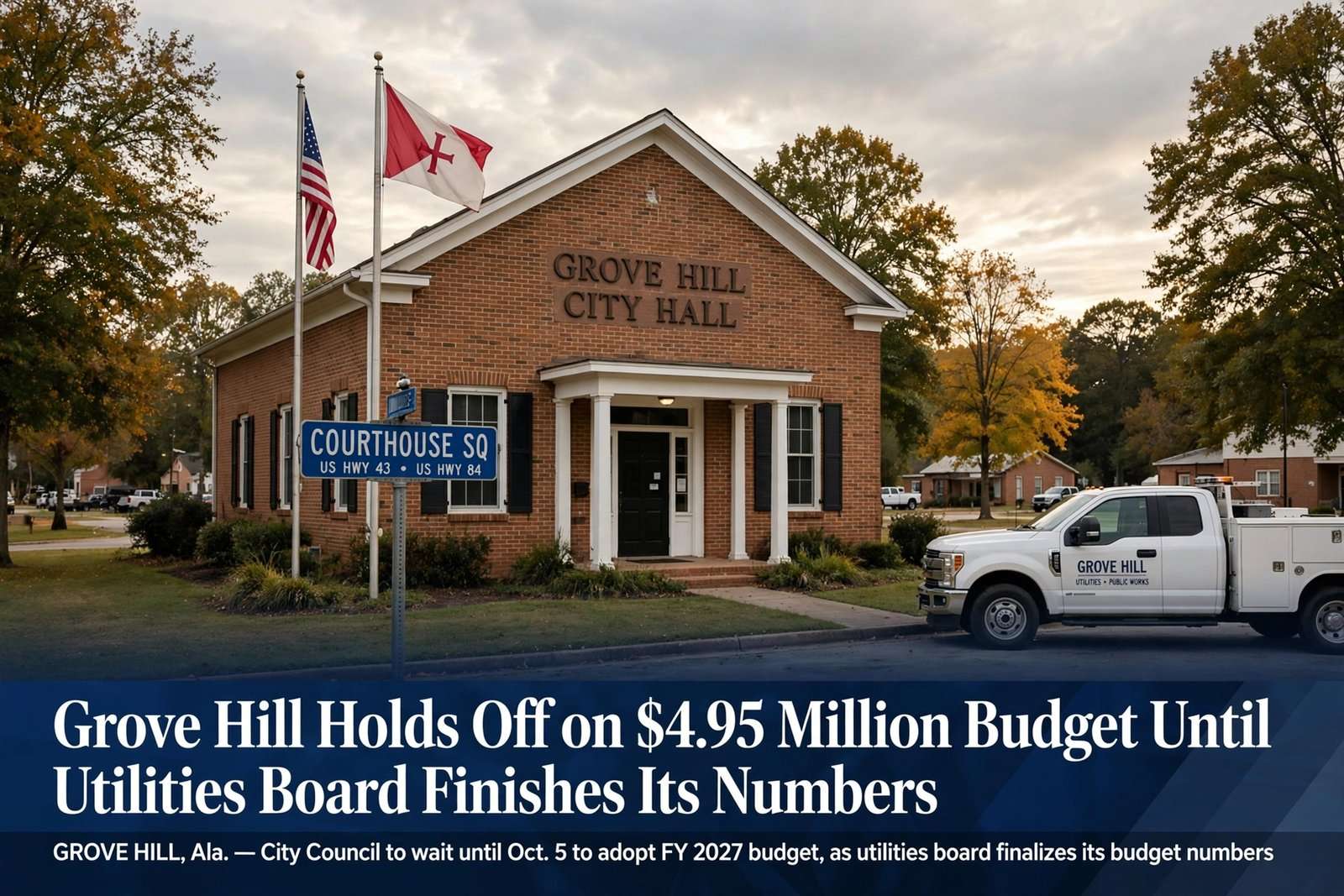
GROVE HILL, Ala. — The Grove Hill City Council has a spending plan for the new fiscal year in hand but will wait until its Oct. 5 meeting to adopt it, holding off until the city’s utilities board finishes work on its own budget.
Council members reviewed a proposed $4.95 million general budget for fiscal year 2027 during their Sept. 21 meeting. The plan projects total revenues of about $4.95 million and a surplus of roughly $138,000, along with pay raises for city employees and higher allowances for fuel.
Mayor Ross Wood said the proposal reflects an overall increase of about 3% compared with the previous year’s budget.
Why the vote is waiting
Like many small Alabama towns, Grove Hill operates its utilities through a separate board, and the city’s finances and the utility’s finances are closely linked. Council members chose to hold the final vote until the utilities board completes its numbers so the two spending plans can be considered together.
Alabama cities and towns operate on a fiscal year that runs from Oct. 1 through Sept. 30, so the new budget year began before the council’s scheduled vote. Municipal governments in that situation commonly continue operating under the prior year’s spending levels until a new plan is formally adopted, and a short delay of a few weeks is not unusual when a related board is still finalizing its figures.
What is in the proposed budget
The draft plan builds in modest inflation adjustments across city operations rather than large new programs. Highlights include:
- Total budget: About $4.95 million for fiscal year 2027
- Projected surplus: About $138,000
- Overall growth: Roughly 3% over the prior year, according to Wood
- Fuel: A 4% increase for anticipated gasoline and diesel purchases, reflecting higher fuel prices
- Other expenses: A 2% increase factored in for most remaining costs
- Employee pay: A 3% raise for city employees
- Minimum pay: Raising the few employees earning less than $15 an hour to at least $15
A $15 pay floor
The council’s effort to bring its lowest-paid workers up to $15 an hour stands out in a state with no minimum wage of its own. Alabama is one of a handful of states without a state minimum wage law, which means the federal minimum of $7.25 an hour applies. Many public employers in rural Alabama have nonetheless raised starting pay in recent years to compete for workers with private employers, retailers and larger nearby cities.
Only a few city employees were earning below the new $15 threshold, according to the budget discussion, so the change carries a relatively small cost while setting a baseline wage for the city’s workforce. Combined with the 3% across-the-board raise, it represents the largest people-related change in the proposed plan.
Fuel costs
The extra cushion for fuel reflects the reality that a small city’s vehicles, from police cruisers to street and sanitation equipment, run on gasoline and diesel every day. Setting aside 4% more for those purchases, compared with 2% for most other line items, is meant to keep the city from running short if prices remain elevated through the year.
Other business: jail costs, movies in the park and boots
Beyond the budget discussion, the council handled a series of agreements, contributions and routine items at the Sept. 21 meeting.
Housing prisoners at the county jail
The council signed an agreement with the Clarke County Commission setting a $25 daily cost for housing city prisoners in the county jail. Small municipalities often do not operate their own jails, and instead pay the county to hold people arrested by city police until they are released or their cases move forward. A fixed daily rate gives the city a predictable way to budget for those costs.
Movies at Hudson Park
The council approved a licensing agreement that will allow the city to show an unlimited number of movies at Hudson Park for $989 a year. Federal copyright law generally requires a public performance license to show films to the public, even when admission is free, and umbrella licenses of this kind let cities, libraries and other groups screen titles from participating studios without arranging rights for each film one at a time.
The idea was first raised by the public library, and Wood said the library may participate with the city in the effort. Outdoor movie nights have become a popular, low-cost community event in towns across the region, and an annual license gives the city flexibility to schedule screenings throughout the year.
Help with work boots
City employees will receive $100 a year toward a pair of boots purchased through Cintas, the uniform and workplace supply company. Employees will be responsible for any amount above $100. Safety footwear is a common requirement for municipal workers in street, utility and maintenance jobs, and the allowance helps offset that out-of-pocket expense.
Community contributions
The council approved several contributions to local organizations:
- An annual $2,000 contribution to the Regional Child Advocacy Center
- An annual appropriation of $5,000 to the Grove Hill Arts Council
- A $500 contribution to the Log a Load Foundation’s golf tournament in Chatom, which benefits the Ronald McDonald House
Child advocacy centers provide a coordinated, child-friendly setting where law enforcement, prosecutors, child protective services, medical providers and counselors work together when children are suspected victims of abuse. Regional centers serving rural counties depend on support from the cities and counties in their service areas.
The Log a Load program is a longtime fundraising effort by the forestry and logging community. It is a natural fit for Clarke County and neighboring Washington County, where Chatom is the county seat and timber has long anchored the local economy. Ronald McDonald House Charities provides lodging and support for families staying near hospitals while their children receive medical treatment.
Building permit
The council also approved a building permit for Jamie Mazingo for his property on Deerfield Trail.
About Grove Hill
Grove Hill is the county seat of Clarke County, in the heart of southwest Alabama’s timber belt along U.S. Highway 43 and U.S. Highway 84. The city is home to the Clarke County Courthouse and serves as a government and commercial hub for the surrounding rural area.
The city’s general budget covers core services such as police, streets, parks and administration. Decisions about water, sewer and other utility service run through the utilities board, which is why its budget timeline affects when the council can wrap up its own work.
What happens next
The council is scheduled to take up the fiscal year 2027 budget for final approval at its Oct. 5 meeting, once the utilities board has finalized its plan. If adopted as proposed, the budget would put the 3% raises and the $15 minimum pay rate into effect for city employees and set the city’s spending priorities for the year ahead.
Residents who want to weigh in on the budget can attend the council’s Oct. 5 meeting or contact city hall before the vote.