

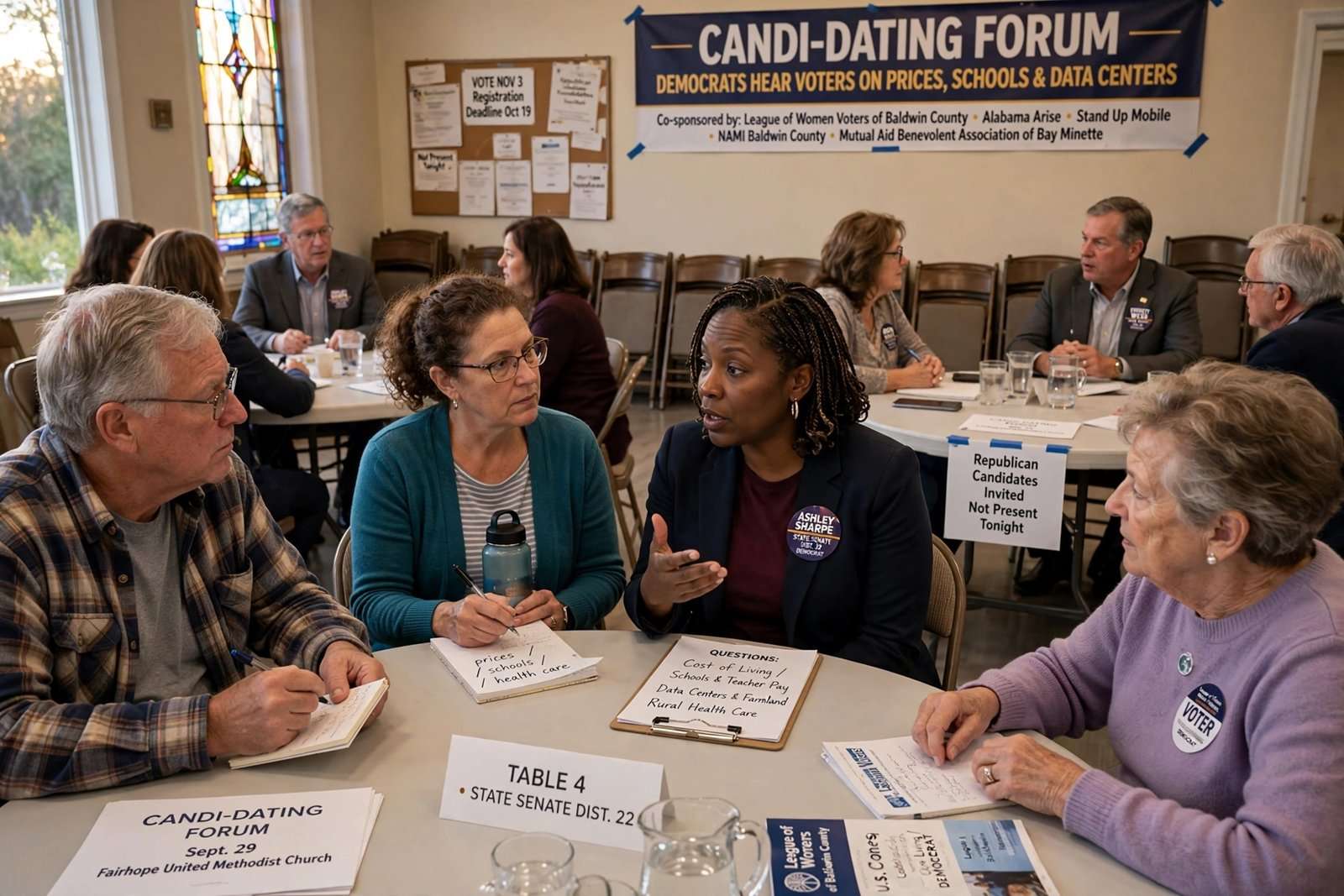
FAIRHOPE, Ala. — Affordability dominated the conversation Tuesday night, Sept. 29, as Baldwin County voters sat down with candidates for federal, state and local offices at a “candi-dating” forum at Fairhope United Methodist Church, about five weeks before the Nov. 3 general election.
The event borrowed its format from speed dating. Instead of standing at podiums, candidates rotated from table to table, spending a few timed minutes with each small group of residents before moving on. Voters asked their own questions, and candidates answered across the table rather than from a stage.
Five organizations co-sponsored the forum: the League of Women Voters of Baldwin County, Alabama Arise, Stand Up Mobile, NAMI Baldwin County and the Mutual Aid Benevolent Association of Bay Minette. A representative of the League of Women Voters of Baldwin County said candidates on both the Republican and Democratic tickets were invited. The candidates who took part in contested races were Democrats; their Republican opponents did not attend, and one sent word that she had a scheduling conflict.
Who was there
- U.S. Senate: Democratic nominee Everett Wess. His Republican opponent, U.S. Rep. Barry Moore, did not attend.
- 1st Congressional District: Democratic nominee Clyde Jones. Republican nominee and former U.S. Rep. Jerry Carl did not attend.
- Commissioner of Agriculture and Industries: Democratic nominee Ron Sparks. Republican nominee Corey Hill did not attend.
- State Senate District 22: Democratic nominee Ashley Sharpe. Republican nominee Terry L. Waters did not attend.
- State Senate District 32: Democratic nominee Janet Appleby, who is challenging incumbent Republican Sen. Chris Elliott.
- State House District 96: Democratic nominee Terri Osborne. Republican nominee Danielle Duggar could not attend because of a scheduling conflict.
- Unopposed candidates: State Sen. Vivian Davis Figures, a Mobile Democrat who represents District 33, and Fred Hardman, the Republican nominee for the Baldwin County Board of Education’s District 6 seat.
Affordability at nearly every table
Across races and tables, the most common theme was the cost of living, along with questions about how government pays for health care, public schools and veterans’ benefits.
Clyde Jones, a Daphne resident whose campaign describes him as an Army veteran and faith leader, said voters pressed him on prices and on federal policy.
“The big concern of course is affordability, gas prices, grocery prices, ways that we can do things at the federal level to help bring those down, so I heard a lot of that,” Jones said. “A lot of concern about that. Ending this Iran war. Kind of reining in the tariffs and the different policies that are causing some of these high prices, so I did hear a lot of that tonight from different tables.”
Carl, who represented the 1st District from 2021 to 2025, is seeking to reclaim the seat after this year’s redistricting and won the Republican nomination in an August special primary with President Donald Trump’s endorsement. He has credited the Trump administration with helping finance the new Interstate 10 Mobile River Bridge and is expected at the president’s Mobile rally on Friday.
Schools and teacher pay
Ashley Sharpe, the Democratic nominee in Senate District 22, said she also heard most about affordability, along with health care and school funding.
“Affordability has been kind of the question that I’ve gotten a lot,” Sharpe said. “Making sure that we’re taking care of people, making sure that people have adequate healthcare. I’ve heard a lot about the school system but how we need to make sure that we have public school funding, especially for teachers, and make sure that we’re paying them adequately.”
She said she would make teachers and public schools a priority in Montgomery.
Rural and veterans’ health care
Everett Wess, a Birmingham attorney and the Democratic nominee for the U.S. Senate seat Tommy Tuberville is leaving to run for governor, said voters at his tables asked about health care in rural areas and for veterans.
“Of course, we’re going to provide funding and make sure that we have rural and veterans’ healthcare throughout the state of Alabama,” Wess said. “One of my ideas was to be efficient with funding and make sure that we have veterans’ facilities in rural areas because some of our veterans live in rural areas, and just make sure they’re able to access that healthcare.”
Moore, a congressman from Enterprise, has supported the Republican budget law that included changes to Medicaid as well as the new Rural Health Transformation Program, which is sending Alabama about $203 million in its first year for rural health initiatives. Wess has argued the program cannot make up for hospital closures. Moore, an early supporter of Trump, is scheduled to speak at the president’s rally in Mobile on Oct. 2. An independent candidate, Craig Jelks, is also on the Senate ballot.
Data centers and farmland
Ron Sparks, who served as Alabama’s commissioner of agriculture and industries from 2003 to 2011 and was the Democratic nominee for governor in 2010, said two topics came up repeatedly.
“There’s no doubt data centers are on people’s minds. Farmland is on people’s minds,” Sparks said. “I saved 3,000 acres of farmland when I was there. That’s why we come to these kind of things, to hear the people and what their concerns are, and I’ve heard them loud and clear.”
He also pointed to his record in the office. “I never made a decision based on whether I was a Democrat or Republican. I represent everybody in the state of Alabama, and I looked forward going back and representing the people again,” he said.
Data centers have become a statewide issue this fall. Democratic gubernatorial nominee Doug Jones has called for a one-year moratorium on new projects, while Tuberville has said Alabama should compete aggressively for the industry while protecting ratepayers and water supplies. In Baldwin County, Foley paused data center applications for six months, and a proposed solar field in north Baldwin tied to a data center project sparked a property-rights fight earlier this year.
The lottery question
Terri Osborne, the Democratic nominee in House District 96, listed what she had heard in a few words: “Data centers, lottery, expand Medicaid, help our teachers.”
She spent the most time on a state lottery, acknowledging the concerns some voters raise about gambling addiction while arguing that Alabama could learn from its neighbors.
“We have a lottery in every state that borders us, and so much money flows out to them to support their educational system,” Osborne said. “We need to keep that at home to support our educational system, but I think we can learn from all the mistakes that all lotteries have done to make a really good one here in Alabama by learning from others’ mistakes.”
Florida, Georgia, Tennessee and Mississippi all operate state lotteries. Alabama voters rejected a lottery in 1999, and later legislative proposals, including a broader gambling package in 2024, have not reached the ballot. Opponents have long raised concerns about the social costs of gambling and about relying on lottery revenue to fund public services.
‘Thrive, not just survive’
Janet Appleby, who is challenging Elliott in Senate District 32, said the biggest thing she heard was residents wanting their voices heard.
“They’re struggling to deal with rising costs when their income is not increasing, and my job, when I get to Montgomery, is to do what I can so that they can thrive. Not just survive,” she said.
Elliott, a Josephine Republican who has represented the Baldwin County district since 2018, has been active on several issues affecting the area this fall, including the Mobile River Bridge. He has drafted legislation that would give Alabama residents with ALGO transponders a state income tax credit for tolls paid on the new bridge and Bayway.
Democrats express optimism in a red state
Alabama remains one of the most reliably Republican states in the country. Trump carried it with nearly 65% of the vote in 2024, Republicans hold every statewide constitutional office, and aside from Jones’ 2017 Senate special election, no Democrat has won a statewide race since 2008. Republicans also hold a large fundraising edge in several top races; through June, Moore had raised nearly $2.5 million compared with less than $4,000 for Wess.
Even so, the Democratic candidates at the forum said they were encouraged.
“I’m speaking to the voters, and I think that’s going to make a difference,” Wess said. “I think Democrats are working statewide to speak with voters. They have the money, but we are working, speaking to the constituents, talking about what Alabamians want and need, and hopefully we will be victorious Nov. 3.”
“I’m feeling great,” Clyde Jones said. “As I talk to people each day, I’m inspired that they’re going to turn out to vote. I think turnout on the Democratic side will be up, which is very encouraging.” He said he has spoken with voters who have long supported conservative candidates and told him they are ready for change.
Sharpe described the final weeks as “the homestretch,” saying her focus is simply making sure voters know an election is coming and where to cast their ballots. Osborne said she plans targeted television and radio ads in her district, arguing that name recognition is the toughest challenge for Democrats in Alabama.
“We’re working hard all over the state of Alabama,” Sparks said. “Farmers are hurting. Shrimpers are hurting. Truckers are hurting. People are hurting, so we need some changes in this country. We need some changes in Alabama.”
Republican candidates have made their own case to voters at other events this fall, and several are expected on stage Friday when Trump holds a midterm rally at the University of South Alabama’s Mitchell Center. The Mobile County Republican Executive Committee will also host U.S. Sen. Katie Britt at a free public meeting on Monday, Oct. 5, where Carl, Hill and other GOP nominees are expected.
Important dates for voters
- Oct. 19: Voter registration deadline for the general election.
- Oct. 27: Last day to apply for an absentee ballot by mail.
- Oct. 29: Last day to apply for an absentee ballot in person.
- Nov. 2: Last day to hand-deliver an absentee ballot.
- Nov. 3: Election Day. Absentee ballots returned by mail must be received by noon.
Voters can check their registration, find their polling place and view a sample ballot through the Alabama Secretary of State’s office. A valid photo ID is required to vote in Alabama.
This article reports statements made by candidates at a public forum and does not constitute an endorsement. Voters can review the positions of all candidates on the November ballot through their official campaign materials.