Broad Street Phase III: Mobile Council to Weigh $763,775 Railroad Crossing Deal for Final Leg of TIGER Project
The Mobile City Council will consider a $763,775.38 agreement with Alabama Export Railroad for crossing gates, lights, ADA sidewalks and a rebuilt crossing surface on Broad Street between Garrity and Palmetto streets, the final phase of the city's TIGER Grant project.
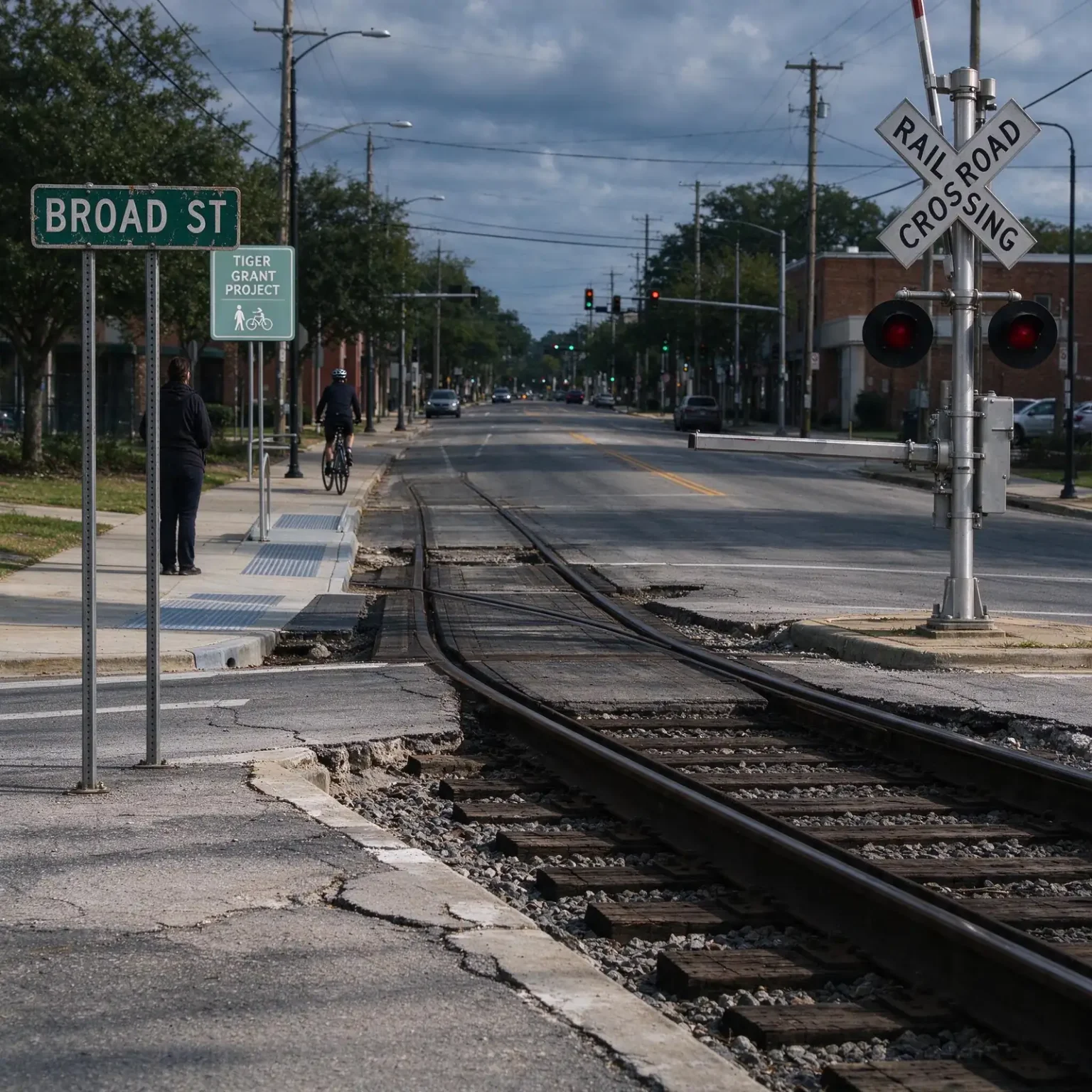
MOBILE, Ala. — A railroad crossing on Broad Street is the focus of the next step in the city’s long-running effort to rebuild the corridor, as the Mobile City Council prepares to take up an agreement with Alabama Export Railroad, Inc. worth an estimated $763,775.38 for the third and final phase of the Broad Street project.
A resolution authorizing the agreement is set to be introduced at this week’s council meeting. The work covers the segment of Broad Street between Garrity Street and Palmetto Street.
What the Agreement Covers
Under the proposed deal, the railroad would handle the design and engineering needed to produce detailed drawings and plans for the rail crossing and would build safety upgrades at the crossing itself. Planned improvements include:
- A rebuilt crossing surface that matches the improved elevation and profile of the reconstructed roadway, so the tracks line up smoothly with the new street.
- Accessible sidewalk crossings at the tracks that meet the Americans with Disabilities Act, giving pedestrians and people using wheelchairs, walkers or strollers a safer path across the rails.
- Modern warning equipment, with crossing lights and gates that meet current standards.
Project at a Glance
- Project: Broad Street Phase III
- Limits: Broad Street from Garrity Street to Palmetto Street
- Partner: Alabama Export Railroad, Inc.
- Estimated agreement total: $763,775.38
- Scope of agreement: Design, engineering and construction of rail crossing safety improvements
- Funding program: Final phase of the city’s TIGER Grant project
- Connection: An essential segment of the Mobile Greenway Initiative
The Final Piece of a Larger Makeover
The crossing work is one part of a broader overhaul planned for Phase III. Across the full project, the city’s plans call for:
- Upgraded utilities
- New sidewalks and curbs
- Better drainage
- Pedestrian-scale lighting
- Bike lanes
- Fresh pavement
- New lane striping
Phase III is the last stage of the work funded through the city’s TIGER Grant. When it is complete, the corridor improvements that began in earlier phases will be carried through this final stretch of Broad Street.
Why a Railroad Agreement Is Needed
Whenever a city rebuilds a street that crosses active train tracks, the crossing becomes a special case. The tracks, signals and the strip of land they sit on are typically controlled by the railroad, and federal and industry safety standards govern how crossings are built and equipped. As a result, cities generally enter formal agreements with railroads so the railroad, or contractors working under its supervision, can design and install the crossing surface and warning devices, with the public project paying for the work.
Changing the height or grade of a road, as often happens when a street is rebuilt with new drainage, means the crossing surface has to be adjusted to match. A mismatch between the road and the rails can create a rough ride for drivers, a tripping hazard for pedestrians and a dangerous obstacle for cyclists, whose tires can catch in poorly aligned flangeways.
Alabama Export Railroad is a short-line railroad that operates in the Mobile area, providing local freight service tied to the region’s industrial and port activity.
Safety Upgrades at Rail Crossings
Highway-rail grade crossings are a persistent safety concern nationwide. Federal railroad safety data show that thousands of collisions happen at crossings each year across the United States, and many involve pedestrians as well as motor vehicles. Active warning systems, meaning flashing lights paired with gates that drop across the road, are among the most effective tools for reducing those crashes, because they give drivers and walkers a clear, timely signal that a train is approaching.
Adding ADA-compliant sidewalk crossings at the tracks also addresses a common gap. Many older crossings were built with little consideration for people on foot, leaving uneven surfaces, missing sidewalks or gaps that make it hard to cross with a wheelchair or stroller. Bringing the crossing up to modern accessibility standards helps the new sidewalks on either side function as a continuous route.
Understanding the TIGER Grant
TIGER stands for Transportation Investment Generating Economic Recovery, a competitive federal grant program created by the U.S. Department of Transportation in 2009. It was designed to fund road, rail, transit and port projects with significant local or regional impact. The program was later renamed BUILD and then RAISE, but projects awarded under the original name, like Mobile’s, are still commonly referred to as TIGER projects.
Federal grants of this type usually come with deadlines and documentation requirements, and they often require projects to be completed in phases as design, right-of-way and construction work move forward.
Part of the Mobile Greenway Initiative
The city describes Broad Street Phase III as a key segment of the Mobile Greenway Initiative. Greenway networks generally aim to connect neighborhoods, parks, schools and job centers with continuous, comfortable routes for walking and biking. The bike lanes, new sidewalks, pedestrian lighting and accessible rail crossing planned for this stretch of Broad Street fit that goal by turning a roadway built mainly for cars into a corridor designed for everyone who uses it.
What Happens Next
Introducing the resolution at this week’s meeting moves the agreement into the council’s formal review. Once the council acts on it, the railroad can proceed with detailed drawings and plans for the crossing, followed by construction of the safety improvements as the larger Phase III project advances.
Residents who live, work or travel along Broad Street between Garrity Street and Palmetto Street can expect more information about construction schedules, potential lane closures and detours from the City of Mobile as the work gets closer to starting. Those who want to follow the item can watch council meetings, which are open to the public, or review the agenda posted by the city ahead of each session.