

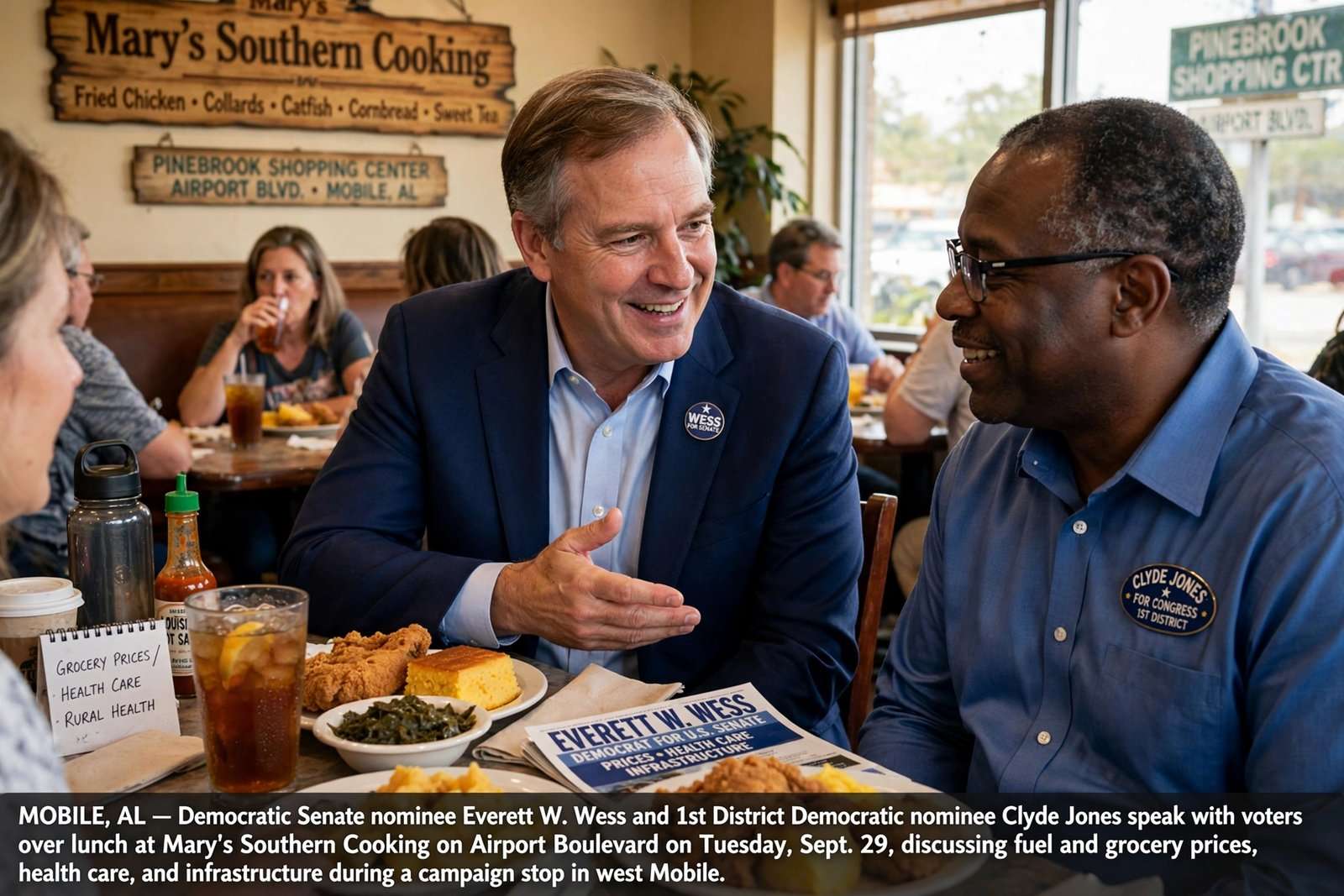
MOBILE, Ala. — Everett W. Wess, the Democratic nominee for U.S. Senate in Alabama, spent his Tuesday lunch hour shaking hands at a west Mobile restaurant, telling voters that gas and grocery prices, health care and infrastructure are the issues driving his long-shot campaign against Republican U.S. Rep. Barry Moore.
Wess met with residents at Mary’s Southern Cooking in the Pinebrook Shopping Center on Airport Boulevard from noon to 1 p.m. on Sept. 29. Clyde Jones, the Democratic nominee in Alabama’s 1st Congressional District, also attended and spoke with members of the community. Both candidates went on that evening to a “candi-dating” forum for Baldwin County voters in Fairhope.
“I’m out meeting people, meeting people in the community, because we are all affected,” Wess said. “It’s not just the Alabama citizens – I’m an Alabama citizen, and I’m being affected also.”
At a glance
- Who: Everett W. Wess, Democratic nominee for U.S. Senate, with 1st District Democratic nominee Clyde Jones
- Where: Mary’s Southern Cooking, Pinebrook Shopping Center, Airport Boulevard, Mobile
- When: Tuesday, Sept. 29, noon to 1 p.m.
- Issues: Fuel and grocery prices, rural and veterans’ health care, data centers and infrastructure
- Opponents: Republican U.S. Rep. Barry Moore and independent Craig Jelks
Prices at the pump and the grocery store
Wess, a Birmingham attorney, said the cost of living is weighing on voters across the state, and on him. He said it cost him about $80 to fill up his vehicle for the drive down from Birmingham.
He also recounted a recent conversation with a mother who told him she had cut back on groceries as prices rose.
“She told me bread is a dollar more than it was just in January. Orange juice prices are higher. She said, ‘I just started drinking water, I stopped buying orange juice for my family,'” Wess said. “I threw my name in to run for United States Senate so that we can get control of our government and do what’s good for the Alabama citizen.”
Fuel prices have become one of the defining issues of Alabama’s fall campaigns. Gasoline has topped $4 a gallon, and AAA reported this month that the state’s average diesel price had climbed above $6 a gallon, roughly 80% higher than a year ago. Democrats have generally blamed the war in Iran and Trump administration policies, including tariffs, for higher prices. Republicans, including gubernatorial nominee Tommy Tuberville, have argued that Democratic energy policies helped drive costs up and have called for more domestic oil production.
Health care for rural Alabama and veterans
Health care has been the centerpiece of Wess’ campaign, and he returned to it in Mobile, calling for long-term reform and more medical professionals in both rural and urban parts of the state.
“What we need to do is have real healthcare reform and ideas that’s going to stay there and be there in the long term. We need doctors and nurses and social workers – we need real healthcare reform in Alabama in the rural and urban areas,” Wess said.
One idea he has promoted is combining funding streams for rural health care and veterans’ care, arguing that many veterans live in rural communities.
“Veterans live in rural Alabama, and that way we can be efficient with our funding and take care of our veterans and our citizens in rural Alabama,” he said.
Earlier this month, Wess criticized Moore for voting for the Republican budget law that included changes to Medicaid, arguing that the new federal Rural Health Transformation Program created by the same law cannot replace hospitals that have closed, such as the one in Thomasville. Alabama received about $203 million for the program’s first year, money the state is directing toward telehealth, emergency medical services, maternal care, mental health, workforce development and other initiatives. Supporters of the law have pointed to the program as a major new investment in rural health care. Moore’s campaign did not respond to a request for comment on Wess’ criticism at the time.
Data centers and infrastructure
Wess said Mobile-area voters have raised concerns about data centers, an issue that has surfaced across southwest Alabama this year with proposed projects in Calvert and Prichard.
On infrastructure, he said he was pleased that funding has come together for the new Interstate 10 Mobile River Bridge, which is scheduled for a groundbreaking ceremony Friday, Oct. 2. He said he wants Congress to keep investing in roads, bridges and broadband across the state.
“Infrastructure is a big thing, I hope that we can pass bills that will really help people in the state of Alabama. Broadband, continue to improve roads and bridges,” Wess said.
The $3.2 billion first phase of the bridge project is being financed through a mix of toll revenue bonds, state money, federal grants and a federal TIFIA loan of up to $2.52 billion, which Alabama Republicans have credited the Trump administration with approving. Moore has proposed naming the new span in the president’s honor.
‘Before any loyalty to any administration’
Wess sought to draw a contrast with Moore, one of Trump’s earliest supporters in Alabama.
“I will always put Alabamians first, I will put my constituents first, I will put the people of Alabama before any loyalty to any administration, and that’s the difference in my opponent and I,” Wess said.
Moore, a congressman from Enterprise, became one of the first elected officials in the country to endorse Trump when the then-candidate held a rally at Mobile’s Ladd-Peebles Stadium in 2015. He has highlighted that support throughout his Senate campaign, and he is scheduled to speak at Trump’s rally at the University of South Alabama’s Mitchell Center on Friday evening. Moore is running for the seat Tuberville is leaving to run for governor.
According to his campaign, Wess is running to advocate for “voting rights, equal justice, affordable healthcare, quality public education, and economic opportunity,” and believes “the justice system should work for everyone—not just the powerful.” He practices law at the Wess Law Firm in Birmingham, has served on the executive committee of the Jefferson County Democratic Party, has taught classes at Faulkner University and has served on the board of Legacy Works, a group that mentors at-risk youth.
A steep climb
Wess faces long odds. Alabama has not elected a Democrat to a full U.S. Senate term since Richard Shelby won as a Democrat in 1992, two years before he switched parties. Through the end of June, Moore had raised nearly $2.5 million, while Wess had raised slightly less than $4,000. About 480,000 voters cast ballots in this year’s Republican Senate primary, compared with roughly 340,000 in the Democratic primary.
Wess said his strategy is to meet as many voters as possible in person. At the Fairhope forum later Tuesday, he said, “They have the money, but we are working, speaking to the constituents, talking about what Alabamians want and need, and hopefully we will be victorious Nov. 3.”
Clyde Jones, who joined Wess in Mobile, faces Republican former U.S. Rep. Jerry Carl in the 1st Congressional District, which under the newly redrawn map includes all of Mobile and Baldwin counties.
What voters should know
- Voter registration deadline: Monday, Oct. 19.
- Absentee ballot applications: Due Oct. 27 by mail or Oct. 29 in person.
- Election Day: Tuesday, Nov. 3. Polls are open 7 a.m. to 7 p.m.
- Photo ID: Required to vote in Alabama.
Voters can confirm their registration and find their polling place through the Alabama Secretary of State’s office or the Mobile County Board of Registrars.
This article reports statements made by a candidate at a campaign event and does not constitute an endorsement. Voters can review positions from all candidates on the November ballot through their official campaign materials.