Mobile-Raised Captain Held Riverboat to New Orleans Dock as It Capsized After Tanker Strike
A captain from Mobile stayed on the bridge of the American Heritage, calling for help and holding the riverboat against a New Orleans wharf, as all 190 people aboard got off before it capsized after a tanker struck it.
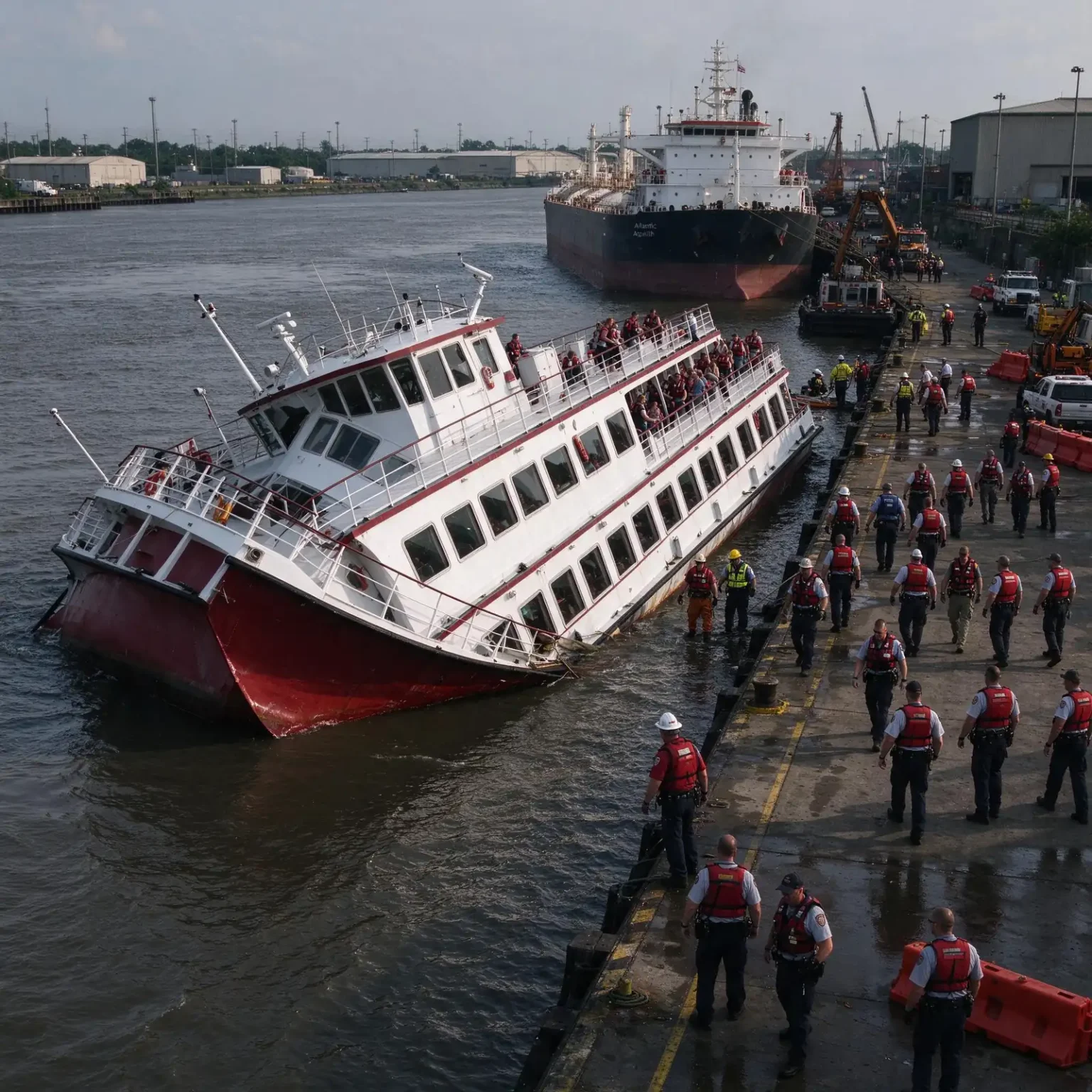
MOBILE, Ala. — A riverboat captain who grew up in Mobile remained at the controls on the bridge of the American Heritage as the vessel rolled over in the Mississippi River at New Orleans, radioing for assistance and working to hold the boat against the dock so the people on board could get to safety, the boat’s operator said.
All 190 people aboard, 140 passengers and 50 crew members, were accounted for after the Friday, Nov. 13, collision at the Thalia Street Wharf. American Cruise Lines, which operates the American Heritage, credited the captain and his crew with moving quickly to get everyone off the vessel during the roughly 22 minutes between the impact and the capsizing.
What Happened
- When: Friday, Nov. 13, at about 12:28 p.m.
- Where: Thalia Street Wharf on the Mississippi River in New Orleans
- Vessels: The riverboat American Heritage, tied up at the wharf, and the tanker Atlantic Asphalt
- On board the riverboat: 140 passengers and 50 crew members, all accounted for
- Outcome: The American Heritage capsized about 22 minutes after it was struck
- Cause: Under investigation; early data points to a steering failure on the tanker
A Captain Who Stayed at His Post
The American Heritage was docked when the Atlantic Asphalt struck it shortly before 12:30 p.m. In the minutes that followed, the captain stayed on the bridge rather than leaving his station, according to the cruise line. He called for help and tried to keep the riverboat pressed alongside the wharf, giving passengers and crew a path off the vessel and onto the dock before it went over.
American Cruise Lines said the captain and the crew responded quickly to carry out the evacuation, and the company confirmed that every person aboard was accounted for.
Keeping a damaged vessel against a dock in the Mississippi is no simple task. The river runs fast and deep through New Orleans, and its current constantly pushes on anything moored along the banks. Holding the boat in position long enough for nearly 200 people to get off required the captain to keep working the controls in the minutes after the collision.
Early Findings Point to a Stuck Rudder
The National Transportation Safety Board has opened an investigation. Investigators said preliminary information from the tanker’s voyage data recorder indicates the ship’s rudder became stuck to starboard, the right side, which sent the Atlantic Asphalt toward the river’s east bank, where the American Heritage was moored.
The NTSB said it recovered about nine hours of data from the recorder. That material includes audio of warnings, calls for help, commands to drop anchor and emergency orders issued aboard the tanker. What caused the steering failure has not been determined, and investigators are continuing to examine it.
The agency expects to release a preliminary report within 30 days.
What a voyage data recorder captures
A voyage data recorder works much like the so-called black box on an airliner. Large commercial ships are generally required to carry one, and it continuously records information such as the vessel’s position, speed and heading, along with steering orders, engine commands and audio from the bridge. After an accident, that record allows investigators to reconstruct what the crew saw, said and did in the moments leading up to the event, and to compare the commands given with how the ship actually responded.
Legal Action and Control of the Tanker
The Port of New Orleans has filed a federal lawsuit against the owners and operators of the Atlantic Asphalt, seeking at least $1 million in damages. A federal judge also issued a warrant that gives authorities control of the tanker.
Under maritime law, a ship itself can be named in a legal claim and held by court order as security while a case moves forward. That process helps ensure that a vessel involved in an accident cannot simply leave port before claims for damage are resolved.
River Traffic Restricted During Salvage
The U.S. Coast Guard has placed restrictions on vessel traffic around the accident site while salvage crews work on the capsized riverboat. The Mississippi River at New Orleans is one of the busiest commercial waterways in the country, carrying tankers, cargo ships, barge tows and passenger vessels, so restrictions near the wharf affect a heavily traveled stretch of river.
The Coast Guard is responsible for safety on the nation’s navigable waters and can establish safety zones and control traffic around a casualty site. Salvage of a capsized vessel typically involves stabilizing the hull, preventing pollution from fuel or other fluids, and eventually righting or removing the vessel so the area can return to normal use.
How the Investigation Will Proceed
The NTSB is an independent federal agency that investigates significant transportation accidents, including major marine casualties. Its role is to determine the probable cause of an accident and to recommend changes that could prevent similar accidents in the future. The agency does not assign legal blame or decide liability; those questions are handled separately, including through lawsuits such as the one filed by the port.
A preliminary report generally lays out the basic facts established so far, such as the timeline, the vessels involved and the early findings, without reaching conclusions about cause. A final report, which includes a probable-cause determination and any safety recommendations, usually takes considerably longer, often a year or more.
Questions likely to draw attention as the investigation continues include:
- Why the tanker’s rudder became stuck and whether the problem could have been detected beforehand
- What the crew of the Atlantic Asphalt did once steering was lost, including the anchor commands captured on the recorder
- How warnings were communicated to other vessels and to people along the riverfront
- How the American Heritage’s evacuation was carried out in the time available
About the Vessels and the Wharf
The American Heritage is a passenger riverboat operated by American Cruise Lines, a U.S.-based company that runs cruises on American rivers and coastal waterways, including the Mississippi. New Orleans is a common starting and ending point for Mississippi River cruise itineraries.
The Atlantic Asphalt is a tanker. Its owners and operators are the targets of the Port of New Orleans lawsuit.
The Thalia Street Wharf is one of the public wharves along the New Orleans riverfront managed by the Port of New Orleans, which oversees docks and terminals that handle both cargo and passenger vessels.
A Mobile Connection
For Mobile, the captain’s role adds a local dimension to a disaster that unfolded about 145 miles to the west. Mobile has a long maritime tradition built around its port, its shipyards and the many residents who make their living on the water, from tugboat crews to harbor pilots to vessel officers working on rivers and coastal routes across the country.
What Comes Next
- Within 30 days: The NTSB plans to release its preliminary report.
- Ongoing: Salvage work at the Thalia Street Wharf continues under Coast Guard traffic restrictions.
- In federal court: The Port of New Orleans lawsuit seeking at least $1 million moves forward, with the tanker held under a court-issued warrant.
- Longer term: Investigators will work to pin down the cause of the steering failure before issuing a final report.
For now, the most important outcome is the one the cruise line emphasized: despite a collision that ended with a passenger vessel on its side in the Mississippi River, every passenger and crew member on the American Heritage was accounted for.