Medical Emergencies Make Up Nearly Two-Thirds of Daphne Fire Department’s 477 October Calls
Daphne firefighters responded to 477 incidents in October, including 299 medical calls, 55 fire alarms and 36 vehicle crashes. Only 10 of the calls were fires.
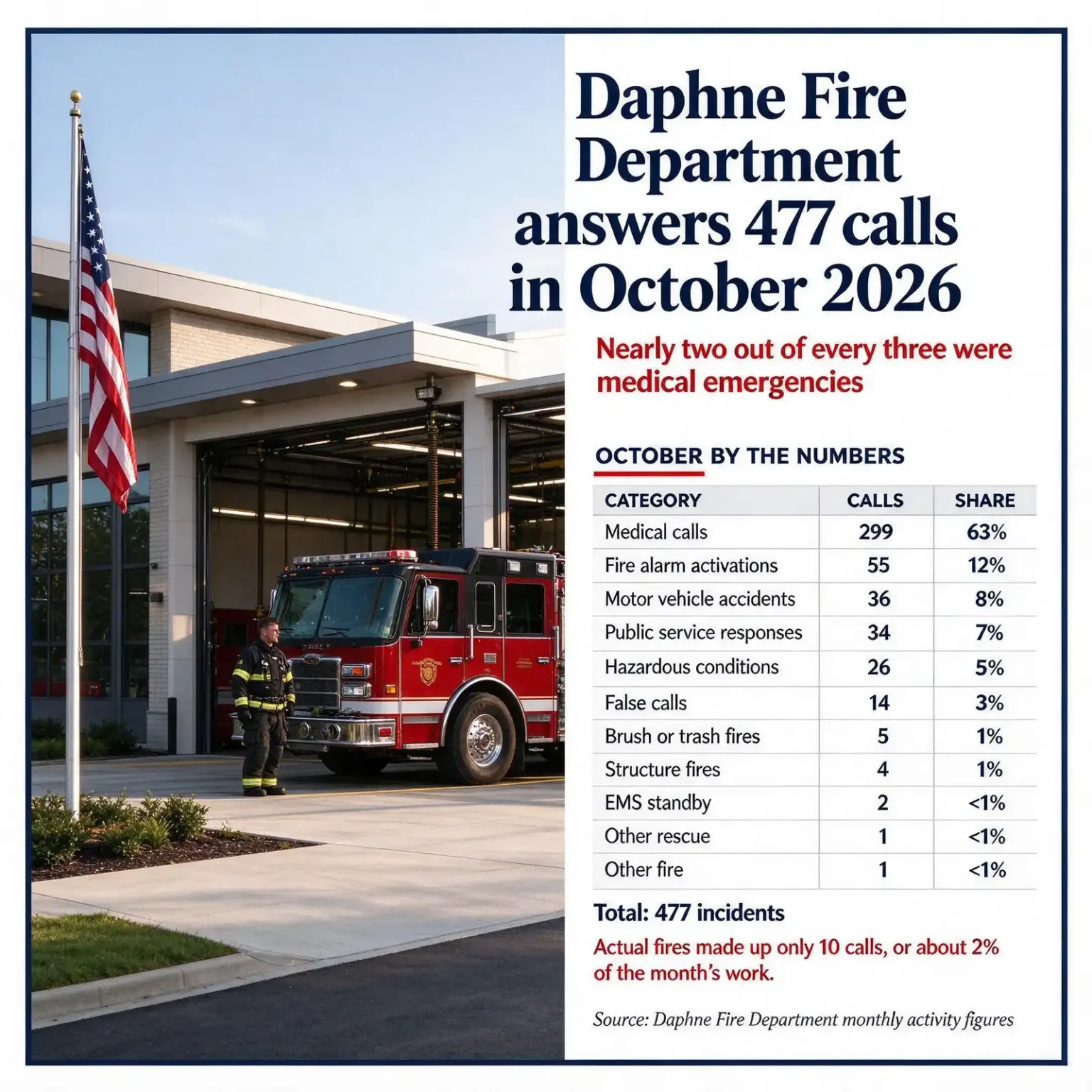
DAPHNE, Ala. — Daphne firefighters answered 477 calls for service in October 2026, and nearly two out of every three were medical emergencies, according to monthly activity figures released by the city.
Actual fires made up only a small share of the month’s work. Crews handled 10 fire calls in all, including four structure fires, while medical responses, fire alarm activations and vehicle crashes accounted for most of the department’s time across its five fire stations.
October by the numbers
The city’s breakdown of the department’s 477 October incidents:
- Medical calls: 299
- Fire alarm activations: 55
- Motor vehicle accidents: 36
- Public service responses: 34
- Hazardous conditions: 26
- False calls: 14
- Brush or trash fires: 5
- Structure fires: 4
- EMS standby: 2
- Other rescue: 1
- Other fire: 1
Medical calls dominate
The 299 medical calls represent about 63% of everything the department responded to last month, or an average of nearly 10 medical calls a day. That pattern is typical for modern fire departments. Across the country, emergency medical calls have become the largest category of fire department work by a wide margin, while structure fires have become a much smaller part of the job than they were decades ago, thanks in part to better building codes, smoke alarms and sprinkler systems.
Firefighters are frequently the closest trained responders when someone calls 911 for a medical emergency, so departments send engines and other apparatus to calls such as breathing problems, chest pain, falls, diabetic emergencies and unresponsive patients. Crews can begin care, including CPR and defibrillation, before or alongside an ambulance.
Alarms, crashes and service calls
Fire alarm activations were the second-largest category, with 55 calls, or roughly 12% of the total. Many alarm calls turn out to be caused by cooking smoke, steam, dust, system malfunctions or work being done on an alarm system, but departments respond to every one as a possible fire because there is no way to know in advance which alarm signals a real emergency.
Crews also answered 36 motor vehicle accidents. At crash scenes, firefighters typically check on the people involved, provide medical care, control fluid leaks and fire hazards, protect the scene from passing traffic and, when needed, use extrication tools to free trapped occupants.
The 34 public service responses cover a wide range of non-emergency help, such as assisting a person who has fallen and cannot get up without injury, or other requests for assistance from residents and agencies. The 26 hazardous condition calls generally involve situations such as gas leaks, fuel spills, downed power lines or electrical problems that could lead to a fire or injury if left alone.
The department logged 14 false calls, a category that generally includes reports that turn out not to be emergencies, such as calls made in error or with good intentions that prove unfounded.
Fires were a small part of the month
Of the month’s 477 incidents, 10 were fires:
- Five brush or trash fires
- Four structure fires
- One fire in the other category
The city did not release details about where the structure fires took place, the extent of damage or whether anyone was hurt.
The city noted that this time of year tends to bring more outdoor fires, traffic crashes and medical calls for area fire departments.
How fire departments sort their calls
Fire departments in the United States generally classify every response by incident type so they can track workloads, plan staffing and report data to state and federal fire agencies. The broad categories used nationally include fires, rescue and emergency medical calls, hazardous conditions, service calls, good intent calls, false alarms and false calls, and severe weather or special incidents.
That reporting allows a city to see how its department’s workload changes from month to month and season to season, where calls are concentrated, and whether trends such as rising medical calls or repeated false alarms at certain buildings need attention. Monthly reports like Daphne’s give residents a window into how their fire department spends its time.
About Daphne
Daphne is one of the largest cities in Baldwin County, located on the Eastern Shore of Mobile Bay between Spanish Fort and Fairhope. Interstate 10, U.S. 98 and U.S. 90 all pass through or near the city, and the Bayway and Causeway connect it with Mobile across the bay. Heavy traffic on those routes is one reason vehicle crashes make up a steady share of the department’s calls.
Fall and winter safety reminders
With cooler weather arriving and the holidays approaching, fire safety officials commonly urge residents to take a few simple precautions:
- Be careful with outdoor burning. Dry grass and leaves can catch quickly. Check local rules before burning yard debris, never leave a fire unattended, keep a hose nearby and avoid burning on windy days.
- Stay in the kitchen while cooking. Unattended cooking is a leading cause of home fires, and holiday meals increase the risk.
- Give space heaters room. Keep them at least 3 feet from anything that can burn, plug them directly into a wall outlet and turn them off when leaving the room or going to sleep.
- Test smoke alarms. Check them monthly, replace batteries as needed and replace alarms that are 10 years old.
- Have heating equipment checked. Furnaces, fireplaces and chimneys should be inspected and cleaned before heavy use.
- Install carbon monoxide alarms. Fuel-burning heaters, generators and attached garages can all produce dangerous carbon monoxide.
When to call 911
Residents should call 911 for any fire, medical emergency, crash with injuries, smell of natural gas or other situation where someone’s life or property may be in danger. When calling, give the address or location clearly, describe what is happening and stay on the line until the dispatcher says it is all right to hang up.
For non-emergency questions about fire safety, smoke alarms or burning rules, residents can contact the Daphne Fire Department directly through the city.