ALEA Airboat Frees Grounded Boater Near I-10 on Mobile Bay; No Injuries
A small boat that ran aground near Interstate 10 on Mobile Bay Sunday morning was freed with an ALEA airboat after Spanish Fort firefighters and Marine Patrol responded. No one was hurt.
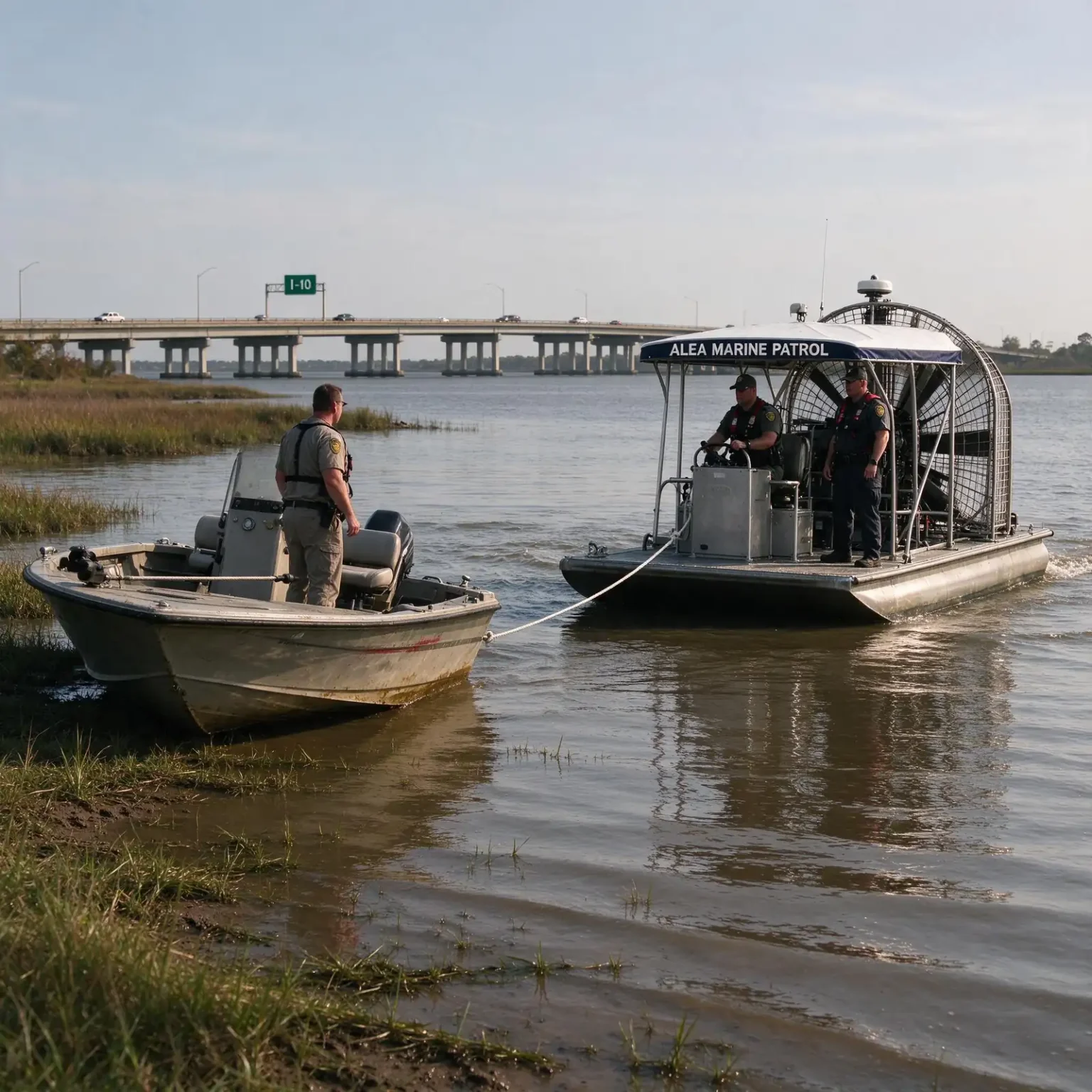
SPANISH FORT, Ala. — A boater who became stuck after running aground in the Mobile Bay area near Interstate 10 on Sunday morning was freed with help from an Alabama Law Enforcement Agency airboat, and no one was hurt, authorities said.
The call for help reached the Baldwin County 911 Communications Center at about 10:45 a.m. Sunday, Nov. 15, 2026. The person at the controls of a small boat had grounded the vessel and could not get it loose without assistance.
Crews locate the boater near I-10
Firefighters from the Spanish Fort Fire Department and officers with ALEA’s Marine Patrol headed to the I-10 area and were able to spot the stranded boater. ALEA then brought an airboat to the scene, and crews used it to get the grounded boat moving again.
Authorities reported no injuries. Officials did not release the boater’s name or say how long the boat was stuck.
Quick facts
- When: About 10:45 a.m. Sunday, Nov. 15, 2026
- Where: Mobile Bay waters in the area of Interstate 10, near Spanish Fort
- What happened: A small boat ran aground and the operator could not free it
- Responders: Spanish Fort Fire Department and ALEA Marine Patrol
- Outcome: An ALEA airboat helped get the boat underway; no injuries
Why an airboat
The waters where I-10 crosses the northern end of Mobile Bay and the Mobile-Tensaw Delta are known for shallow flats, marsh and shifting bottom conditions. In some places the water can be only inches to a few feet deep, especially when tides are low or wind pushes water out of the bay.
Those conditions make it hard for conventional boats with propellers hanging below the hull to reach someone who is stuck. An airboat is driven by a large fan mounted above the deck rather than an underwater propeller, and its flat bottom lets it skim across very shallow water, mud and vegetation. That makes airboats a common tool for rescue and enforcement work in marshes, swamps and shallow bays.
What ALEA’s Marine Patrol does
The Alabama Law Enforcement Agency is the state’s main law enforcement agency, and its Marine Patrol Division is responsible for policing Alabama’s waterways. Marine Patrol troopers enforce boating laws, investigate boating crashes, check for boaters operating under the influence, and assist people in trouble on the water. They also take part in search and rescue missions, often working alongside local fire departments, sheriff’s offices and the U.S. Coast Guard.
Along the coast, Marine Patrol covers Mobile Bay, the Mobile-Tensaw Delta, the Intracoastal Waterway and Alabama’s Gulf waters, and its troopers operate a range of boats suited to both open water and shallow backwaters.
Local fire departments on the water
Fire departments in coastal communities often serve as first responders for water emergencies near their cities. Spanish Fort sits on the eastern shore at the northern end of Mobile Bay, with the Causeway and I-10 Bayway nearby, so water calls are part of the department’s territory. Firefighters can help locate people in distress, provide medical care when needed and coordinate with state and federal agencies that have specialized boats and equipment.
What to do if you run aground
Running aground is one of the most common problems boaters face in shallow coastal waters. Boating safety officials generally offer the following advice:
- Check for injuries first. Make sure everyone on board is unhurt and wearing a life jacket.
- Look for damage. Check the hull for leaks and shut off the engine if the lower unit or propeller is striking the bottom, to avoid damaging it or stirring up sediment that can clog the cooling system.
- Do not force it. Gunning the engine can dig the boat in deeper. Shifting weight toward the part of the boat that is still floating, or tilting the motor up, can sometimes help.
- Consider the tide. In tidal waters, a rising tide may lift the boat free on its own. Knowing the tide schedule before heading out can help boaters avoid getting stuck in the first place.
- Call for help early. If the boat cannot be freed safely, or if weather, darkness or injuries are a concern, call 911 or contact the Coast Guard on VHF marine radio channel 16. Give your location as precisely as possible, using GPS coordinates or nearby landmarks such as bridges and markers.
Boating safety basics
Many groundings and other on-the-water emergencies can be prevented with preparation. Boating safety organizations and state agencies commonly recommend that boaters:
- Study a nautical chart or reliable navigation app of the area before going out, and stay in marked channels when unfamiliar with local depths.
- Check the weather and wind forecast, since strong north winds in particular can lower water levels in Mobile Bay.
- Carry a properly fitting life jacket for every person aboard, along with a whistle or horn, a fire extinguisher and other required safety gear.
- Bring a charged cellphone in a waterproof case, and a marine radio when possible.
- File a float plan by telling someone on shore where you are going and when you expect to return.
- Avoid alcohol while operating a boat.
Alabama requires operators of motorized vessels on state waters to hold a boater license, which is obtained by passing an approved boating safety exam. Boating safety courses cover navigation rules, required equipment and emergency procedures, and is a useful refresher even for experienced boaters.
Fall boating on the bay
Mild autumn weather draws many anglers and recreational boaters onto Mobile Bay and the Delta in November. Cooler water temperatures in the fall and winter can increase the danger of an unexpected fall overboard, so wearing a life jacket is especially important this time of year. Shorter days also leave less daylight for help to arrive if a boater becomes stranded late in the afternoon.
Sunday’s call ended without injury, but officials encourage anyone heading out on the water to plan ahead and to call 911 quickly if they get into trouble.