Foley Weighs Federal Mitigation Grant to Move Utilities Underground, Plus Senior Center Design and Sidewalk Plans
Foley City Council took up a pre-disaster mitigation grant to bury city utilities, along with a new Senior Center design, sidewalk projects and an expanded downtown facade grant area.
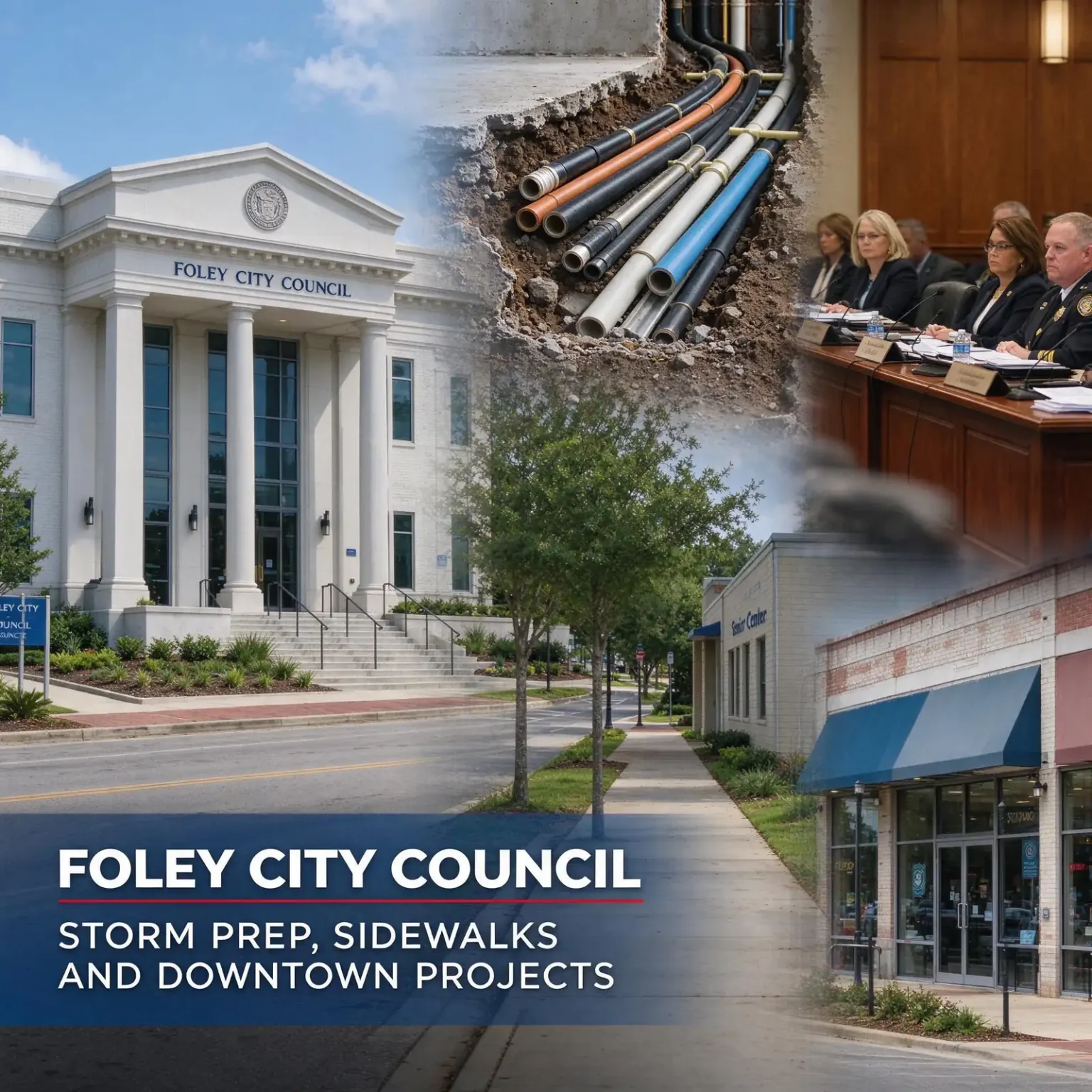
FOLEY, Ala. — Moving more of Foley’s utility lines below ground, ahead of the next hurricane rather than after it, was among the leading items before the Foley City Council on Monday, Nov. 16, as members took up a pre-disaster mitigation grant that would use federal money to bury utilities in the city.
The grant shared a crowded agenda with a design proposal for a new Senior Center, two sidewalk and pedestrian projects, a wider footprint for the downtown facade grant program and a long list of routine business, from nuisance hearings to new equipment for the city’s sports tourism venue.
The work session and regular council meeting were scheduled to begin at 4 p.m. in the Council Chambers at Foley City Hall.
Agenda Highlights
- Underground utilities: A pre-disaster mitigation grant to fund placing city utilities underground.
- Senior Center: A design proposal from GeoCon for a new Senior Center building, up for final review.
- Sidewalks: A Capstone proposal for sidewalk improvements on Juniper Street between Azalea Avenue and Hamilton Boulevard.
- Pedestrian path: A second Capstone proposal for a new path along West Peachtree Avenue.
- Downtown: An amendment extending the facade grant program to the expanded downtown district.
- Graham Creek: A license agreement with PowerSouth Energy Cooperative for transmission line improvements at Graham Creek Preserve.
Burying Lines to Reduce Storm Risk
The mitigation grant is federal funding aimed at making Foley’s infrastructure sturdier by relocating utilities underground. Pre-disaster mitigation money is intended to pay for projects that lower the risk of damage before a disaster occurs, rather than for repairs afterward.
For a city roughly 10 miles from the Gulf of Mexico, the reasoning is straightforward. Overhead power and communication lines are exposed to high winds, falling trees and flying debris, which is why they are often among the first things to fail when a tropical storm or hurricane moves ashore. Lines that run underground are shielded from most of those hazards, which can mean fewer outages and fewer downed wires blocking roads after a storm.
South Baldwin County residents have firsthand experience with the problem. Hurricane Sally made landfall near Gulf Shores in September 2020 as a Category 2 storm, and its slow-moving winds and heavy rain knocked out power to large parts of Baldwin County for days, with some customers waiting much longer.
The tradeoffs
Underground utilities are not without drawbacks. Installation generally costs considerably more than stringing new lines on poles, which is one reason cities often look to grant funding for the work. Underground equipment can also be harder to reach when something does go wrong, and in low-lying coastal areas, engineers have to account for flooding and water intrusion. Even so, utilities and local governments across hurricane-prone areas have increasingly turned to undergrounding for critical lines and high-traffic corridors.
How mitigation grants work
Federal hazard mitigation grants generally require a local cost share and a detailed application showing that a project will reduce future losses. To be eligible for most federal mitigation programs, a community must also have a hazard mitigation plan approved by the Federal Emergency Management Agency. Baldwin County coordinates a multi-jurisdictional plan with its municipalities that identifies hazards such as hurricanes, flooding and storm surge and lists strategies to reduce the damage they cause.
The agenda materials did not spell out which lines or neighborhoods the project would cover, how much the grant is worth or when work might start. Those details typically become clearer as a grant moves through approval and design.
A New Senior Center Moves Closer
The council also had before it a design proposal from GeoCon for a new Senior Center building, which was slated for a final review. Approval of a design contract is usually one of the early steps in a public building project, followed by detailed plans, bidding and construction.
Senior centers in Alabama cities commonly serve as gathering places for older residents, offering exercise classes, meals, social activities, educational programs and help connecting with services. Foley’s population has grown quickly in recent years, and much of south Baldwin County has long been a popular destination for retirees, adding to demand for those kinds of programs.
Sidewalks and Walking Paths
Making it easier and safer to get around on foot was another focus of the agenda. The council reviewed two proposals from Capstone:
- Sidewalk improvements along Juniper Street from Azalea Avenue to Hamilton Boulevard.
- A new pedestrian path on West Peachtree Avenue.
Foley has made sidewalk and path construction a steady part of its capital work, with recent projects aimed at linking schools, neighborhoods and commercial corridors. Proposals like these generally cover engineering and design, with construction coming later once plans are finished and the work is bid out.
Facade Grants for a Larger Downtown
An amendment on the agenda would extend the city’s facade grant program to cover the extended downtown district. Facade grant programs, which many Alabama cities use to support their historic business districts, typically reimburse property or business owners for part of the cost of improving the front of a building, such as new paint, signs, awnings, windows or storefront repairs, provided the work meets the city’s design standards.
Expanding the area where owners can apply would allow more buildings near the edges of the traditional downtown to qualify. The change ties into the city’s broader push to revitalize its downtown.
Transmission Work at Graham Creek
The council considered executing a license agreement with PowerSouth Energy Cooperative for transmission line improvements at Graham Creek Preserve, the city-owned nature preserve known for its trails and outdoor recreation.
PowerSouth is a generation and transmission cooperative based in Andalusia that supplies wholesale electricity to member distribution cooperatives and municipal utilities in Alabama and northwest Florida. A license agreement generally gives a company permission to use or cross a piece of property for a defined purpose, in this case work on transmission lines, without transferring ownership of the land.
Public Safety, Equipment and City Operations
A number of administrative and operational items were also on the agenda:
- Personnel funds: A transfer of money budgeted for personnel between the Police and Public Safety departments, which city officials described as a way to make better use of local resources.
- Business licenses: A first reading of an update to the business license ordinance that would replace Section 5-4 of the city code. A first reading introduces an ordinance, with a final vote typically coming at a later meeting.
- Equipment: The purchase of a new floor sweeper vacuum.
- Event center stage: Seeking bids for an all-terrain stage for the Foley Sports Tourism Event Center, the city’s venue for tournaments, events and gatherings.
- Disability inclusion: An application for a micro-grant intended to accelerate disability inclusion in Alabama communities.
- Appointment: The appointment of Wayne Trawick to the Public Facilities Cooperative District Board.
- Right-of-way: A proposal to vacate a 20-foot unopened right-of-way on city-owned property.
An unopened right-of-way is land set aside on paper for a street or access route that was never actually built. Vacating it removes that public designation, which can simplify future use of the property.
Nuisance Hearings on Trash and Weeds
The council also scheduled public hearings on whether accumulations of trash and weeds at two locations should be declared public nuisances:
- 3801 Linton Lane
- The common area of Arbor Walk Phase 3
Alabama law allows cities to address overgrown weeds and accumulated trash that threaten public health or safety. The usual process involves notice to the property owner and a public hearing. If the council declares a nuisance and the owner does not clean up the property, the city can have the work done and seek to recover the cost, often through a lien on the property.
Following Up
Many of the items, including the mitigation grant, the Senior Center design and the sidewalk proposals, are early steps in longer projects. Contracts, final costs and construction schedules will come back to the council in later meetings as each moves forward.
Foley City Council meetings are open to the public, and the city posts agendas and minutes on its official website. Residents who want to comment on a particular item can attend a meeting in person at City Hall or contact the city clerk’s office ahead of time.