Free Smoke Alarms on Offer as Mobile Fire-Rescue Brings Quarterly Blitz to Rickarby Neighborhood
Mobile Fire-Rescue is offering free smoke alarms in the Rickarby community from 3 to 8 p.m. Tuesday, Nov. 17, during its quarterly Smoke Alarm Blitz. Residents can pre-register with the department.
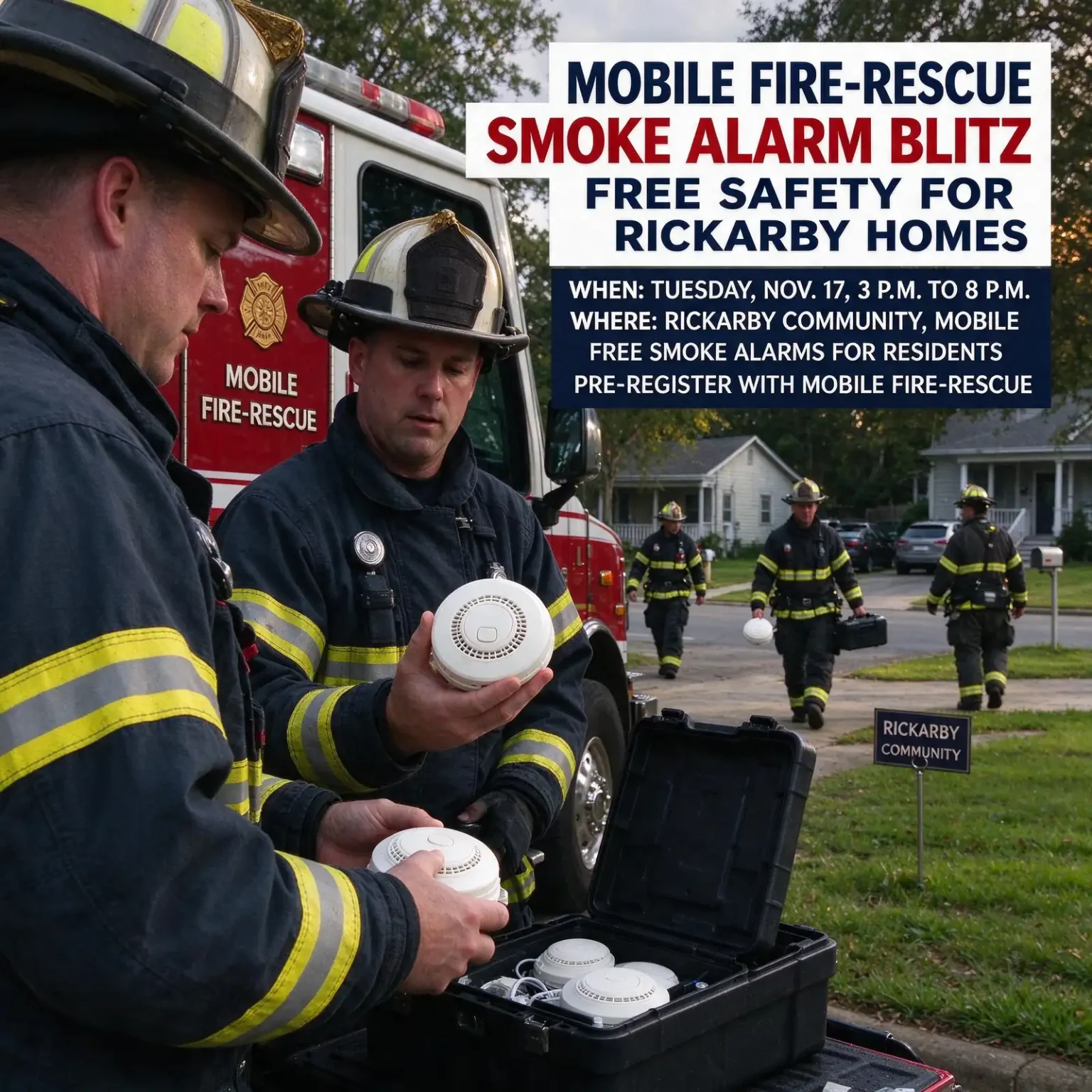
MOBILE, Ala. — Firefighters with Mobile Fire-Rescue are spending Tuesday afternoon and evening, Nov. 17, in the Rickarby community, offering free smoke alarms to households as part of the department’s quarterly Smoke Alarm Blitz. The neighborhood outreach runs from 3 p.m. to 8 p.m.
Residents who want a free alarm are encouraged to pre-register with the Mobile Fire-Rescue Department.
Event details
- What: Mobile Fire-Rescue Department Smoke Alarm Blitz
- When: Tuesday, Nov. 17, 2026, from 3 p.m. to 8 p.m.
- Where: The Rickarby community in Mobile
- Cost: Free smoke alarms for residents
- How to take part: Pre-register with the Mobile Fire-Rescue Department
Hundreds of alarms installed this year
The blitz is part of an ongoing effort by the city’s fire department to put working alarms in more Mobile homes. Since January, department personnel have installed more than 500 working smoke alarms and more than 50 carbon monoxide detectors in houses within the city limits.
Fire officials said the alarms, combined with fire safety education for residents, give families a safeguard that is already in place before a fire ever starts. The department describes its approach to public safety as a combination of three things: assessing risks in the community, responding quickly when emergencies happen, and reducing risk ahead of time through prevention programs such as the Smoke Alarm Blitz.
What a smoke alarm blitz is
Fire departments across the country use focused neighborhood campaigns, often called blitzes, to reach many homes in a short window. Rather than waiting for residents to request help one at a time, crews concentrate their efforts in a single area on a set day. Programs of this kind generally pair the installation of alarms with basic safety information, such as how to test an alarm and how to plan an escape route.
Mobile Fire-Rescue holds its blitz on a quarterly schedule, giving different parts of the city a turn throughout the year. The Rickarby community is the focus of the November event.
Why working smoke alarms matter
Smoke alarms are among the simplest and least expensive safety devices a household can have, and national fire safety research shows how much difference they make. According to the National Fire Protection Association, roughly three out of every five home fire deaths happen in homes that either have no smoke alarms or have alarms that do not work. The association’s data also show that the risk of dying in a reported home fire is roughly cut in half in homes with working smoke alarms.
National fire data show that roughly half of home fire deaths come from fires reported between 11 p.m. and 7 a.m., the hours when most people are asleep. Smoke can spread through a house in minutes, and its toxic gases can make sleeping occupants drowsy and disoriented rather than waking them. A loud alarm can buy the few extra minutes a family needs to get out safely.
Alarms fail most often because of missing, disconnected or dead batteries. People sometimes remove batteries after nuisance alarms from cooking, or forget to replace them when an alarm starts to chirp. An alarm without power offers no protection at all.
Where to put smoke alarms
Fire safety organizations recommend the following placement for home smoke alarms:
- Inside every bedroom
- Outside each sleeping area, such as in the hallway leading to bedrooms
- On every level of the home, including the basement if there is one
- High on walls or on ceilings, since smoke rises
- At least 10 feet from cooking appliances, to cut down on nuisance alarms while cooking
In larger homes, interconnected alarms are recommended so that when one sounds, they all sound. That way, a fire that starts at one end of the house can still wake people sleeping at the other end.
Keeping alarms in working order
An installed alarm only helps if it is maintained. Fire safety guidance commonly includes these steps:
- Test monthly. Press the test button once a month to make sure the alarm sounds.
- Respond to chirping. A regular chirp usually signals a low battery. Replace the battery right away.
- Replace batteries as directed. Alarms that use replaceable batteries generally need new batteries at least once a year. Some newer models have sealed batteries designed to last 10 years.
- Replace old alarms. Smoke alarms should be replaced when they are 10 years old. The manufacture date is usually printed on the back of the unit.
- Never disable an alarm. If cooking sets off an alarm, open a window or fan the air near it instead of removing the battery.
For residents who are deaf or hard of hearing, specialized alarms are available that use strobe lights or bed and pillow shakers to alert people when smoke is detected.
The danger of carbon monoxide
Alongside smoke alarms, Mobile Fire-Rescue has been installing carbon monoxide detectors this year. Carbon monoxide is a colorless, odorless gas produced when fuels such as natural gas, propane, gasoline, wood or charcoal burn. Because people cannot see or smell it, a detector is the only reliable way to know when levels are rising inside a home.
Common sources include gas furnaces, water heaters, stoves, fireplaces and portable generators, as well as vehicles left running in attached garages. Early symptoms of carbon monoxide poisoning, such as headache, dizziness, weakness, nausea and confusion, can be mistaken for the flu. High exposure can cause loss of consciousness and death.
Safety agencies recommend placing carbon monoxide alarms outside each sleeping area and on every level of the home. If a carbon monoxide alarm sounds, everyone should move outside to fresh air right away and call 911. Portable generators, which see heavy use along the Gulf Coast after hurricanes and storms, should never be run inside a home, garage or other enclosed space, and should be placed well away from doors and windows.
Plan your escape
A smoke alarm gives warning, but a family also needs to know what to do when it goes off. Fire safety organizations encourage every household to make and practice a home escape plan:
- Know two ways out of every room, usually a door and a window.
- Make sure windows and doors open easily and are not blocked.
- Choose an outside meeting place a safe distance from the home, such as a mailbox or a neighbor’s driveway.
- Practice the plan at least twice a year, including at night.
- Once outside, stay outside, and call 911 from a safe location.
Children, older adults and people with disabilities may need help getting out, so households should decide in advance who will assist them.
A timely reminder heading into the holidays
The November blitz comes as households head into the time of year when home fire risks climb. National fire data show that cooking is the leading cause of home fires and home fire injuries, and Thanksgiving is the peak day of the year for home cooking fires. Heating equipment is another major cause of home fires, with the highest share of those fires occurring in the winter months.
Simple habits can lower those risks. Stay in the kitchen while frying, grilling or broiling food. Keep anything that can burn, such as towels and paper, away from the stovetop. Give space heaters at least three feet of clearance from furniture, bedding and curtains, and turn them off when leaving the room or going to sleep. Have chimneys and fuel-burning heating systems inspected regularly.
How residents can get involved
Rickarby-area residents who want a free smoke alarm are encouraged to pre-register with Mobile Fire-Rescue. Residents in other parts of the city who are interested in future blitzes can contact the department to learn about upcoming quarterly events.
Even households that already have alarms can use the event as a reminder to test their devices, check their manufacture dates and review their escape plans with everyone who lives in the home.