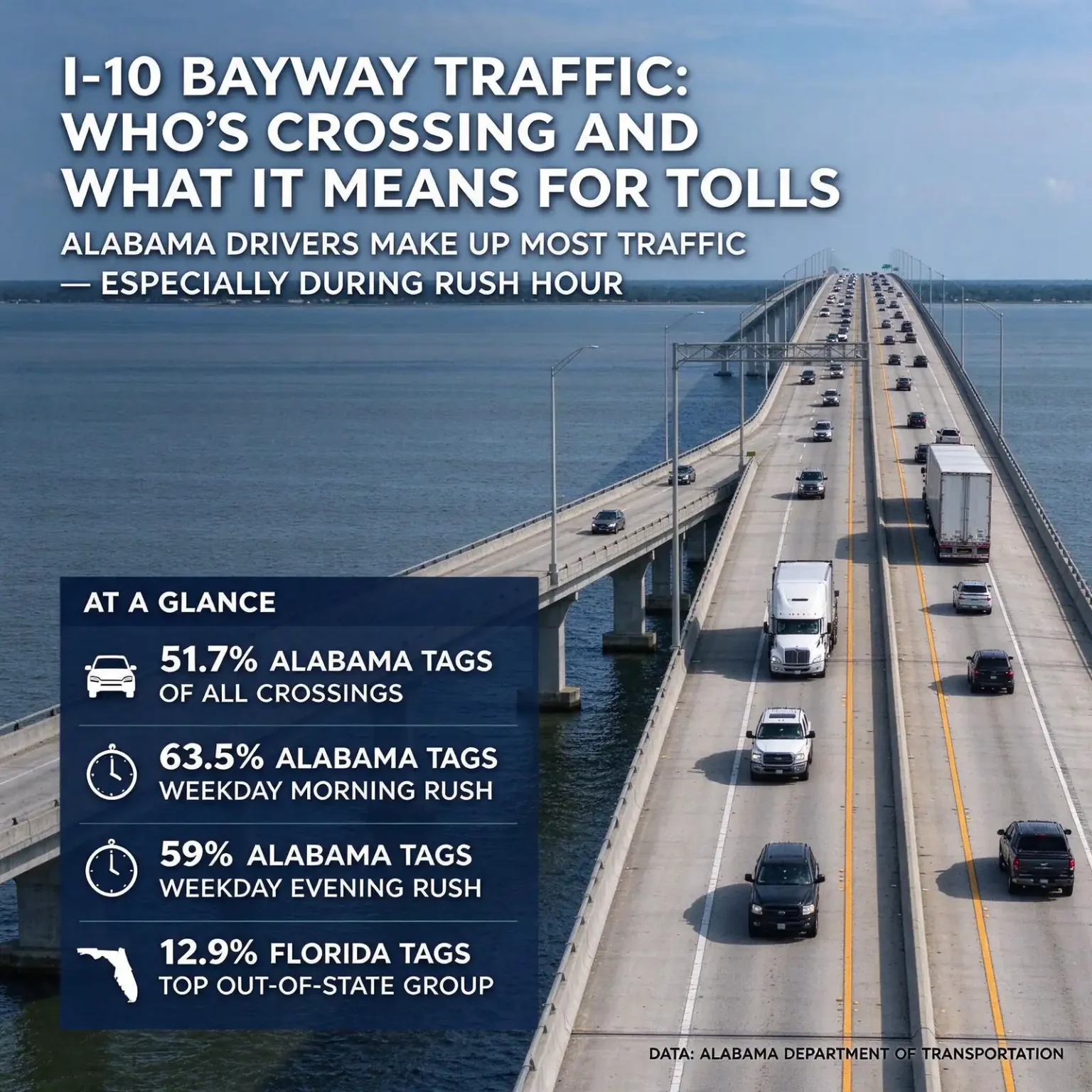
MOBILE, Ala. — Vehicles with Alabama license plates make up just over half of all traffic on the Interstate 10 Bayway across Mobile Bay, and close to two-thirds of it during the weekday morning commute, according to Alabama Department of Transportation camera records collected to plan the future Mobile River Bridge and Bayway toll project.
The records cover the 2025 calendar year and the first nine months of 2026 and log more than 41.3 million vehicle crossings. Of those, 21.4 million, or 51.7%, carried Alabama tags.
Rush Hour Numbers at a Glance
The share of Alabama plates climbs during the hours when commuters typically travel between Mobile and Baldwin County:
- Weekdays, 7 a.m. to 9 a.m.: 63.5% of vehicles recorded had Alabama tags.
- Weekdays, 4 p.m. to 6 p.m.: 59% of vehicles recorded had Alabama tags.
- Both peak windows combined: more than 5 million Alabama-tagged crossings over the period, or roughly 11,343 on an average weekday.
Where the Data Came From
ALDOT placed cameras and other data-collection equipment on the Bayway in December 2024. At the time, the agency said the equipment would measure how many vehicles use the corridor, what kinds of vehicles they are and which states they are registered in, information intended to guide planning for the bridge and Bayway project.
The department released the camera records in early October in response to public records requests. It had turned down three earlier requests for the information, saying it was connected to the agency’s ongoing deliberations over toll policy.
The records do not break Alabama plates down by county. ALDOT says it does not have data that shows whether an Alabama-tagged vehicle is registered in Mobile County, Baldwin County or another part of the state, so the figures cannot show how many of the Alabama drivers are local commuters from the two bay counties and how many come from elsewhere in Alabama.
Out-of-State Drivers
Florida was the largest identifiable out-of-state group in the records, accounting for 12.9% of all crossings. Louisiana, Texas and Mississippi were next in line.
The Bayway is part of I-10, the southernmost coast-to-coast interstate in the country, which links the Florida Panhandle, coastal Alabama, Mississippi, Louisiana and Texas. Long-distance travelers and freight moving along the Gulf Coast use the corridor alongside daily commuters.
Summer Brings a Different Mix
Total traffic rises only slightly in the summer, but the states represented on the plates change more noticeably. During June, July and August of 2025 and 2026, the Bayway averaged 67,417 crossings a day, about 2.1% more than during the rest of the period covered by the records.
- Alabama: 46.8% of summer traffic, compared with 53.7% in other months.
- Florida: 12.1% in summer, compared with 13.2% in other months.
- Louisiana: 7.8% in summer, up from 4.7% in other months.
- Texas: 6.9% in summer, up from 4.1% in other months.
Louisiana and Texas plates both rose in summer, while Florida’s share did not increase. The Alabama Gulf Coast beaches in Gulf Shores and Orange Beach draw large numbers of visitors from the Gulf South and Texas during the summer season, and many of those trips cross the bay on I-10.
Cars and Trucks on the Corridor
Passenger-size vehicles make up the vast majority of Bayway traffic. The camera records include:
- Two-axle vehicles: 37,131,872 records, or 89.7% of all traffic, averaging 59,602 per day.
- Five-axle vehicles: 2,846,781 records, or 6.9% of all traffic, averaging 4,569 per day.
Two-axle vehicles include most cars, pickups and SUVs. Five-axle vehicles are typically tractor-trailers, the large commercial trucks commonly called 18-wheelers.
How the Tolls Are Set Up
ALDOT has adopted a toll schedule for the opening year of the new bridge and Bayway. The lowest rates go to drivers enrolled in the department’s planned ALGOPass program, with higher rates for drivers using another compatible transponder and the highest rates for those billed by mail through video tolling.
- Two-axle passenger vehicle: $3.00 with ALGOPass, $7.70 with an interoperable transponder and $15.40 by video bill.
- Five-axle commercial truck: $25.20 with ALGOPass, $44.45 with an interoperable transponder and $88.90 by video bill.
In video tolling, cameras photograph a vehicle’s license plate and a bill is sent to the registered owner. An interoperable transponder is an electronic toll tag issued by another toll system that can be read on participating roads outside its home network. In its financing documents, ALDOT said it expects that half of toll-by-video billings will not be collectable.
Future rate increases
ALDOT says drivers who sign up for ALGOPass when tolling begins will have their toll rate locked with no increase for 10 years. Other tolls, including video billing for drivers without ALGOPass, are scheduled to rise each year from 2032 through 2041 by at least 5%, or by the South region CPI-U inflation rate if that figure is higher. After 2041, the minimum yearly increase falls to 2.5%, again with the CPI-U rate applying when it is higher.
The CPI-U, or Consumer Price Index for All Urban Consumers, is the federal government’s most widely used measure of inflation. The U.S. Bureau of Labor Statistics publishes it nationally and for regions of the country, including the South.
About the Mobile River Bridge and Bayway Project
The project would build a new I-10 bridge over the Mobile River along with a new Bayway. The existing Bayway consists of the elevated I-10 spans that carry traffic several miles across the upper end of Mobile Bay between Mobile and the Eastern Shore. Today, I-10 traffic passes under the river through the George Wallace Tunnel, a long-standing bottleneck for travelers on the Gulf Coast.
ALDOT’s tolling system is expected to start when the new bridge and Bayway open, currently projected for around 2031.
The tolls have been a major political issue in coastal Alabama. Our earlier coverage examined how opposition to the Mobile River Bridge tolls crossed party lines during the fall campaign, and how utility relocation for the project led to a Claiborne Street lane closure in downtown Mobile.
What Drivers Can Do Now
Tolling is still years away, but drivers who cross the bay regularly can follow ALDOT’s announcements about when ALGOPass enrollment opens, since the lowest rate and the 10-year rate lock both depend on signing up when tolling begins. Commuters and businesses that run trucks across the bay may also want to compare the opening-year rates by payment method as they plan future travel and operating budgets. Project updates are posted by ALDOT as construction moves forward.