Mobile River Bridge Tolls Unite Democrats, Republicans in Opposition as Coastal Alabama Candidates Make Final Pitch
Candidates from both parties in Mobile and Baldwin counties oppose the tolls planned for the new Mobile River Bridge and Bayway, though they disagree over who is to blame. Tolls are not expected until 2031, when the $3.2 billion first phase opens.
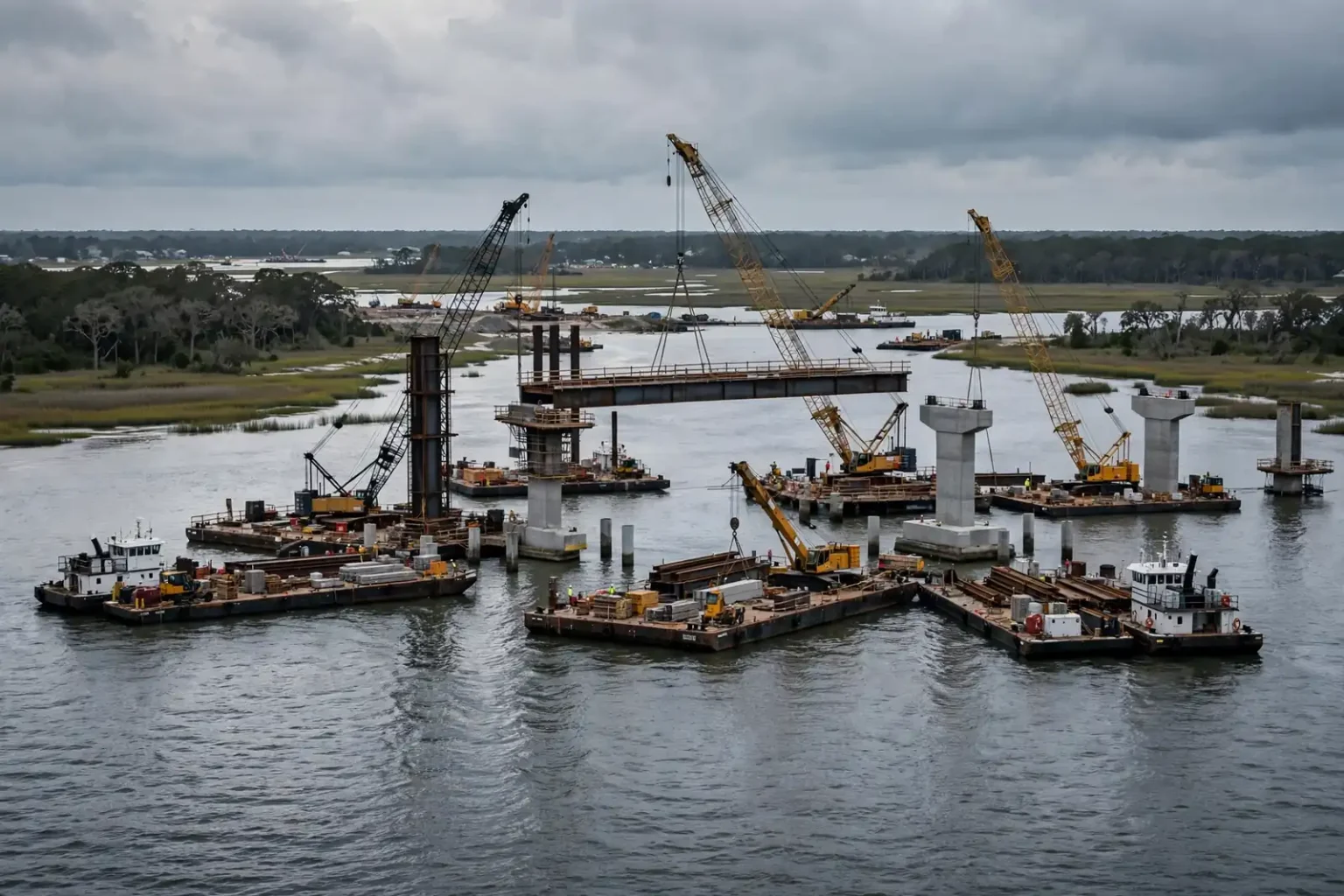
If there is one issue that can bring Democrats and Republicans together in coastal Alabama this election season, it is opposition to the tolls planned for the new Mobile River Bridge and Bayway project across Mobile Bay.
Candidates from both parties in Mobile and Baldwin counties say they do not want commuters to pay to cross the bay. Republicans compare the tolls to a tax that falls hardest on local drivers. Democrats say the fees would add another cost for working families at a time of high inflation. Where they part ways is over who deserves the blame.
The tolls are not expected to take effect until 2031, when the first phase of the project is scheduled to be completed. Many local officials who once fought the project have since accepted the tolls after the state agreed to reduce the original rates and preserve toll-free routes across the bay.
Candidates on both sides oppose the tolls
The race for Alabama House District 96 illustrates the rare agreement. Republican nominee Danielle Duggar said residents have already paid for the region’s roads.
Duggar said in an interview last week that he believes they have already paid for these roads with their federal tax dollars and state tax dollars.
Her Democratic opponent, Terri Osborne, also opposes the tolls.
Osborne said if a toll has to be imposed, it should be as low as possible for the shortest amount of time, especially for residents of Baldwin and Mobile counties who commute back and forth across the bay.
Former Mobile Mayor Sam Jones, now a Democratic state representative for the city, said he would have preferred no toll at all.
Jones said he would think that with Mobile and Alabama being considered one of the reddest of red states, they shouldn’t have to pay a toll. He said with their Congressional and Senate delegations, if they had Sen. Richard Shelby, they probably would not have had a toll, but now someone is suggesting they borrow tax dollars and pay interest on their own tax dollars to get the bridge built, and he has a problem with that.
Other Democratic candidates for the Alabama House joined together to voice their opposition in a Facebook video.
Rep. Adline Clarke, D-Mobile, said the bridge should be uniting the region, not putting a tear in their pocketbooks.
Why the project is needed
Despite their objections to the tolls, candidates and officials broadly agree that a new crossing is necessary. Local and state leaders have recognized the need for another route across Mobile Bay since the early 2000s, as traffic through the George Wallace Tunnel, a key artery through downtown Mobile, has grown well beyond what it was built to handle.
According to a federal grant application for the project, the Wallace Tunnel was designed to carry about 35,000 vehicles a day. It now carries about 65,000 vehicles a day on weekdays and about 75,000 on weekends. By 2040, traffic is projected to reach 95,000 vehicles a day.
The project is designed to ease congestion on Interstate 10 at peak travel times, reduce crashes, provide a more direct interstate route, address the effects of shipping traffic on the crossing and reduce the effects of storms and sea level rise on the crossing.
Jones said the one thing it does for the city of Mobile is keep from blocking the tunnels. He said when you block the tunnels, you block up traffic in downtown Mobile and back up traffic on the Bayway, and that it has a purpose and is needed.
What will be built
According to an Alabama Department of Transportation fact sheet, the first phase of the project will build a new six-lane bridge over the Mobile River, with three lanes in each direction, and restripe the existing Bayway from four lanes to six. A second phase would build a new six-lane Bayway.
The first phase is expected to cost about $3.2 billion to build. Details and financing for the second phase still need to be finalized.
The project will be paid for in part by two federal grants totaling $675 million, and ALDOT will contribute at least $250 million. The rest will come from a $2.52 billion federal loan through the Transportation Infrastructure Finance and Innovation Act, known as TIFIA. Toll revenue would repay that loan and other project debts.
ALDOT said in a statement that tolls are necessary for the project’s financial viability.
The department said its Phase I cost is roughly double the entire state of Alabama’s transportation budget, and rapidly rising inflation on construction materials further limits the state’s ability to fund the project without revenue sources.
Construction on the long-awaited project formally began earlier this month, when state and local leaders held a groundbreaking for the Mobile River Bridge.
How much the tolls will cost
Under the current plan, no tolls will be charged until the project opens in 2031. After that, drivers will have several options:
- ALGO Pass monthly plan: $60 a month for unlimited trips, with the price locked for the first 10 years after tolling begins.
- ALGO Pass per trip: $3 per trip for passenger vehicles with an ALGO account but no monthly plan.
- Other toll accounts: $7.70 per trip for drivers who use another toll-payment system instead of ALGO.
- No account: $15.40 per trip for drivers with no toll plan.
Toll prices are scheduled to rise over time to help repay the federal loan. The $60 monthly pass will stay the same for 10 years and then increase. Other toll rates will rise every year once tolling begins, by either 5% or the change in the Consumer Price Index for the South region, whichever is higher, for the first 10 years. After that, annual increases will be 2.5% or the South region CPI change, whichever is greater.
Commuters and House Democrats from the area have raised concerns that the increases are automatic and have no cap.
A long road to approval
Residents and officials have resisted user fees on the crossing before. For the project to move forward, it had to be included in the transportation plans of the region’s metropolitan planning organizations. In 2019, the Mobile Metropolitan Planning Organization tabled a vote on the project, and the Eastern Shore Metropolitan Planning Organization voted 8-1 to remove it from its plan, halting it.
Fairhope City Councilman Jack Burrell, who chairs the Eastern Shore MPO, said the proposal at the time was advertised with a toll of $6 in each direction, and that there was no mention of a monthly pass, he said in an interview earlier this month.
In 2021, the MPO wrote to Gov. Kay Ivey asking to revive the project.
Burrell said the traffic congestion just to make a simple trip across the bay on a Friday or any given weekend requires planning for a couple more hours for the trip. He said he thinks the need to solve traffic congestion was the reason they needed to pursue a solution.
Burrell said he was open to a toll but wanted it capped at $2.50, pressed to preserve non-toll routes and wanted to eliminate a proposed public-private partnership. ALDOT had considered partnering with a private company that would help pay for the project and collect tolls, but that plan was abandoned.
Burrell said in that agreement it was stated they could toll any access across the bay now and into the future, which they found totally unacceptable. He said with the new framework, that went away and they preserved toll-free options.
Burrell said he also wants to make sure all toll money stays with the project and is not diverted to other state spending.
Who gets the credit, and the blame
Republicans have praised President Donald Trump and U.S. Transportation Secretary Sean Duffy for making the federal loan available.
U.S. Sen. Katie Britt, R-Alabama, said in a video posted on ALDOT’s website that thanks to President Trump and Secretary Sean Duffy’s leadership, they are seeing real progress. She said she has been proud to work alongside them to ensure Alabama’s priorities are heard in Washington.
Jones placed the blame for the cost and the tolls on the president’s administration.
He said he has been listening to the president say they have trillions of dollars in tariffs, so let’s spend some of it on the bridge. He said let’s delegate some of that to infrastructure and put some of it toward the bridge.
Local House Democrats, in their video, tied the tolls to U.S. Sen. Tommy Tuberville, the Republican nominee for governor, because he helped secure the federal loan.
Jones said in the ad that they were promised a flat toll of $2.50, but Sen. Tuberville raised that to $3, and now Trump’s new federal loan locks them into automatic increases based on inflation.
Tuberville’s campaign pointed to a news article reporting that he opposed the tolls and would work to reduce them.
Proposals to soften the cost
Some Republican lawmakers are proposing relief for drivers. Duggar and state Sen. Chris Elliott, R-Josephine, have proposed legislation that would let drivers claim a state tax credit for tolls they pay, capped at $15 million a year for five years.
Local officials say they have resigned themselves to the tolls as the price of relieving traffic that continues to frustrate commuters.
Mayor Robin LeJeune of Daphne said the city does not want any tolls but understands the situation. He added that he hopes the federal government will provide additional funding and that the next governor will work with the next ALDOT director to limit tolling.
Key facts
- Project: New six-lane Mobile River Bridge and an expanded I-10 Bayway across Mobile Bay
- Phase one cost: About $3.2 billion
- Funding: $675 million in federal grants, at least $250 million from ALDOT and a $2.52 billion federal TIFIA loan repaid by tolls
- Tolls begin: Not before 2031, when phase one is expected to open
- Toll rates: $60 monthly ALGO Pass; $3 per trip with ALGO; $7.70 with another toll account; $15.40 with no account
- Election Day: Tuesday, Nov. 3
Related coverage from South AL News
- Elliott Drafts Toll Tax Credit to Refund Mobile River Bridge Tolls; Daphne Mayor Signals Support
- Mobile River Bridge Groundbreaking Launches Long-Awaited I-10 Bayway Project After Decades of Delay
- Forgive the Bridge Loan? Mobile Councilman Ben Reynolds Hopes Trump Visit Brings End to Planned I-10 Tolls
- $2.52 Billion Federal Loan Closes the Financing Gap on the Mobile River Bridge; Construction Expected to Begin Next Month