Alabama State Government Daphne
Mobile River Bridge Groundbreaking Launches Long-Awaited I-10 Bayway Project After Decades of Delay
Leaders including Gov. Kay Ivey and Transportation Secretary Sean Duffy broke ground Friday on the Mobile River Bridge and Bayway, an I-10 crossing projected to open in late 2031 with tolls for drivers who use it.
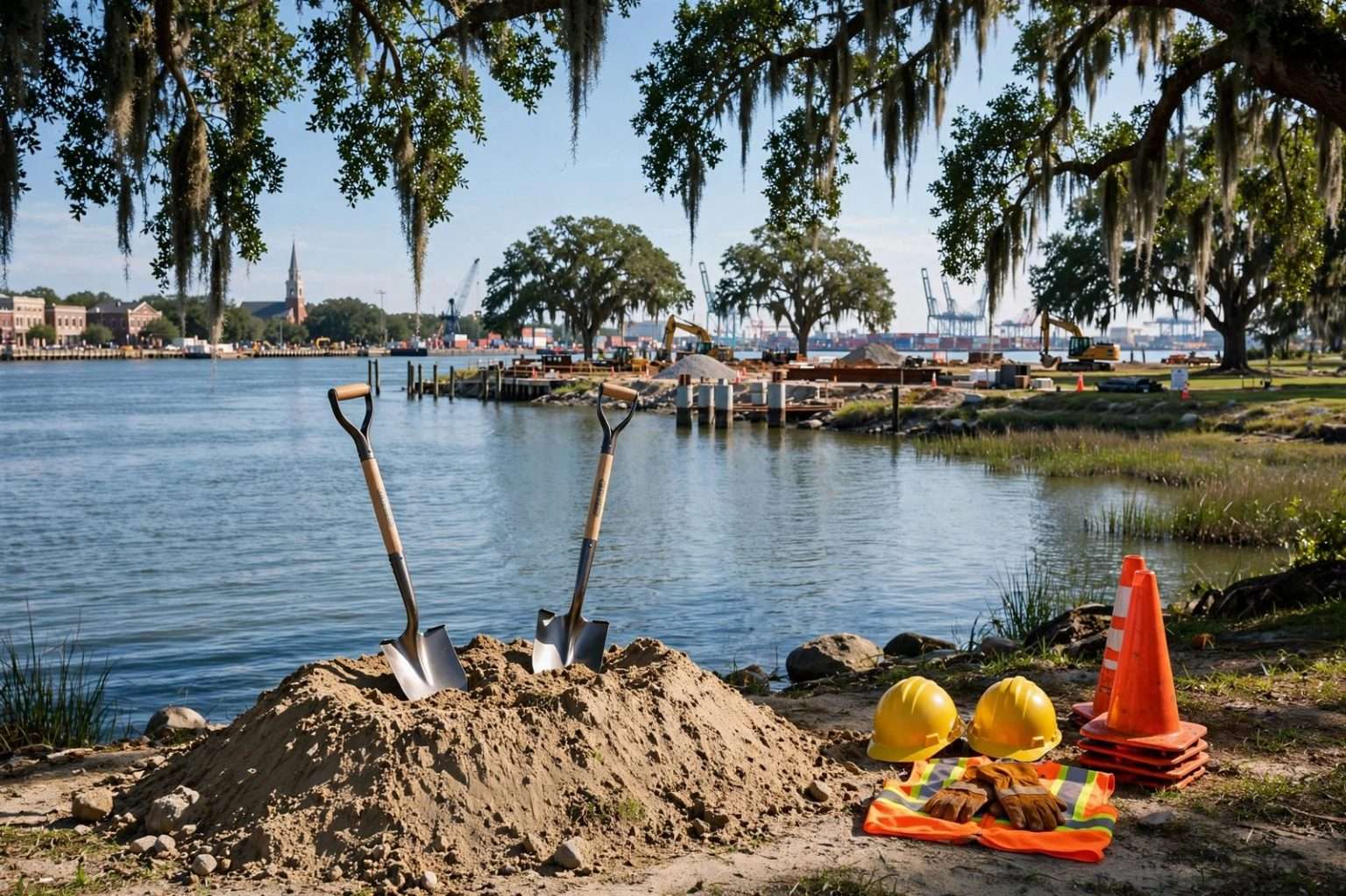
MOBILE, Ala. — The Mobile River Bridge is no longer just a line on a planning map. Federal, state and local leaders gathered Friday at Cooper Riverside Park in downtown Mobile to ceremonially break ground on the Mobile River Bridge and Bayway project, an Interstate 10 crossing that has been studied, debated, shelved and revived for more than three decades.
Gov. Kay Ivey, U.S. Transportation Secretary Sean Duffy, U.S. Sens. Katie Britt and Tommy Tuberville, and U.S. Reps. Barry Moore and Shomari Figures turned the first ceremonial shovels of sand along the Mobile riverfront. Leaders from the Eastern Shore and Mobile metropolitan planning organizations and other state and local officials joined them, along with representatives of the project’s design-build team. University of South Alabama President Jo Bonner served as master of ceremonies.
The project is widely described as the largest transportation undertaking in Alabama history. State officials have put the price of the first phase at $3.2 billion, while other estimates of the overall first-phase cost run to $4.15 billion.
“It’s going to change the face of our area forever,” Mobile Mayor Spiro Cheriogotis said. “You know it’s going to change the skyline of Mobile. But even better, it’s going to change the reality of passengers flowing in and out of our city. Commerce flowing in and out of our city.”
From Notice to Proceed to Shovels in the Sand
Friday’s ceremony followed a busy stretch of paperwork. The Alabama Department of Transportation issued a notice to proceed to the Kiewit Massman Traylor design-build team, known as KMT, on Sept. 25. That step came after the project’s bond sale closed and the federal government finalized a $2.52 billion loan under the Transportation Infrastructure Finance and Innovation Act, commonly called TIFIA.
KMT is a joint venture of Kiewit, Massman Construction Co. and Traylor Bros. Inc. Since the notice to proceed, the team has been mobilizing crews and equipment, and work actually started Thursday, a day before the public celebration.
Construction is expected to take about five years, with the new six-lane, cable-stayed bridge projected to open in late 2031.
“Well, you heard Coach, he put the pressure on me already,” said Doug Glaser, executive vice president of Omaha-based Kiewit. “We’re confident in the schedule. It’s going to be a lot of hard work for now, for a lot of locals and a lot of people from the state of Alabama. But we’re looking forward to the challenge.”
What Phase One Will Build
The project has been split into two phases under an arrangement announced in July. The first phase, which officials say is fully financed and backed by a toll plan, includes:
- A new six-lane, cable-stayed bridge over the Mobile River, rising 215 feet above the water, with an overall structure height of more than 500 feet, according to Cheriogotis.
- A connection from the new river bridge to the existing Bayway across Mobile Bay.
- Restriping of the existing Bayway to carry three lanes in each direction between Mobile and the U.S. 98 interchange in Daphne.
- Improvements to key interchanges and traffic flow, with state officials also planning to extend the widened interstate east to the State Route 181 interchange in Malbis.
A second phase would tear down the existing Bayway and replace it with a new, higher elevated interstate across Mobile Bay. No funding source, construction timeline or cost estimate has been announced for that phase.
Standing on the riverbank, Cheriogotis pointed out where the span will go.
“It’s going to come right through here,” he said. “Cut right next to us. So they’re joining the Bayway. It’s going to stand tall 215 feet from the water, a height of over 500 total. I can’t wait to see it grow for five years.”
How the Bridge Is Being Paid For
The financing package for phase one relies on several pieces, according to officials:
- A $2.52 billion federal TIFIA loan through the U.S. Department of Transportation.
- $675 million in federal grants, which includes a $550 million grant awarded during the Biden administration.
- At least $250 million from the state of Alabama.
- Bonds issued through the Alabama Toll Road, Bridge and Tunnel Authority. The Mobile project is the first ever built under that authority, which will receive the TIFIA loan.
Toll Rates Drivers Can Expect
Tolls will begin when the new bridge opens and will be collected electronically, without toll booths. The rate structure is designed to steer drivers toward the state’s ALGO Pass transponder account. Rates announced for the project are:
- $3 per trip for drivers using an ALGO Pass.
- $60 per month for unlimited trips with an ALGO Pass monthly plan.
- $7.70 per trip for drivers with an out-of-state toll transponder.
- $15.40 per trip for drivers with no transponder. Those drivers can later open an ALGO Pass account and pay the lower rates.
- Up to $121.10 per trip for commercial vehicles without a transponder.
Toll rates are expected to rise over time. The Causeway, the tunnels and the existing bridges will remain free, giving drivers a toll-free option.
Ivey: ‘This New Bridge Is Simply a Must’
“Y’all, we are finally breaking ground on the Mobile River Bridge and Bayway Project,” Ivey said. “1990. That’s how long ago a new I-10 crossing has been talked about. And if you know me, you know I’m not one for chit-chat. I just prefer to get things done.”
The governor said the current crossing was built to handle 35,000 vehicles a day but now sees as many as 95,000 at its peak. Other figures put the Bayway’s typical daily traffic at roughly 80,000 vehicles.
“Well, y’all, this new bridge is simply a must,” she said. “Secretary Duffy, you and President Trump made a very wise investment in Alabama. So let’s build this bridge, and let the good times roll.”
Duffy Recounts a Call From the President
Duffy drew laughs with a brief impression of President Donald Trump, mimicking the president’s voice and hand gestures as he described the phone call that pushed the project forward.
“When you get a call from the president, he’s like, ‘Sean, I love Alabama. Alabama’s amazing. I love it. Good people in Alabama. I-10. I think we need to build that bridge, Alabama,’” Duffy said. “And I’m like, ‘Okay, Mr. President.’”
He then turned to the stakes for commuters. “You’re going to save on average 30 minutes plus in travel, and that’s time they get with their husbands, their wives, their grandkids, their kids,” Duffy said.
“There was a time that people wanted to build bike paths, and I love bikes, by the way,” Duffy said. “But we have a choice to build bike paths or build bridges, and I think bridges have a way bigger impact on your life than a bike path. And we only have so much money. So this administration, we are investing in roads and bridges that move people and products.”
In July, the administration removed federal requirements for a pedestrian and bicycle path and an “observation overlook” from the project. Britt and Tuberville had written that those features “added to the cost but did nothing to solve the central problem.”
Duffy credited the Alabama delegation, along with Federal Highway Administration Administrator Sean McMaster, for helping craft the two-phase plan and its financing, saying the effort “wasn’t easy.”
Britt and Tuberville Describe the Washington Push
Tuberville said he and Britt went to see Duffy about a year ago, and that the secretary was initially reluctant. “He wasn’t fired up about it. He said we don’t have the money,” Tuberville said. He described Duffy predicting that the senators would lobby the president until Trump called him. “Well, that’s how it goes in D.C.,” Tuberville said.
Britt said the president’s involvement was decisive. “I will say this would not have happened without President Trump,” she said. “Without you, without Susie Wiles, and without President Trump, we wouldn’t be standing here today.”
Britt has pushed the project since taking office, writing to Duffy in January to call it “the largest shovel-ready infrastructure project in the country” and meeting with him alongside Tuberville in March to press for the TIFIA loan. She also serves on the Senate Appropriations Committee, which writes the Transportation Department’s budget.
She called the day a “full circle moment” and described the corridor’s reach.
“This corridor is going to be a lifeline for Alabama, for the region, and for the nation,” Britt said. “It’s going to connect the port of Mobile. It’s going to connect our shipbuilders, our military assets, our hardworking Alabamians, and wonderful Americans who travel to visit our great state. This investment will mitigate ongoing safety concerns and also strengthen our hurricane evacuation routes.”
Tuberville described the bridge as a matter of national security and contrasted Alabama’s progress with projects elsewhere.
“There’s a bridge that has been okayed to be built in Cincinnati, Ohio. There’s a bridge that’s been okayed to build in Baltimore, Maryland, the one that got knocked down by that barge. They’re not building them,” Tuberville said. “This has been approved by the best president that’s ever been in this country, Donald Trump. He figured out a way to do it with Secretary Duffy, the best transportation secretary we’ve ever had, and they got it done.”
A Football Connection and a Five-Year Clock
Tuberville, who is running for governor in the Nov. 3 election, singled out Glaser. Glaser played offensive line for Nebraska in the late 1980s, while Tuberville was an assistant on Jimmy Johnson’s Miami Hurricanes staff that beat Nebraska in the 1988 Orange Bowl.
“So, Doug, we’re counting on you. We’re going to be good friends if I can somehow win this governor’s race between now and that time,” Tuberville said. “Governor Ivey’s going to be on you, and then I’m going to be on you for five years.”
Moore and Figures Weigh In
Moore, a Republican from Enterprise and his party’s nominee for U.S. Senate, called the bridge a conservative infrastructure investment.
“For generations we’re going to benefit from this,” Moore said. “Economic impact, emergency services impact, just people coming to the beach, trying to get there.”
Figures, a Democrat whose district includes Mobile, thanked both the current and previous administrations.
“I do want to thank the Trump administration for their role in getting us here,” Figures said. “But I would be remiss not to thank the Biden administration as well. Biden’s administration made a huge investment in this project, $550 million.”
Mayor: ‘Like a Kid … on Christmas Morning’
Cheriogotis said the bridge will boost commerce by easing the chokepoint at the George Wallace Tunnel, improve hurricane evacuations and expand traffic capacity between Mobile and Baldwin counties.
“I am benefiting from the hard work of so many who came before me,” he said. “I feel like a kid who woke up on Christmas morning and got everything he dreamed of without having to write too many letters to Santa.”
He thanked leaders at every level for sticking with the effort. “I’m just thankful that none of them threw in the towel before it was done,” Cheriogotis said.
Decades in the Making
Bonner has a long personal history with the crossing. He was on the staff of then-U.S. Rep. Sonny Callahan in 1997, when Alabama secured its first $10 million to study a new I-10 river crossing.
“I wish we had just built it back then; it would have been a lot cheaper,” Bonner said.
Trump Visit Caps the Day
The groundbreaking came hours before Trump’s scheduled 6 p.m. rally at the University of South Alabama’s Mitchell Center.
“He’s going to come in tonight,” Duffy said at the ceremony. “But this is meaningful to him. It’s meaningful to me. It’s meaningful to this delegation. So let’s build a bridge, man. Let’s do it.”
What It Means for Residents and What Comes Next
The existing crossings stay open and toll-free during construction; tolls apply only to the new bridge once it opens. Frequent users will pay far less with an ALGO Pass than without a transponder, and the Causeway, the tunnels and the existing bridges remain toll-free alternatives.
Expect construction activity along the riverfront, the Bayway and connecting interchanges over the next five years. The second phase, a full Bayway replacement, awaits funding that has not been identified.
Update: Toll-Free Routes and the Tolling Pilot Program
Once the new bridge opens, tolls will help the Alabama Toll Road, Bridge and Tunnel Authority repay the federal Transportation Infrastructure Finance and Innovation Act loan. In July, the Trump administration allowed Alabama to become the first state to use the Interstate System Reconstruction and Rehabilitation Pilot Program, which permits tolling on an interstate for reconstruction and rehabilitation purposes. Tolling has been a controversial issue for decades and derailed earlier attempts to build the bridge.
Passenger vehicles with an ALGO Pass will pay $3 per trip, while those using interoperable transponders will pay $7.70. The Causeway, the Wallace Tunnel, the Bankhead Tunnel and the Africatown Bridge will remain toll-free alternatives.
Gov. Kay Ivey noted that the existing infrastructure was designed to carry 35,000 vehicles a day but handles about 95,000 in peak season. U.S. Transportation Secretary Sean Duffy said the project will save drivers an average of more than 30 minutes in travel time.