State Has Not Released Cleanup Plan for Toxic Soil at Former Bender Shipyard Where I-10 Bridge Footings Will Rise
Testing at the old Bender Shipbuilding property found PCBs, lead, mercury and arsenic where new I-10 bridge footings are planned. The public comment window has closed, but the state's cleanup plan has not been made public.
MOBILE, Ala. — The public window to weigh in on how the state will deal with toxic soil beneath part of the new Interstate 10 Mobile River Bridge has already closed, yet the document laying out that cleanup has still not been made available to the people who were invited to comment on it.
The contaminated ground sits on the former Bender Shipbuilding property along the downtown Mobile riverfront, where footings for the new bridge are planned. Testing there turned up PCBs, lead, mercury and arsenic, several of them at high concentrations. Mobile Baykeeper, the local nonprofit that monitors water quality and pollution across the Mobile Bay watershed, says that without the actual cleanup plan in hand, residents have no real way to judge whether the approach is adequate.
The Alabama Department of Transportation, which is building the $3.2 billion project, says the plan is in its final stages and will be made available once complete. The agency also says the contamination did not come as a surprise and was accounted for in both the budget and the construction schedule.
The Core Dispute: A Comment Period Without the Plan
At issue is a document known as a voluntary cleanup plan. Under the Alabama Administrative Code, a plan of this type must go through a period of public comment before it moves forward. According to a fact sheet the state distributed about the site, that comment period ran out on Nov. 13.
The state has shared two documents so far: the environmental site assessment describing what was found in the ground and a fact sheet that sums up the problem. What it has not shared is the voluntary cleanup plan itself, the document that would spell out how polluted soil will be dug up, moved, treated or contained, along with any other remediation steps.
Mobile Baykeeper says that gap undercuts the purpose of the comment period. A scientist with the organization said the public cannot offer meaningful input, raise concerns or suggest changes when nobody outside the agencies knows how widespread the contamination is or how the state intends to manage it. In the group’s view, the information that would let residents evaluate the cleanup is exactly the information that is missing.
What Testing Found at the Riverfront Parcels
Environmental consultants gathered samples at the site over a roughly nine-month stretch, from February through October 2024. The firm Southern Earth Sciences analyzed soil drawn from 31 separate locations, along with groundwater pulled from 11 temporary monitoring wells.
The sampling covered two parcels, one on Royal Street and one on Old Water Street, near the western bank of the Mobile River. The results showed significant contamination. Among the substances identified in the soil:
- PCBs (polychlorinated biphenyls), a family of industrial chemicals
- Lead
- Mercury
- Arsenic
Mobile Baykeeper described the concentrations of these pollutants as very high.
The site assessment also identified who could be at risk. It cautioned that two groups could be exposed if ALDOT failed to put protective measures in place: the crews who will be working the ground during construction, and members of the public who would later use public green space planned for the area.
Why These Contaminants Draw Concern
Each of the pollutants found at the site is regulated because of documented effects on human health and the environment.
PCBs were once widely used in electrical equipment such as transformers and capacitors, as well as in hydraulic fluids, paints and sealants. Congress banned their manufacture in the late 1970s, but the compounds break down very slowly and can linger in soil and sediment for decades. Federal health agencies classify them as probable human carcinogens, and they can build up in fish and wildlife.
Lead is a toxic metal with no known safe level of exposure, particularly for young children, in whom it can harm brain development. Mercury can damage the nervous system and kidneys. Arsenic, a naturally occurring element that also appears in industrial waste, is a known human carcinogen when people are exposed over long periods.
On construction sites, the main pathways of concern are typically breathing contaminated dust, accidentally swallowing soil particles and direct skin contact. Those pathways are why dust control and soil covers figure so heavily in cleanups of this type.
ALDOT Outlines Its Approach
An ALDOT spokesperson said the Alabama Department of Environmental Management signed off on the transportation department’s participation in the voluntary cleanup program this past summer. While the final plan has not been published, the spokesperson described its main elements in a written statement.
According to ALDOT, the plan relies on established remediation practices designed to manage the affected soil safely and keep the public from coming into contact with it. The measures the agency described include:
- Handling and disposing of excavated material properly
- Laying temporary ground cover during construction to hold down dust
- Installing a permanent protective cap made of a minimum of two feet of compacted clay, covered by a six-inch layer of topsoil planted with vegetation
- Putting in paved surfaces and other protective surfaces in designated areas
The spokesperson said environmental safeguards are being built into the construction work itself, and that the permanent soil cap will be put in place at a later stage of the project. The agency maintains that it anticipated finding contamination at the site and factored it into the project’s cost and timeline from the outset.
How Alabama’s Voluntary Cleanup Program Works
ADEM runs a voluntary cleanup program for properties where past use has left pollution behind. The program allows a property owner or developer to enter the process, investigate the site, and propose a plan for addressing contamination, which state regulators then review. The idea is to return contaminated land, often former industrial property, to productive use while meeting state environmental standards.
Cleanups under such programs do not always involve hauling away every bit of polluted soil. A common strategy, and the one ALDOT has described here, pairs removal of soil that must be dug out for construction with engineering controls such as caps that seal off what remains. A properly built clay cap is meant to block contact between people and the material underneath and to limit rainwater filtering through it.
Because a cap leaves contamination in place, the details tend to matter a great deal to environmental advocates: exactly where it goes, how it will be maintained over the long term, and how excavated soil will be transported and where it will be disposed of. Those are the kinds of specifics a full cleanup plan would normally contain, and they are what Mobile Baykeeper says the public has not been able to review.
A Five-Year Build Through Downtown and Across the Bay
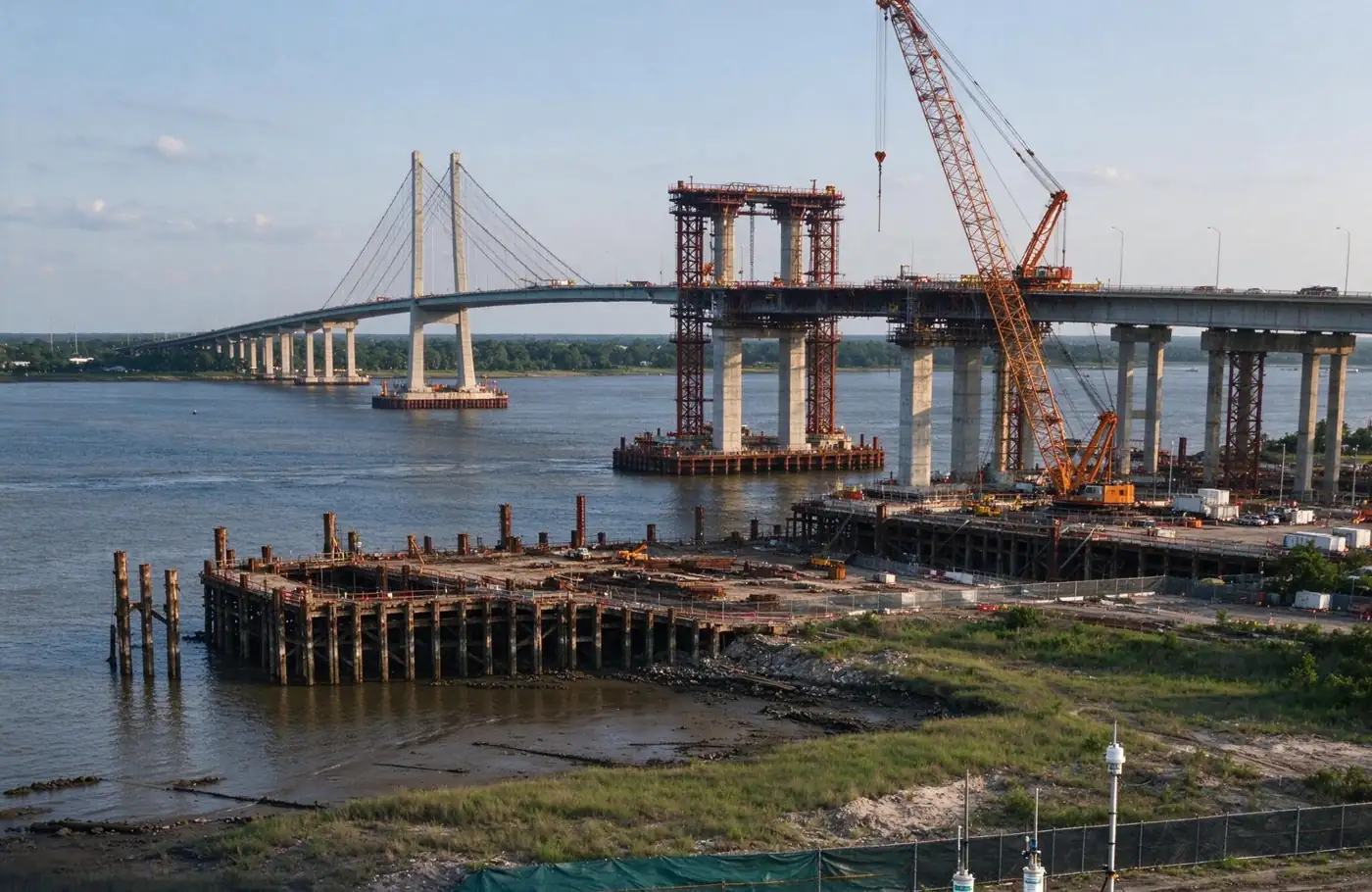
Crews broke ground on the Mobile River Bridge and Bayway project in October, and the job should take roughly five years. The centerpiece is a cable-stayed span carrying six lanes over the Mobile River. The project also calls for restriping the existing Bayway, the twin I-10 spans that carry traffic across Mobile Bay between Mobile and Baldwin County, so that it can carry six lanes.
The bridge is meant to ease the long-standing bottleneck at the George C. Wallace Tunnel, which funnels I-10 traffic under the Mobile River and has been a chronic source of congestion for decades. Its footings on the downtown side are what bring the project onto the former shipyard land.
Riverfront property in downtown Mobile has a long industrial history tied to shipbuilding, ship repair and port operations. Sites with that kind of past frequently carry legacy pollution that has to be dealt with before new construction or public use.
What Comes Next
ALDOT has said the cleanup plan will be made public once it is complete, but it has not given a date for its release. Mobile Baykeeper has made clear that it wants to see the full document so the community can evaluate how the contaminated soil will be handled.
Several questions remain open until the plan is released, including the full extent of contamination across the two parcels, how much soil will be excavated and where it will go, and how the protective cap will be inspected and maintained once the bridge is finished and the green space opens.
Key Points
- Soil at the former Bender Shipbuilding site, where new bridge footings will be built, contains PCBs, lead, mercury and arsenic.
- Southern Earth Sciences tested soil from 31 locations and groundwater from 11 temporary wells on parcels along Royal Street and Old Water Street between February and October 2024.
- The site assessment warned of possible exposure for construction workers and future users of planned public green space without protective measures.
- The public comment period on the voluntary cleanup plan ended Nov. 13, but the plan itself has not been released.
- ADEM approved ALDOT’s participation in the voluntary cleanup program this summer; ALDOT says the plan is nearly finished and will be shared with the public.
- Planned protections include dust-controlling ground cover, proper disposal of excavated soil, paved areas and a permanent cap with no less than two feet of clay beneath a six-inch layer of planted topsoil.
- The $3.2 billion bridge and Bayway project got underway in October and should take about five years to build.