Environmental Group Presses Baldwin County Commission to Turn Smart Growth Guidance Into Enforceable Rules
At a Fairhope town hall, Mobile Baykeeper laid out a Smart Growth Blueprint for Baldwin County and asked residents to lobby county commissioners for stronger wastewater, stormwater and subdivision standards.
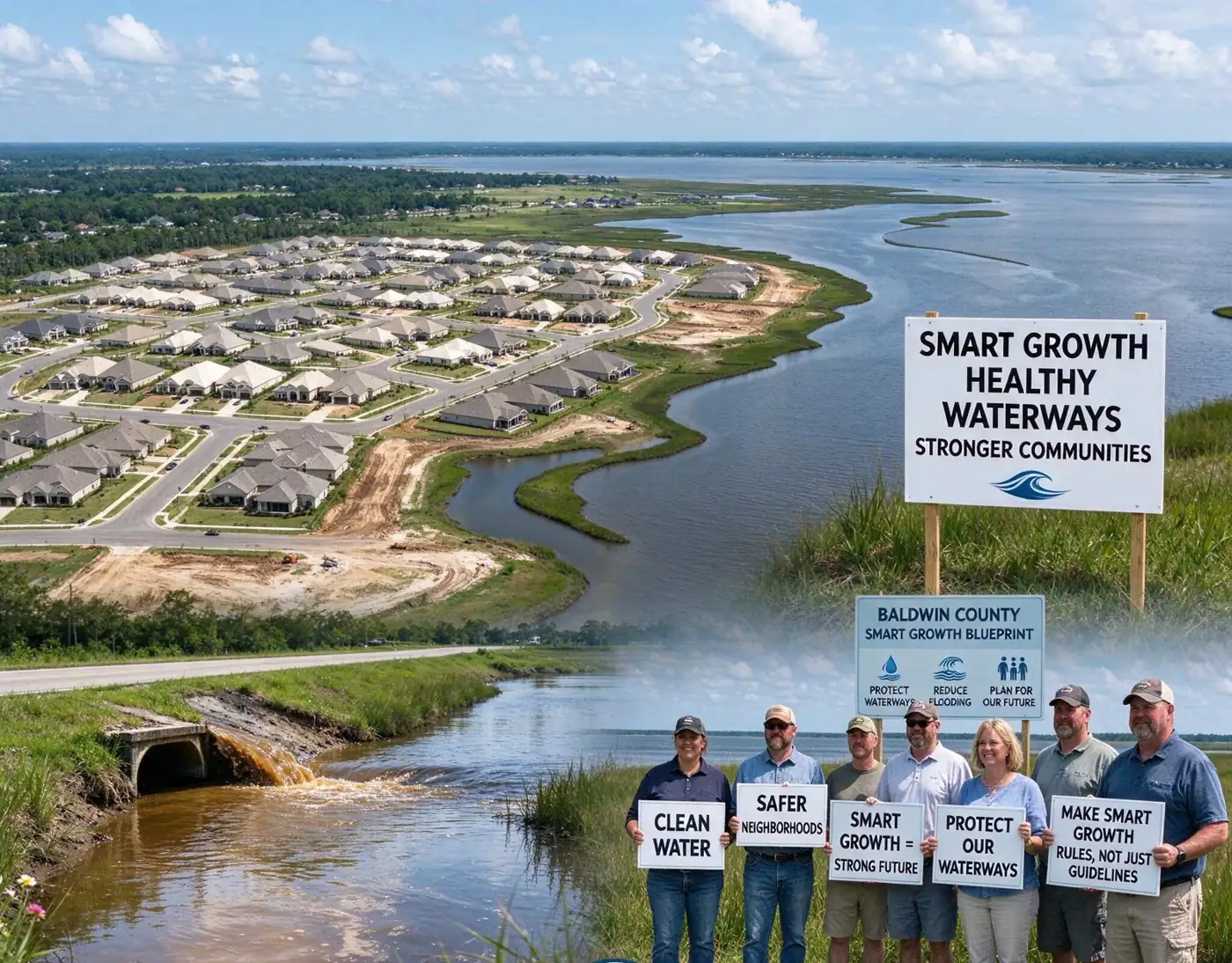
FAIRHOPE, Ala. — Baldwin County’s population boom is outrunning the pipes, ditches and permits meant to manage it, and the county’s waterways are paying the price, an environmental advocacy group told residents at a recent town hall in Fairhope. The group, Mobile Baykeeper, used the meeting to unveil its Baldwin County Smart Growth Blueprint and to recruit citizens to carry its recommendations to the Baldwin County Commission.
The nonprofit’s central message was that many of the good ideas for managing growth in Baldwin County already exist on paper as recommendations, but too few of them carry the force of law. The organization wants the county to convert that guidance into rules it can enforce, and it argued that only residents speaking up can make that happen.
The Problems the Group Says Growth Has Created
A Mobile Baykeeper representative told the audience that the speed of development in the county has contributed to a series of environmental problems. Among those the group highlighted:
- Sewage spills from wastewater systems strained by new connections.
- More stormwater runoff flowing off rooftops, roads and parking lots into creeks, rivers and bays.
- Loss of wetlands that once soaked up floodwater and filtered pollutants.
- Declining seagrass in local waters, an important nursery habitat for fish, shrimp and crabs.
The organization said its aim is a pattern of growth that safeguards both local waters and the way of life that draws so many people to the county in the first place.
What the Smart Growth Blueprint Recommends
The blueprint is a set of policy recommendations meant to protect waterways, cut down on flooding and make sure roads, sewers and drainage keep up with new construction. Its main proposals fall into four areas.
Wastewater capacity
The plan calls for tougher requirements tying new development to proof that adequate wastewater treatment capacity exists. When sewer lines and treatment plants are pushed beyond what they were built to handle, heavy rains can lead to overflows that send untreated or partially treated sewage into streets, ditches and waterways.
Stormwater management
The blueprint seeks better handling of the rainwater that runs off developed land. Natural ground absorbs much of the rain that falls on it, but pavement and rooftops do not, so each new subdivision or shopping center can increase the volume and speed of water rushing downhill. That runoff carries sediment, fertilizer, oil and other pollutants and can worsen flooding for neighbors downstream.
Conservation subdivisions
The group favors conservation subdivisions, a design approach that groups homes more closely together on part of a property while setting aside a large share of the land as permanent open space. Done well, that layout can protect wetlands, stream buffers and woods, and it can reduce the length of streets and pipes a developer needs to build.
Permitting efficiency
Not every recommendation is a new restriction. The blueprint also calls for a more efficient permitting process, a nod to the idea that clear, predictable rules can benefit builders as well as the environment.
A Former Local Leader Offers a Counterweight
The town hall also heard from a former mayor of a Baldwin County city, who agreed that the county faces real development problems but cautioned against overlooking the progress already made. He said a great deal of work has gone into the issue and that approaches to managing growth have improved.
He pointed to stronger stormwater regulations and requirements the county has already put in place. He also addressed the idea of reducing the amount of pavement in new projects, acknowledging that less paving could cut down on runoff while noting that any such change has to account for safety concerns.
His broader point was one of balance. Environmental protections, he said, have to be weighed against public safety and the cost of development, and he urged both residents and officials to think through how proposed policies would actually work on the ground before adopting them.
The Case for Countywide Standards
Mobile Baykeeper’s response centered on consistency. The group argued that adopting countywide standards would let officials handle development concerns the same way every time, instead of reacting project by project as each new subdivision or commercial site comes up for review.
The organization also rejected the idea that protecting water and allowing growth are at odds. Its representative said sound rules can protect the county while still letting development move forward effectively.
Case-by-case decision making can leave both neighbors and developers uncertain about what will be required. Clear standards written into county regulations, by contrast, tell everyone in advance what a project must include, whether that is a stormwater pond, a buffer along a creek, or confirmation that sewer capacity is available.
What Residents Are Being Asked to Do
The town hall closed with a call to action. Mobile Baykeeper asked residents to:
- Show up at meetings of the Baldwin County Commission.
- Contact their county commissioners directly.
- Speak up in support of the blueprint’s recommendations.
The group stressed that the county has the ability to adopt many of these measures, but that nothing will change unless the County Commission chooses to act. Residents who want to participate can find meeting dates, agendas and contact information for commissioners on the Baldwin County Commission’s official website. Public comment opportunities are typically listed on meeting agendas.
Why Baldwin County Is Under Pressure
Baldwin County has been one of the fastest-growing counties in Alabama for years. The 2020 census counted 231,767 residents, up from roughly 182,000 a decade earlier, and growth has continued since. New neighborhoods have spread across the Eastern Shore, along the Highway 59 corridor through Loxley, Robertsdale and Foley, and toward the beach cities of Gulf Shores and Orange Beach.
That growth has brought jobs, tax revenue and new amenities, but it has also challenged local governments and utilities. Sewer providers have had to expand treatment plants and lines, and roads that once served farm traffic now carry commuters. Low-lying land and heavy Gulf Coast rainfall make drainage an especially sensitive issue, since water that once spread across fields and wetlands is now funneled through culverts and channels.
Authority over land use in Alabama is also divided. Cities regulate development inside their limits and, in some cases, within planning jurisdictions beyond them. In unincorporated Baldwin County, zoning applies through planning districts, and the county’s subdivision and stormwater rules govern how land can be divided and drained. That mix of rules is one reason advocates focus on countywide standards that would apply evenly.
About Mobile Baykeeper
Mobile Baykeeper is a nonprofit organization based in coastal Alabama that works to protect the waters of the Mobile Bay watershed, one of the largest river systems in the country. It is part of the international Waterkeeper Alliance network of local water advocates. The group monitors water quality, tracks sewage spills and pollution, comments on permits, and pushes for policies aimed at keeping rivers, bays and beaches clean for swimming, fishing and drinking.
Why Seagrass and Wetlands Matter
Two of the losses the group highlighted, wetlands and seagrass, play outsized roles in coastal ecosystems. Wetlands act like natural sponges, holding floodwater during storms and releasing it slowly, while their plants trap sediment and absorb nutrients that would otherwise feed algae blooms. Seagrass beds in shallow bays and bayous shelter young fish and shellfish, stabilize the bottom and improve water clarity.
Both are sensitive to the effects of runoff. Muddy water blocks the sunlight seagrass needs to grow, and excess nutrients from fertilizer and sewage can fuel algae that smother it. Wetlands, meanwhile, can be filled or drained for construction, and once lost they are difficult and expensive to restore.
Tips for Residents Who Want to Weigh In
People who have not spoken at a county government meeting before may find the process easier than expected. A few practical pointers:
- Review the agenda ahead of time, since items are often posted several days before a meeting.
- Learn which commissioner represents your district, and reach out by phone or email with specific concerns.
- Keep public comments brief and focused, and bring photos or details if you have experienced flooding or sewage problems near your home.
- Follow up in writing so your comments become part of the record.
Residents who see a sewage overflow or other pollution can also report it to the Alabama Department of Environmental Management, the state agency that regulates wastewater and stormwater discharges.
What Comes Next
The blueprint does not take effect on its own. Any of its recommendations would have to be adopted by the Baldwin County Commission or other governing bodies, likely after staff review and public hearings. The debate at the Fairhope town hall, with an advocacy group calling for firmer rules and a former local leader urging attention to cost and safety, previews the kind of discussion commissioners are likely to face if they take up the proposals.
For now, Mobile Baykeeper’s strategy is to build public pressure. The group is betting that residents who see the effects of rapid growth in flooded yards, closed swimming areas or murky water will show up at commission meetings and ask for change.