Mobile County Health Department Marks GIS Day by Honoring Its Data and Epidemiology Mapping Team
The Mobile County Health Department used GIS Day to highlight its Data Analytics and Epidemiology Team, whose maps and online tools track mosquitoes, restaurant scores and community health needs.
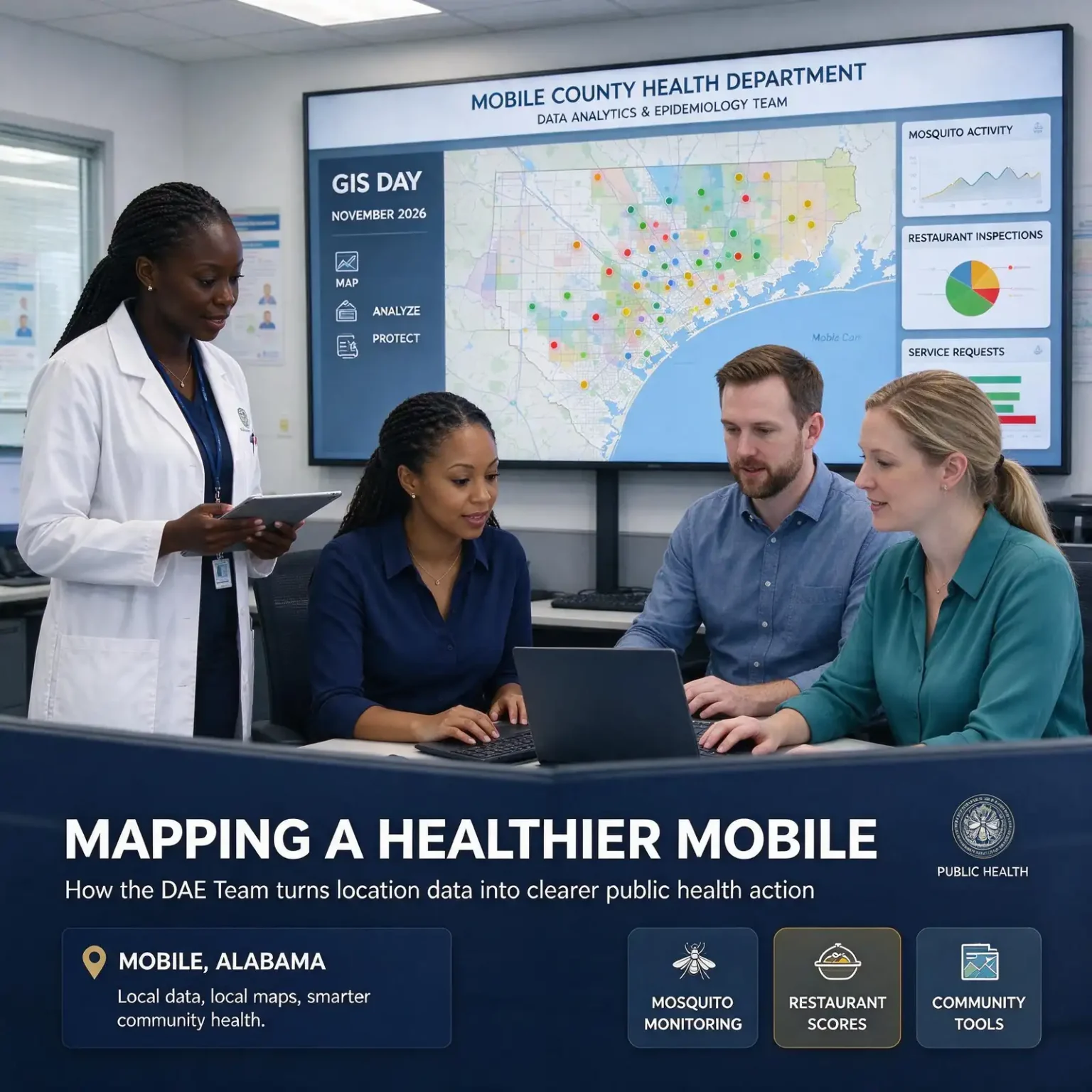
MOBILE, Ala. — The Mobile County Health Department is using this year’s GIS Day to spotlight an in-house group whose maps, data reports and online tools have become part of how the agency tracks disease, plans services and shares information with residents.
The group, formally called the Data Analytics and Epidemiology Team, or DAE Team, has relied on mapping software from Esri since 2020. Its first major mapping work was built for the department’s COVID-19 reporting, and the team has since expanded into a long list of public-facing tools, from a mosquito monitoring site to an application that lets residents look up restaurant inspection scores.
The department said the team has more work planned for 2027 aimed at widening outreach and education for both the public and the organizations that partner with the agency.
What GIS Day Celebrates
GIS Day is an annual observance devoted to geographic information systems, the family of technologies used to collect, organize, analyze and display information tied to specific places on a map. The first GIS Day was held in 1999, which makes 2026 the observance’s 27th year. It takes place each November, and schools, government agencies, universities and businesses around the world use it to show how location-based data helps solve everyday problems.
At its simplest, a GIS lets users stack different layers of information on top of one another. A single map might combine street addresses, census boundaries, water features and reported cases of an illness, allowing analysts to see patterns that would be hard to spot in a spreadsheet. That ability to connect health information to geography is why public health agencies across the country have increasingly built mapping into their daily operations.
A long tradition in public health
Mapping disease is not new. One of the best-known examples in the history of public health dates to 1854, when physician John Snow plotted cholera deaths in a London neighborhood and traced the outbreak to a contaminated water pump. Modern software has made that kind of analysis far faster and more detailed, but the basic idea remains the same: where people live, work and gather can reveal a great deal about the health risks they face.
Who Is on the Team
The DAE Team brings together three kinds of specialists:
- Epidemiologists, who study how diseases and health conditions are distributed in a population and what factors drive them.
- Data analysts, who clean, organize and interpret large sets of information.
- GIS analysts, who turn location-based data into maps and spatial analyses.
The team gathers data at both the local and national level, evaluates it and produces visual summaries and written reports. The department said those products help shed light on ongoing public health work and point to unmet needs in the community. Partner organizations help the team develop and circulate the reports.
National Recognition in 2023
The team’s work drew attention beyond Mobile County in 2023, when it received a Special Achievement in GIS Award at the Esri User Conference in San Diego. That annual event draws more GIS users than any other conference of its kind worldwide.
The award honored the department’s online public portal for requesting mosquito and rodent control services. The portal gives residents a direct way to report problems and ask for help from the agency’s vector control staff without having to call or visit an office.
Esri, a geographic information systems company based in Redlands, California, presents Special Achievement in GIS awards each year to organizations it considers to have used mapping technology in innovative or meaningful ways. Recipients range from small local agencies to large national and international bodies.
Tools Already in Residents’ Hands
According to the department, the team has finished a number of projects designed to make health information easier for the public to find and use.
Online hub sites
Several hub sites have been launched to broaden the department’s community outreach:
- Healthy Communities Project Hub — focused on delivering education and outreach to vulnerable populations.
- Overdose Prevention Resource Hub — a central collection of resources related to preventing drug overdoses.
- Mosquito Monitoring Hub — explains the department’s vector monitoring activity and offers prevention guidance for residents.
Restaurant inspection scores
The team also built an application for the department’s Inspection Services division that allows the public to see restaurant scores in Mobile County. The department described the tool as a way to bring more transparency to food safety inspections.
County health departments in Alabama carry out routine inspections of restaurants and other food service establishments to check for issues such as proper food temperatures, sanitation and safe handling practices. Making those results searchable gives diners a simple way to check on places they plan to visit.
Awareness graphics
The team has produced infographics on three topics that are especially relevant along the Gulf Coast:
- Preventing mosquito bites and mosquito breeding
- Recognizing and preventing heat stroke
- Raising awareness about overdoses
Projects Now Under Way
The department listed three efforts the team is currently working on:
- Internal process improvements intended to help the department keep delivering thorough and dependable health services.
- Expanded data sharing, with broader data reports meant to give community partners and the public access to more health information.
- A Community Health Assessment, a publication that will document and report health care needs raised by local residents.
What a Community Health Assessment does
Community health assessments are a standard tool in public health. Health departments typically use them to gather information about a population’s health status, the conditions that affect it and the resources available to address problems. The process often combines statistics with input collected directly from residents, community groups and health care providers. The findings are commonly used to set priorities and guide planning for programs and partnerships in the years that follow.
Because the Mobile County assessment draws on needs submitted by people who live in the area, it is designed to reflect local concerns rather than relying solely on numbers from outside sources.
Why Mosquito and Rodent Data Matter Locally
Two of the team’s best-known products, the award-winning service request portal and the Mosquito Monitoring Hub, both relate to vector control, the public health work of managing animals and insects that can spread disease.
Mobile County’s warm, humid climate and abundant rainfall create conditions in which mosquitoes thrive for much of the year. Some mosquito species can carry illnesses such as West Nile virus. Health officials generally advise residents to reduce mosquito breeding by emptying containers that hold standing water, such as buckets, flowerpot saucers, old tires and birdbaths, and to use an EPA-registered insect repellent when spending time outdoors.
Mapping where residents report problems, and where monitoring finds mosquito activity, can help an agency decide where to focus its field crews and where to direct education efforts.
Looking Ahead to 2027
A member of the team said more projects are on the schedule for 2027, all aimed at broadening outreach and education for residents and for the department’s community partners.
The county’s health officer said the upcoming projects, together with the department’s community partnerships, open the door to addressing the health care needs of both the people who live in Mobile County and those who visit it. He added that the department’s goal is for people in the county to be safe.
How Residents Can Use the Department’s Data Tools
For residents who want to take advantage of the team’s work, the department’s online resources offer several practical starting points:
- Use the online request portal to ask for mosquito or rodent control services.
- Check the Mosquito Monitoring Hub for information on vector activity and prevention tips.
- Look up restaurant inspection scores before dining out.
- Visit the Overdose Prevention Resource Hub for information on overdose prevention resources.
- Watch for the upcoming Community Health Assessment, which will summarize health needs identified by local residents.
The Mobile County Health Department serves all of Mobile County in Alabama’s southwest corner, including the city of Mobile and the county’s smaller cities and unincorporated communities. Residents with questions about any of these services can contact the department directly.