Mobile County Schools Hit Record 86 on State Report Card as Grant, Davidson Post Big Gains
Mobile County Public Schools earned an 86 on the Alabama State Report Card, its best ever, with 16 A schools, two perfect 100s and six campuses gaining 11 points or more, though four schools received failing grades.
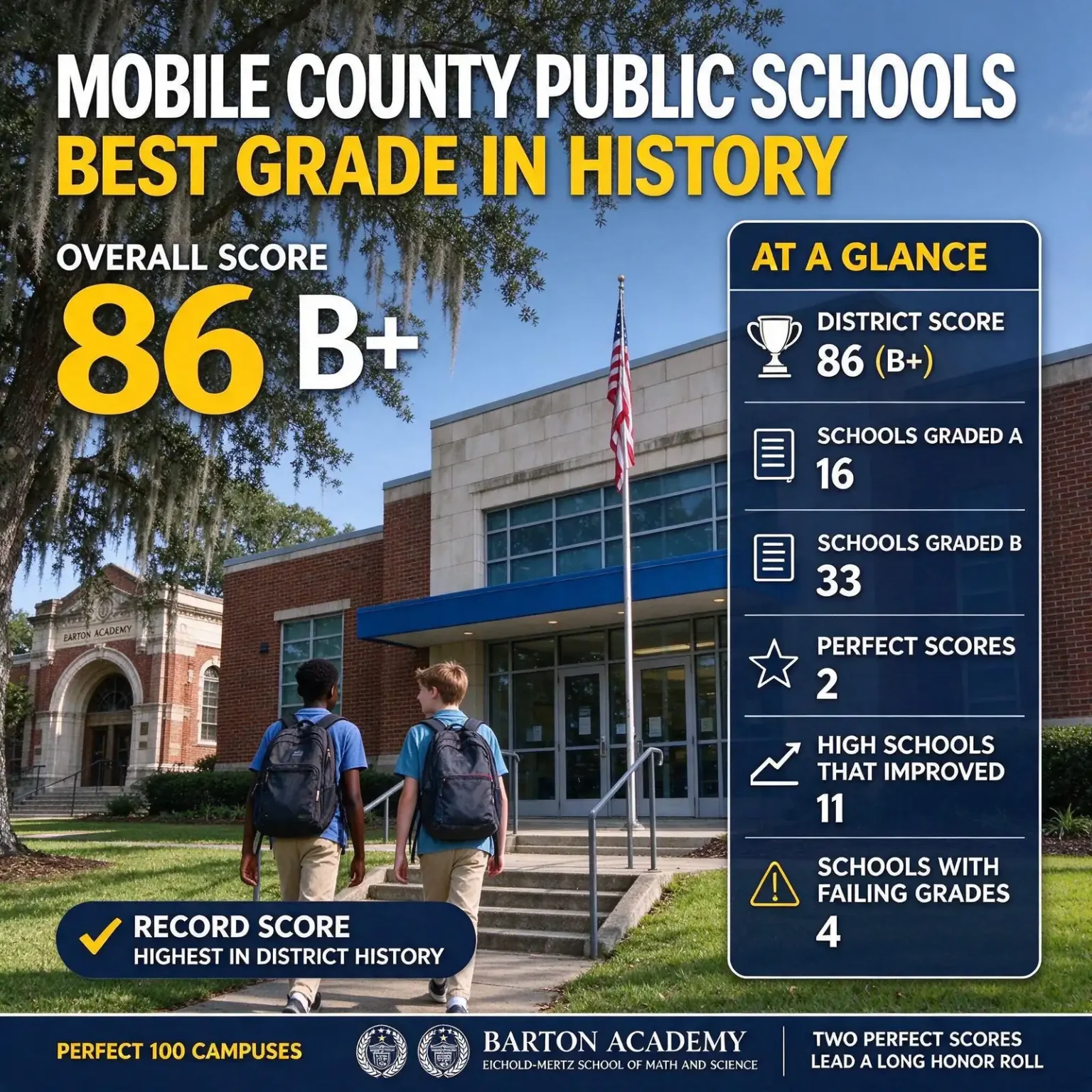
MOBILE, Ala. — The Mobile County Public School System has posted the best grade in its history on the Alabama State Report Card, earning an overall score of 86, which district leaders are calling a B+. The record-setting mark arrives with a long list of individual campus successes, from two perfect scores to double-digit jumps at elementary and high schools across the county, along with a reminder that four schools still landed in failing territory.
The results give families across Mobile County a fresh look at how their neighborhood schools performed during the 2025-26 school year, and they set the stage for months of planning as principals and central-office staff decide where to focus next.
At a Glance: The District’s Numbers
- District score: 86, the highest the system has ever recorded
- Schools graded A: 16
- Schools graded B: 33
- Perfect scores: 2
- Schools that held steady: 10, including both perfect-score campuses
- High schools that improved: 11
- Schools with failing grades: 4, two elementary and two middle schools
Two Perfect 100s Lead a Long Honor Roll
Barton Academy for Advanced World Studies and Eichold-Mertz School of Math and Science each scored a perfect 100, putting them among the highest-rated public schools anywhere in Alabama. Both schools matched their scores from the previous year.
Barton Academy operates as a magnet school inside the historic Barton Academy building in downtown Mobile, a structure that dates to the 1830s and is one of the oldest public school buildings in the state. Eichold-Mertz is a magnet elementary school with a focus on math and science.
Just behind them, a cluster of campuses scored in the high 90s and low 90s:
- 99: Council Traditional School, Dauphin Island Elementary and Old Shell Road School of Creative and Performing Arts
- 98: Phillips Preparatory
- 97: Denton Magnet School of Technology and Clark-Shaw School of Math, Science and Technology
- 93: J.E. Turner Elementary and O’Rourke Elementary
- 92: Dawes Intermediate, along with Collier, Hutchens, Taylor-White and Tanner Williams elementary schools
- 91: Castlen Elementary
The list is notable for its geographic spread. Magnet programs in the city of Mobile sit alongside traditional zoned schools in west Mobile County and a small island elementary school on Dauphin Island, showing that high marks were not limited to a single type of campus or a single part of the county.
The Biggest Climbers
While the top-rated schools drew attention, some of the most striking results came from schools that made major leaps over the prior year. Six schools improved by 11 points or more:
- Grant Elementary: up 27 points, from 48 to 75, the largest gain in the district
- Callahan School for the Deaf and Blind: up 18 points
- Davidson High School: up 13 points to 87
- John Will Elementary: up 12 points to 82
- Dixon Elementary: up 11 points to 83
- Theodore High School: up 11 points to 83
Grant’s jump is especially significant because a 48 falls well inside the F range on Alabama’s grading scale, while a 75 is a C. Moving from one end of that scale to the middle in a single year is the kind of turnaround that state and local education officials point to as evidence that targeted support can work.
Beyond those six, district figures show 26 schools improved by one to five points and eight schools improved by six to 10 points. Among high schools specifically, 11 posted higher scores than the year before.
How the District Says It Got There
District academic leaders described the improvement as the product of years of work rather than a one-year spike. An academic supervisor with the system said each school is assigned specific targets every year, and that tailoring the plan to the needs of each campus has helped lift the district as a whole. Central-office staff visit schools and hold discussions with teachers and principals so that every campus has a concrete plan of action for raising its scores, the supervisor said.
Inside classrooms, that strategy has translated into changes in how subjects such as math are taught. A district math coach said teachers have become more hands-on with students and have focused on helping them understand the reasoning behind mathematical concepts, which the coach credited for much of the improvement in math results.
The coach also pointed to the work teachers have done on their own development. Educators attended professional development sessions and training, and they asked for help when they needed it, the coach said, describing a culture in which teachers readily consult colleagues in the grade above or below their own to figure out how to close gaps in student learning as children move from one grade to the next. For many teachers, the coach said, seeing the scores rise confirmed that the early mornings and late afternoons they have put in are paying off.
The superintendent credited the record score to determination, resilience and commitment, and above all to everyone in the system working toward the same goal of success for every student. He acknowledged that district data shows many students face real struggles, but said the 86 demonstrates that those students are resilient and on a path to success because of the dedication of their teachers.
Four Schools Still Graded F
The celebration came with a sober counterpoint. Four Mobile County schools, two at the elementary level and two at the middle school level, received failing grades on this year’s report card.
That outcome carries practical consequences for families. Under Alabama’s school choice law, students who attend eligible failing schools have the option of transferring to a different school. The state’s framework for that option traces back to the Alabama Accountability Act of 2013, which created transfer rights and related options for students zoned to schools labeled as failing. Parents at affected schools who want to learn more about transfers should contact the school system directly to ask about eligibility, deadlines and which receiving schools have space.
On the high school side, the trend lines are more encouraging. Mobile County has not had a high school receive a failing grade since 2022.
District leaders have said the work is far from finished. Their focus now is on building on this year’s gains and bringing more schools up alongside the top performers.
How Alabama Grades Its Schools
The Alabama State Department of Education issues report cards every year for each public school and each school system in the state. The grades are built from several measures, each weighted within a 100-point formula:
- Academic achievement: how students perform on state standardized tests in reading and math
- Academic growth: how much students improve on those tests from one year to the next
- Chronic absenteeism: the share of students who miss a significant number of school days, which reflects attendance
- Graduation rate: for high schools, the share of students who finish within four years
- College and career readiness: for high schools, the share of graduates who meet at least one benchmark showing preparation for college or work
- English language proficiency: progress made by students who are learning English
Different tests feed into the formula depending on grade level. Elementary and middle schools are measured with the Alabama Comprehensive Assessment Program, known as ACAP. High schools are measured in part through the ACT, the widely used college entrance exam, which Alabama administers to its high school juniors.
Numerical scores convert to letter grades on a familiar scale: 90 and above is an A, 80 to 89 is a B, 70 to 79 is a C, 60 to 69 is a D, and anything below 60 is an F. The state assigns the letter, while the plus that Mobile County attaches to its 86 reflects where the score sits within the B range.
Reading a school’s score
Because the formula blends several indicators, two schools with the same overall grade can have very different strengths. One may post high achievement but modest growth, while another may have lower test scores but strong year-over-year gains. Parents who want a full picture of their child’s school can look up the detailed report card on the state education department’s website, where each indicator is broken out separately.
Graduation and college and career readiness figures are based on the previous graduating class, so those parts of a high school’s score trail the testing data by a year. Attendance has become an increasingly important piece of the formula in recent years as schools across the country have worked to reduce chronic absenteeism.
Why the District Score Matters
Mobile County Public Schools is one of the largest school systems in Alabama, serving tens of thousands of students in the city of Mobile and in communities stretching from Citronelle and Mount Vernon in the north to Bayou La Batre, Grand Bay and Dauphin Island along the coast. With that much variety in size and setting, the district’s overall score reflects a wide mix of campuses, from large comprehensive high schools to small neighborhood elementary schools and specialized magnet programs.
A higher district grade can matter beyond bragging rights. Report card results are widely watched by families deciding where to live, by employers evaluating the region’s workforce pipeline and by economic development officials making the case for new investment in Mobile County. For teachers and principals, the scores serve as an annual checkpoint showing which strategies are working and where students still need more help.
Statewide report cards for the 2025-26 school year were released earlier this month, and Alabama’s public schools as a whole posted their strongest overall results since letter grades were introduced. Mobile County’s record score places the district firmly within that broader upward trend.
What Families Can Do Next
- Look up your school: Detailed report cards for every Mobile County school are available through the Alabama State Department of Education.
- Ask questions: Teachers and principals can explain what the indicators mean for a specific campus and what improvement plans are in place.
- Check transfer options: Families at schools with failing grades can contact the district about eligibility to transfer under state law.
- Stay involved: Regular attendance is part of every school’s score, so helping students get to class every day directly supports both learning and the school’s grade.
- Follow the school board: Report card results typically shape discussion at Mobile County Board of School Commissioners meetings in the months that follow.
With a record district score, a pair of perfect campuses and dozens of schools moving in the right direction, Mobile County enters the rest of the school year with momentum. The four schools that fell short, and the students who attend them, are likely to be at the center of the district’s next round of improvement plans.