Clarke County Commissioner Moye Named to National Policy Panel
Clarke County Commissioner Tyrone Moye has been appointed to a National Association of Counties policy steering committee focused on economic and workforce development.
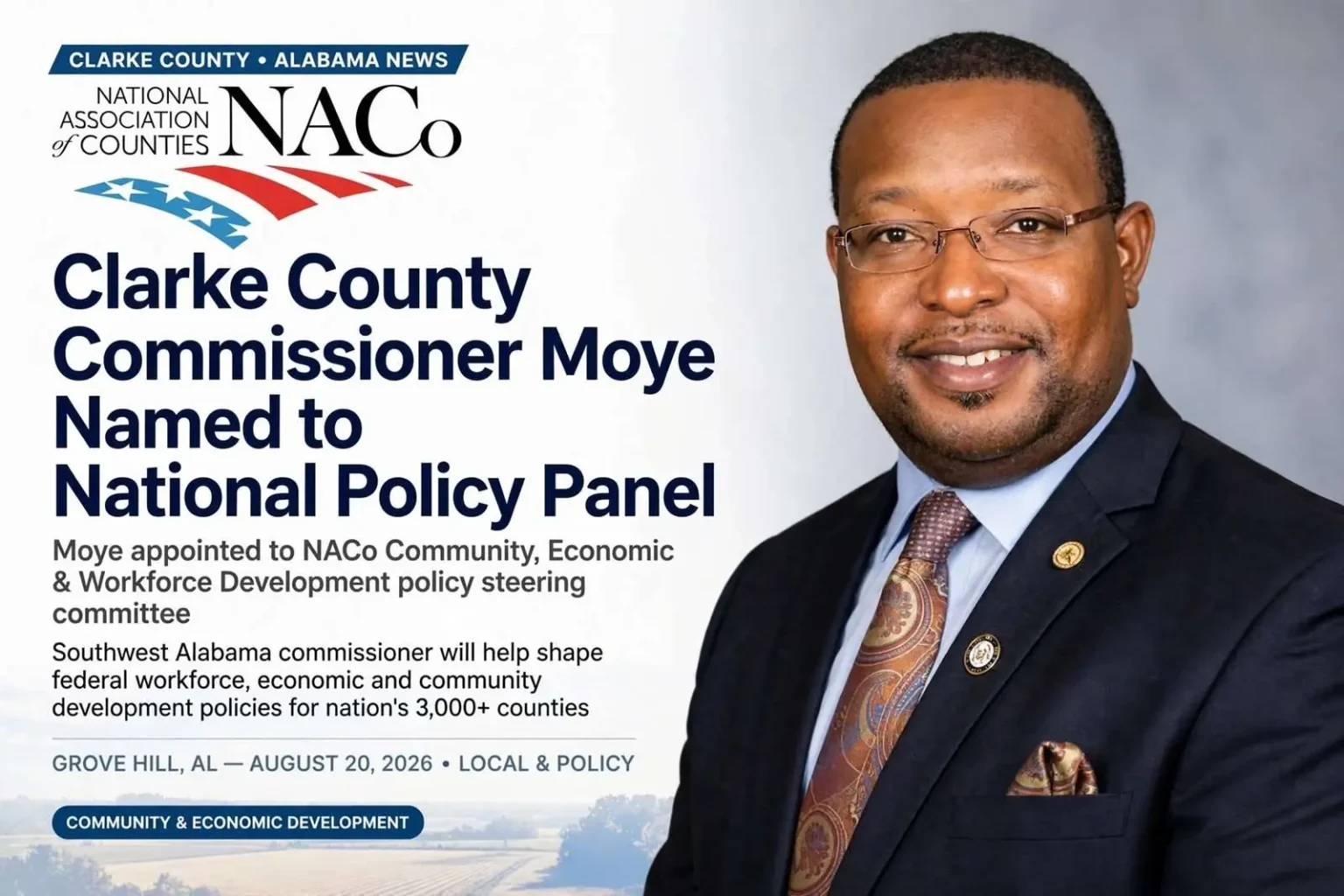
Clarke County Commissioner Tyrone Moye has been appointed to the National Association of Counties Community, Economic and Workforce Development policy steering committee. The national committee plays a key role in shaping policies that strengthen local economies, expand workforce opportunities and support community development across the country. The appointment places a southwest Alabama county official in a position to help set the legislative priorities of the nation’s largest county-level advocacy organization.
The National Association of Counties, known as NACo, represents the more than 3,000 county governments in the United States from its headquarters in Washington, D.C. Its policy structure is built around steering committees that meet during the year to draft positions on federal legislation and regulation affecting counties. Those positions become the association’s official policy platform, which its Washington staff uses when lobbying Congress and federal agencies. For counties like Clarke County, which depend heavily on federal programs for roads, public safety, rural health and economic development, having a voice in that platform is a direct channel to national decision-making.
What the Committee Does
The Community, Economic and Workforce Development steering committee focuses on issues that sit squarely in the middle of rural Alabama’s challenges: attracting jobs to areas with limited infrastructure, preparing workers for modern industries, supporting small business growth, expanding broadband access and ensuring that federal community development dollars reach communities that need them most. The committee’s work touches programs administered by the U.S. Department of Agriculture, the Department of Housing and Urban Development, the Economic Development Administration and the Department of Labor, among others.
Members of NACo steering committees are appointed by the association’s president and typically serve alongside county commissioners, judges and executives from across the country. The committee meets in person at NACo’s legislative conference in the winter and its annual conference in the summer, with additional work conducted by teleconference between meetings. Members are expected to review proposed policy resolutions, debate their merits and vote on the language that ultimately goes to the full membership.
For Moye, the appointment means bringing Clarke County’s perspective to those deliberations. Rural counties in Alabama face a distinct set of circumstances compared with suburban and urban members of the committee: smaller tax bases, older infrastructure, limited public transportation and difficulty competing for economic development projects that often favor metro areas. Commissioners from such counties have historically used national committee seats to press for formula-based funding and rural set-asides in federal programs, arguing that competitive grants too often bypass small counties that lack grant-writing staff.
Why It Matters for Clarke County
Clarke County, with its seat in Grove Hill, is one of Alabama’s Black Belt counties, a region that stretches across the central and southern part of the state and has long faced elevated poverty rates and limited economic opportunity. The county’s economy has traditionally rested on timber, paper manufacturing and agriculture, industries that have consolidated over recent decades. Attracting new employers and preparing residents for available jobs are standing priorities for the county commission, and the subjects the steering committee addresses are the same ones that determine whether federal assistance flows to those efforts.
County commissions in Alabama are responsible for roads, bridges, solid waste, emergency management and law enforcement support, and county leaders routinely argue that federal policy decisions made in Washington — from transportation funding formulas to workforce development grants — shape their ability to deliver those services. A commissioner serving on a national steering committee gains early visibility into pending federal legislation and can advocate directly for provisions that benefit counties back home.
NACo’s policy process is designed to translate local experience into national advocacy. When a county encounters a problem — an unfunded federal mandate, a gap in rural broadband coverage, a workforce program that does not fit small communities — the commissioner can bring that issue to the steering committee, propose a resolution and, if adopted, see it become part of the association’s agenda in Congress. Over the years, positions advanced through NACo committees have influenced legislation on infrastructure, opioid response, rural health care and disaster recovery.
Service and Representation
Moye serves on the Clarke County Commission, the five-member governing body that sets county policy, adopts the budget and oversees county departments. Commissioners in Alabama’s rural counties typically balance their public service with private careers, and those who take on national roles do so on top of local duties. National committee service involves travel to conference cities and significant preparation, but counties often see the investment returned in the form of relationships, information and access that benefit local projects.
The appointment also reflects the broader engagement of Alabama county officials in NACo. Delegations from the Association of County Commissions of Alabama, the state’s NACo affiliate, regularly participate in national conferences and hold seats on steering committees and the association’s board of directors. That participation has helped Alabama counties secure attention on issues such as rural road funding, prescription drug pricing and federal forest revenue programs that support county budgets in timber-heavy states.
Workforce development is likely to be a particularly active front for the committee in the years ahead. Rural Alabama counties continue to work on connecting residents to training for health care, advanced manufacturing and skilled trades, often through partnerships with two-year colleges in the Alabama Community College System and local workforce development councils. Federal programs such as the Workforce Innovation and Opportunity Act provide funding streams for those efforts, and the rules that govern them are exactly the kind of policy the steering committee weighs in on.
Community development block grants, brownfield remediation funding, water and sewer infrastructure programs, and broadband expansion initiatives all fall within the committee’s policy scope as well. Each of those programs has a direct bearing on small-town Alabama, where aging water systems and the digital divide remain among the most frequently cited barriers to growth.
Local officials said the appointment demonstrates that Clarke County’s voice can be heard beyond the courthouse in Grove Hill. For a county of roughly 22,000 residents, representation on a national policy body means its specific needs — from rural roads to job training — get carried into rooms where federal priorities are debated, and its commissioner returns with information and contacts that can be applied at home. It is, supporters of the appointment noted, an investment of time that pays dividends for years.
NACo membership also opens doors to federal grant programs and technical assistance that individual counties can struggle to navigate alone. The association operates practice networks where county staff share model programs, publishes research on county finances and service delivery, and runs direct advocacy campaigns during congressional session. Counties of every size participate, and small counties often gain the most because the association’s staff in Washington effectively serves as an extension of a county government that cannot maintain its own federal affairs office.
The committee structure splits NACo’s policy work into broad areas — in addition to Community, Economic and Workforce Development, there are committees covering transportation and public works, justice and public safety, health, human services and education, environment, energy and land use, and government operations. Resolutions adopted by steering committees are then considered by the full policy body, and the positions expire and are renewed on a regular cycle so the platform keeps pace with changing federal law.
A Long Tradition of County Leadership
County commissioners from Alabama have a long history of taking roles in NACo leadership, and several have served as the association’s national president over the decades. That tradition reflects the reality that Alabama’s 67 counties rely on federal partnerships for a substantial share of their road funding, emergency management resources and community development dollars. The Alabama association coordinates the state’s delegation and helps arrange appointments so that counties of different sizes and regions are represented.
For residents of Clarke County, the practical effects of such service show up in concrete ways: advance notice of federal grant opportunities, a contact at the national level when a local project hits a regulatory wall, and a vote in Washington on the policy positions that shape how Congress treats rural counties. Commissioners who serve on steering committees frequently report that the relationships built with officials from other states prove as valuable as the formal policy work, since solutions to common rural problems — aging bridges, volunteer fire department recruitment, hospital closures — have often already been tested somewhere else.
The Clarke County Commission’s regular meetings in Grove Hill continue to be where local decisions are made, but appointments like this one extend the county’s reach. Officials indicated that Moye would bring back information from the committee’s meetings and apply it to the county’s ongoing economic development efforts, which focus on supporting existing industry, recruiting new employers to the region and improving the workforce readiness of county residents.