Grove Hill Council Hires Local Business Owner Zachary Hughes as New Police Officer
Grove Hill hired lifelong resident Zachary Hughes as a new police officer, while the council also approved a 22.5% jump in its insurance premium and several community fundraisers.
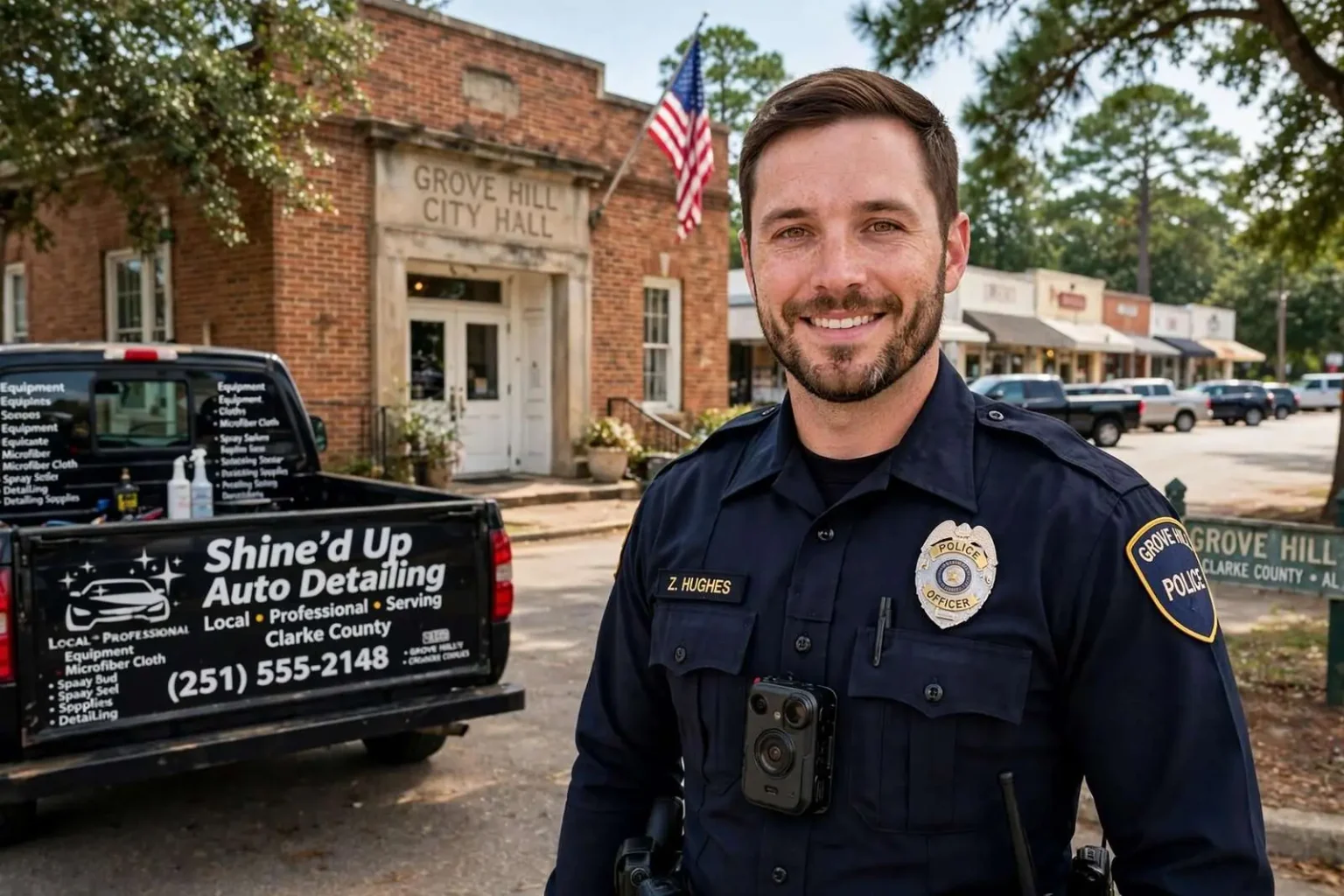
The Grove Hill City Council hired lifelong resident Zachary Hughes as a police officer during its meeting Monday, adding a familiar local face to the department’s ranks. Hughes’ hiring is contingent on him attending and completing training at the police academy, which the city will pay for. Small departments across rural Alabama regularly face the challenge of recruiting certified officers away from larger agencies, so the chance to sponsor a hometown candidate through the academy represents an investment in both the department’s future and the town’s own talent pool. The academy route, typically a dozen weeks of basic training followed by field work, will put Hughes on the street with full certification once he completes the program.
Hughes also owns a local business, Shine’d Up Auto Detailing, which he plans to continue operating alongside his new law enforcement duties. The dual role makes him a visible part of the community he will police — the kind of officer whose name and face residents already know from town, an asset in a small Clarke County seat where community relationships often matter as much as enforcement. Council members welcomed the hire as both a staffing gain and a signal that the department can attract local residents who want to serve their hometown.
Insurance costs climb with property values
In other business, the council approved a $156,929 quote from Skipper Insurance for the city’s property and liability coverage, a 22.5% increase over last year’s premium. David Skipper of Skipper Insurance told the council the increase was driven mostly by rising values of city properties, including the new fire station, along with an approximately $9,700 increase in liability coverage. Rising construction costs across the region have pushed replacement values of public buildings sharply higher in recent years, and insurers price coverage against what it would actually cost to rebuild — not what the city originally paid. The new fire station, a significant capital investment for a town of Grove Hill’s size, alone accounts for a meaningful share of the insured value on the city’s schedule of covered property.
Mayor Ross Wood said the city’s utilities board will cover the portion of the premium related to its operations, splitting the burden so that the town’s general fund does not absorb costs tied to the publicly owned utility system. The arrangement matters for a small municipal budget, where a six-figure insurance bill landing entirely in the general fund would crowd out other spending. Councilmember Phyllis Barnes abstained from the vote since Skipper is her son-in-law, a standard step to avoid any appearance of a conflict of interest when a council member has a family relationship with a vendor doing business with the city.
Fiber conversion brings permit revenue
The council also heard that TDS, the local telephone and internet provider, will pay the city $1,000 for right-of-way and construction permits as the company works to convert its copper landlines to fiber optic infrastructure. The upgrade is part of a wider industry shift: telephone companies across Alabama have been replacing aging copper networks with fiber lines capable of carrying high-speed internet, and the work requires crews to dig along public rights-of-way in towns like Grove Hill. For residents, the conversion promises faster, more reliable broadband and telephone service, a meaningful quality-of-life and economic development issue in rural counties where connectivity has historically lagged behind urban areas. For the city, the permit payments are a modest but welcome source of revenue that offsets the staff time spent reviewing where utility work crosses city streets and easements.
Fundraisers get the green light
Council members approved a boot drive fundraiser for the Clarke County High School Band Boosters, allowing volunteers to solicit donations from motorists along Jackson Street in Grove Hill on Saturday. Boot drives — the long-standing tradition of students or firefighters collecting contributions in fire boots at intersections — are a familiar sight in small Alabama towns, and the proceeds support band uniforms, instruments, travel and competition expenses that school budgets rarely cover in full. The council’s sign-off is required for collections on public streets, and the club’s request drew no objection from members who noted the boosters’ role in keeping the high school band program active.
The council also approved a 1-mile walk on Oct. 17 to benefit the McDonald House, for which the city waived its usual $50 permit fee. The Ronald McDonald House provides lodging for families of patients receiving treatment at hospitals far from home, and charity walks organized in its honor draw participants from across the region. Waiving the permit fee for the event costs the city little and puts the town’s support squarely behind the charitable cause, a common gesture for councils handling community fundraisers.
Road repair contract approved
The council additionally approved hiring local contractor Tommy Lee Chapman to make $2,875 in repairs to a washing-out road that runs behind the medical clinic building to the hospital, work that will include cement repairs and rip rap to stabilize the roadway. The route is a working access road serving the town’s medical facilities, and washouts there are more than an inconvenience: ambulances, patients and clinic staff rely on it daily. Rip rap — heavy angular rock laid along eroded edges and drainage paths — is the standard fix for the kind of water damage that unpaved and low-lying Alabama roads suffer during heavy rain, slowing runoff and holding soil in place where the water cuts hardest. Hiring a local contractor keeps the modest expenditure in the community and typically shortens the response time when follow-up work is needed.
Schedule change for the holiday
The council announced it will not meet on Sept. 7 due to the Labor Day holiday, instead rescheduling its next session later in the month. Labor Day, the federal holiday on the first Monday of September, falls on the council’s regular meeting night this year, and shifting the session avoids calling members and the public to city hall on a holiday. Residents who want to address the council or follow city business should watch for the rescheduled date, which will be posted through the city’s usual channels.
The meeting’s agenda, taken together, reflected the rhythm of a small Alabama town handling its core business: a police hire built around hometown roots, an insurance renewal that mirrors the rising cost of public infrastructure, fiber construction bringing both better connectivity and permit dollars, fundraisers that connect the schools and hospitals to the wider community, and a practical road repair protecting access to medical care. Council members will carry each item forward when they reconvene after the holiday, with the police academy sponsorship and the roadway repairs among the items to track in the months ahead.
Why the police hire matters in a small town
The academy sponsorship deserves a closer look, because it illustrates how small-town law enforcement actually works in Alabama. A town Grove Hill’s size cannot match the salaries offered by county sheriff’s offices or the cities along the coast, and departments across the state’s rural counties carry vacancies for months at a time. Sponsoring a recruit through the academy inverts the usual recruiting problem: instead of hoping a certified officer will move to town, the city builds its own. The city’s tuition investment is modest compared with the cost of an empty patrol shift, and candidates with local ties tend to stay. Hiring a resident who already runs a business downtown means an officer with roots in the community, an understanding of its streets and families, and a stake in how the town is policed.
Context: Grove Hill’s civic landscape
Grove Hill, the county seat of Clarke County, sits along U.S. Highway 84 in southwest Alabama, serving as the commercial and governmental center for a county of roughly 22,000 people spread across pineywoods communities from Jackson to Thomasville’s outskirts. The city government operates its own police department, fire service and public utilities, which is why a single council agenda can span law enforcement hiring, insurance premiums, telephone infrastructure and road repair. The new fire station that helped drive the insurance increase is among the town’s most significant recent capital projects, and the hospital and medical clinic anchor a health care presence that surrounding rural residents depend on. Against that backdrop, routine-sounding votes — a premium, a permit fee, a contractor’s bid — carry real weight for a town budget measured in modest annual figures.
The council’s handling of the family relationship on the insurance vote also reflects the realities of small-town government, where council members, vendors and officials are often relatives, neighbors or business associates. Abstention on conflicted votes is the established practice across Alabama municipal government, and its routine use keeps decisions like a six-figure insurance renewal on solid procedural ground even in a county where everyone knows everyone.