

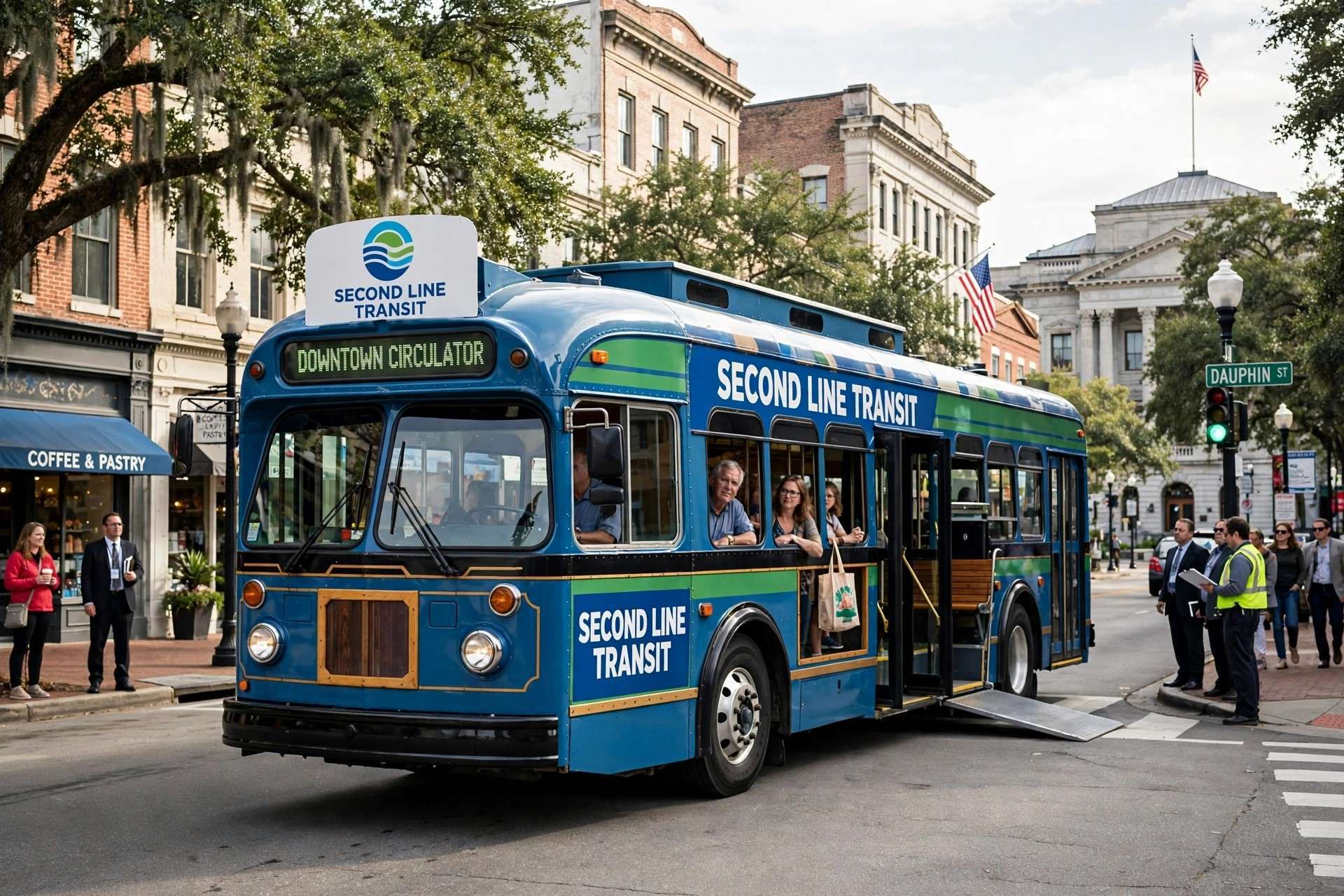
MOBILE, Ala. — Mobile’s first trolley-style bus is officially carrying riders, and Mayor Spiro Cheriogotis used its first week in service to make the case that it should be the first of many.
City leaders, reporters and a handful of community leaders took a ride through downtown on Wednesday aboard the blue-and-green trolley, the only one of its kind in the new Second Line Transit system, which replaced the city’s former bus service when it launched this week. The vehicle has wooden benches, room for about 24 passengers and a $1.25 fare.
“People just are more willing to ride these than the buses I rode on in Chicago or in New York and San Francisco,” Cheriogotis told reporters during the ride. “I rode on their buses. For whatever reason, I just don’t think people are willing to jump on those buses in a way that they would be on these trolleys.”
A used trolley from Virginia
The prototype is not new. The city bought the used trolley-style bus from the city of Roanoke, Virginia, for $173,000, then rebranded it with the Second Line Transit logo. Roanoke’s transit system has long run trolley-style buses on a downtown circulator route.
On Saturdays, the trolley will run Mobile’s downtown circulator route. During the week, it will rotate onto other routes across the city so more riders get to see and use it.
Cheriogotis has made no secret of his fondness for the vehicles. He described himself as “obsessed” with trolley-style buses on the campaign trail last year and has made them the centerpiece of his plan to redesign the city’s public transit system. His long-term goal is to replace all of the city’s larger, older buses with trolleys.
“This historical look, the history of the trolleys in San Francisco. The history that we had here. It brings a piece of nostalgia with,” the mayor said.
Six is ‘not really going to do it’
The city has applied for more than $1.3 million in federal grant money to buy about five more trolleys, but that funding has not yet been awarded. As previously reported, the council approved the application in September after Councilman Ben Reynolds urged the administration to “put the brakes on” and measure results from the first handful of trolleys before committing to more.
Cheriogotis said Wednesday that he hopes to have 10 to 12 trolleys by the end of the fiscal year that began Thursday, Oct. 1, arguing that a small fleet will not be enough to prove the concept.
“In order to have a real proof of concept to show choice ridership and increase in ridership, I don’t think six is really going to do it,” he said.
“Choice riders” are people who have a car or other options but choose to take transit anyway, as opposed to riders who depend on public transportation to get to work, school, medical appointments and stores. Attracting them is one of the hardest challenges in American transit, and Cheriogotis believes the trolley’s look and feel can help.
“I believe in seemingly unachievable goals,” he said. “I think the way you get the closest to an unreasonable, unachievable kind of dream goal is by shooting for it.”
Cheaper and easier to steer
The mayor also argued that trolleys are not just a novelty. He said they cost about a third as much as a full-size bus and are more maneuverable, which matters in a city with older, narrower streets.
“We have roads right now in Midtown, downtown, in many areas, especially the older areas of the city, a bus literally could not turn on without hitting a telephone pole or some other structure,” he said. “To me, that’s a problem.”
Ridership and on-time numbers
Mobile’s transit system recorded 561,000 riders from October through August, according to the city, which also said its new operator, Via Transportation, has improved on-time performance by 60 percent. The city noted those gains came before any of the planned new vehicles entered service and before the expansion of on-demand microtransit took effect.
Via, a New York-based transit technology and operations company, took over management of the city’s system under a contract approved last year. The rebranded Second Line Transit combines consolidated fixed routes, the trolley and app-based microtransit vans that pick riders up on request within defined zones.
Cheriogotis said fares feed directly back into growth.
“Every time somebody decides to call on a micro transit vehicle, hop on a bus, hop on a trolley that’s putting money back into the system that we can reinvest in, either making it the frequency increase, or by buying more vehicles, or by expanding the network,” he said. “And I want this microtransit network to cover the entire city.”
Community leaders take a wait-and-see approach
Robert Clopton, president of the Mobile County NAACP, rode the trolley Wednesday and called the experience “somewhat impressive.” Clopton served on the steering committee for the transit changes, but he said he remains concerned about the shift toward microtransit in large parts of the city.
“We have to really monitor them and see if it’s going to satisfy the needs of all of the people, not just some of the people,” Clopton said.
He said the organization is “somewhat in a wait-and-see” posture, with particular concern for riders in and around Prichard and on the outskirts of the city.
“There are some areas that will not have bus service and/or trolley service yet. They have what it’s called microtransit, where they can call in or utilize the internet to schedule a ride,” Clopton said. He added that seniors and other riders will need training to use the new system.
Cheriogotis acknowledged the change will be difficult for some riders. He described meeting a woman at a restaurant who was worried that her bus route had changed. He said he downloaded the Second Line Transit app on her phone and showed her that her walk to the new stop was actually shorter.
A family outing on rails, minus the rails
Mobile resident Victoria Taylor, who also rode Wednesday, said the trolley could draw people who might not otherwise ride transit.
“This gives us an option that makes it fun, right? When I see the trolley, I think, oh, I would love to get my kids together and plan a day trip around downtown and see the different museums and landmarks, and we can have fun riding the trolley all along the way,” Taylor said.
A return to Mobile’s streetcar past
Trolleys are not new to Mobile. The city had a streetcar system from the 1860s until the 1940s, beginning with mule-drawn cars and later converting to electric streetcars that connected downtown with neighborhoods and suburbs to the west. Like most American cities, Mobile replaced its streetcars with buses in the mid-20th century.
Today’s trolleys are rubber-tired buses built to look like those historic cars. They need no tracks or overhead wires and run on ordinary streets, which keeps costs far below those of a true streetcar line. Similar vehicles operate in tourist districts and downtowns across the South, including in Tuscaloosa and Montgomery.
Latest developments: Old Shell Road route and a four-year goal
More details about the trolley and the mayor’s plans came out of the same media ride-along.
The vehicle was built in 2018 by Wisconsin-based Hometown Trolley and had operated in Roanoke, Virginia, before Mobile bought it. Figures reported for the purchase have differed. One account put the price at about $100,000, paid with leftover revenue set aside in the city’s capital budget. The trolley will be stationed downtown.
Cheriogotis has said he wants 10 to 12 trolleys running throughout Mobile, and in one account of the ride he set a four-year timeline for that goal. Getting there will take federal money and City Council support.
The grant and a proposed route
The pending $1.36 million Federal Transit Administration grant would buy five trolley-style buses for Second Line Transit’s fixed-route network and would require a $320,000 local match. Cheriogotis called that manageable compared with new buses, which he said can cost as much as $1 million each.
He said he hopes the grant will be awarded within the next year. If it is, the city would add a trolley route along Old Shell Road connecting downtown Mobile with Spring Hill College and the University of South Alabama.
‘Give them good homes’
The mayor’s long-term aim is to replace the city’s fleet of roughly 50 buses with rubber-tire trolleys.
“It’s my stated goal to get rid of the buses,” he said. “We want to give them good homes to transit systems that love them.”
Existing buses and vans are being rewrapped with Second Line Transit branding in place of the former Wave Transit identity. Because the city hopes to replace many of its buses eventually, Cheriogotis said some of them will not get the new branding. He joked about what might go on the remaining buses instead: “I’m thinking stickers on the back saying, ‘I wish I was a trolley,’ or ‘trolleys are coming.'”
“I realize these are not rail-based trolleys, but it’s a historical look,” he said. “It’s the history we had here up until 1950. It brings a piece of nostalgia with them. I think people, in many ways, yearn for simpler times — whether it was actually simple or not — I think they like the trolleys.”
He has also said he still hopes a billionaire donor might someday help pay for a light-rail line.
Council caution and NAACP concerns
Council members appear open to the idea but have reservations. Councilman Ben Reynolds said last month that the city needs more analysis of how Second Line Transit and the new trolleys perform before moving toward large-scale bus replacement.
Clopton said the NAACP’s main worry is coverage, including in Prichard and in Africatown, north of downtown. “Our concern is the territory,” he said. “It could be a good addition. It serves the same purpose (as a bus). But our concern is with microtransit and how it will be conducive for the people on the outskirts of the city.”
Cheriogotis said the longtime rider he helped lives along U.S. 45. “Instead of walking six blocks daily (to a bus stop), she is now looking to walk a block-and-a-half,” he said. “The microtransit network will come on your schedule, not the buses schedule.”
In his nightly newsletter Wednesday, the mayor predicted that Second Line Transit will be accessible to 60,000 more Mobilians than the old fixed-route Wave Transit system. “This is a new era in Mobile’s public transit, and the future is bright,” he wrote. He also said he believes the move from large buses to microtransit vehicles and trolleys will bring in revenue that can help pay for more trolleys. The Second Line name was chosen through an online vote and is inspired by Mardi Gras traditions, and the city expects the system to be fully in place in the coming months.
What comes next
For now, the single trolley will split its time between the Saturday downtown circulator and weekday rotations on other routes. Whether more follow depends largely on the pending federal grant and on how the city’s budget for Second Line Transit plays out over the coming year.
Ridership numbers, on-time performance and the experience of riders who now rely on microtransit, especially in outlying neighborhoods, will be the measures council members and community leaders watch as the city decides how far to take the mayor’s trolley vision.
Second Line Transit trolley at a glance
- Vehicle: Used trolley-style bus bought from Roanoke, Virginia
- Cost: Reported as $173,000; another account put it at about $100,000 from leftover capital budget funds
- Built: 2018 by Hometown Trolley of Wisconsin; previously operated in Roanoke
- Capacity: About 24 passengers on wooden benches
- Fare: $1.25
- Schedule: Downtown circulator on Saturdays; other routes on weekdays
- More on the way? $1.36 million federal grant application pending for five more, with a $320,000 local match; mayor wants 10 to 12 in service
- Possible next route: Old Shell Road, linking downtown with Spring Hill College and the University of South Alabama