Daniel Holifield Admits Federal Fraud, Laundering and Tax Crimes in $382,837 Mobile County Sheriff’s Office Double-Billing Case
Former Mobile County Sheriff's Office fleet manager Daniel Holifield pleaded guilty Tuesday in federal court to bank fraud, money laundering and tax evasion, admitting a double-billing scheme that, with unpaid taxes, totals about $382,837. Sentencing is set for Feb. 22, 2027.
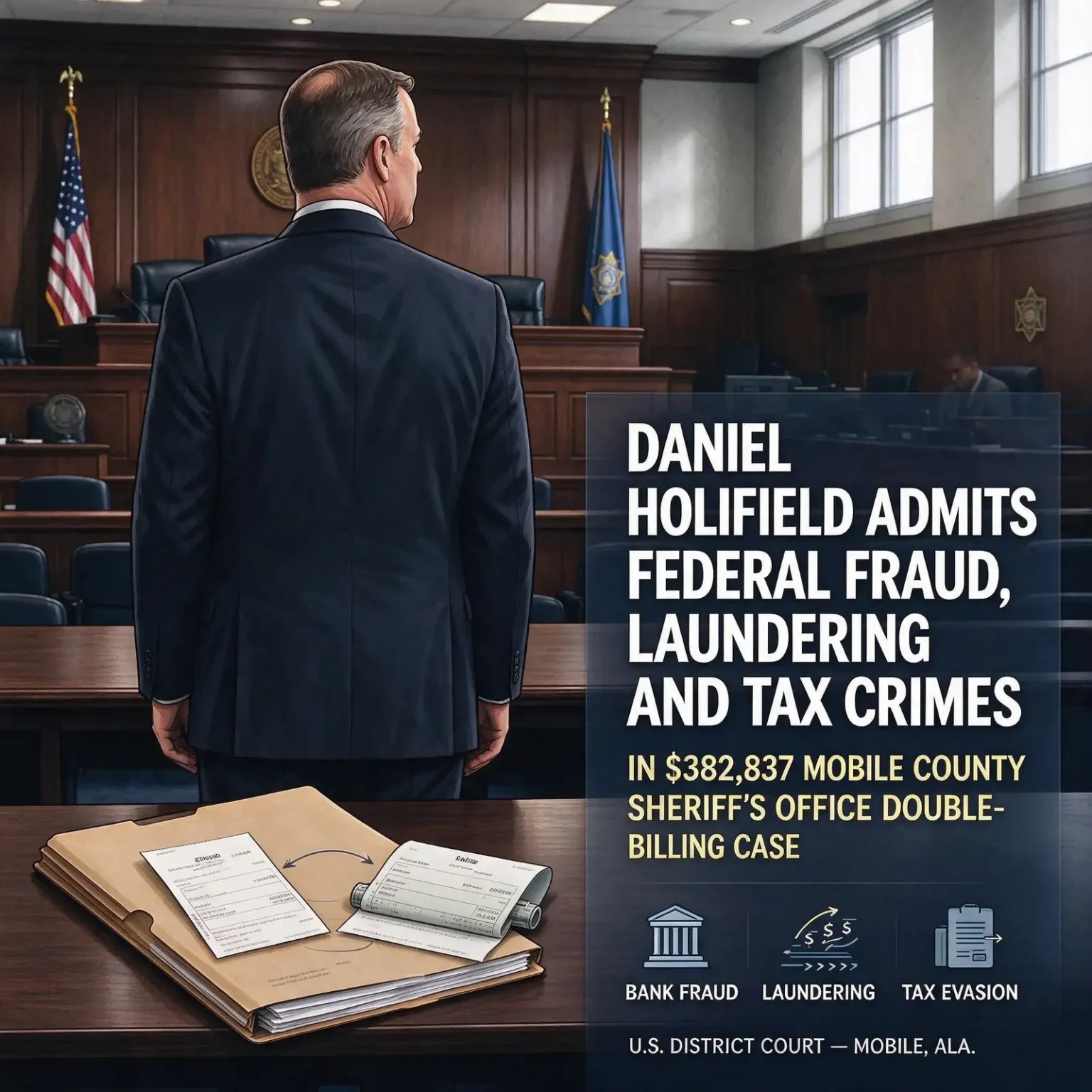
MOBILE, Ala. — A former sergeant who ran the vehicle fleet for the Mobile County Sheriff’s Office stood before a federal judge Tuesday, Nov. 17, and admitted he spent roughly three years siphoning public money through doubled-up invoices and diverted checks. Holifield, a 52-year-old Mobile resident, entered guilty pleas in the U.S. District Court in Mobile to three federal counts: one each for bank fraud, money laundering and tax evasion.
Under the written plea agreement, Holifield acknowledged taking about $277,814 between 2021 and 2023 and then leaving that money off his federal tax returns, which cost the government about $105,023 in taxes. Together, those figures put the total loss tied to his crimes at about $382,837.
Chief U.S. District Judge Jeffrey Beaverstock scheduled sentencing for Feb. 22, 2027.
From Trial Date to Courtroom Admission
Holifield’s case had been on track for a December 2026 trial. That changed last Wednesday, Nov. 11, when the court was told he planned to plead guilty. The plea agreement and an accompanying factual resume, a document laying out the conduct a defendant admits, were filed Tuesday, and Holifield entered his plea the same day.
A federal grand jury had indicted him in May on 14 counts: 10 of bank fraud, one of money laundering and three of tax evasion. His plea covers three of those counts, one in each category.
How the Double-Billing Worked
As fleet manager, Holifield was in a position to handle paperwork for vehicle repairs, equipment, services and insurance claims. The plea documents describe a scheme built on the fact that two separate government bodies, the county’s sheriff’s agency and its governing commission, could each be asked to pay for the same work.
- Same invoice, two payers: Holifield arranged for matching invoices to be sent to the County Commission as well as to the Sheriff’s Office.
- Vendors got paid once: The County Commission paid the vendors, by check or electronic payment, so the businesses received what they were owed.
- The second check went to him: The Sheriff’s Office cut its own checks to those same vendors, and Holifield intercepted those checks and put them into bank accounts under his control.
- Insurance money, too: He also admitted diverting insurance reimbursements and other payments intended for businesses or government agencies, taking checks that were passing between the county, the sheriff’s agency, insurers and approved vendors.
Because the vendors were being paid, the duplicate payments did not trigger complaints from the businesses involved, a feature that can allow schemes of this type to go unnoticed for long stretches.
Where the Money Went
According to the plea documents, most of the money landed first in a business account at Wells Fargo that showed little or no real commercial activity. From there, Holifield moved the funds into his personal bank accounts. He then took cash out at ATMs, paid personal expenses and spent money at casinos, including on gambling trips.
Running stolen proceeds through a business account and then into personal accounts is the conduct behind the money laundering count. Failing to report the stolen money as income on his federal returns for tax years 2021 through 2023 is the basis for the tax evasion count.
What He Could Face
The plea agreement lists the maximum prison terms for each count:
- Bank fraud: up to 30 years
- Money laundering: up to 10 years
- Tax evasion: up to five years
Those ceilings are rarely the measure of an actual federal sentence. As part of the deal, the U.S. Attorney’s Office agreed to ask for a term at the bottom of the range produced by the advisory federal sentencing guidelines. His defense attorney had earlier estimated the likely sentence at around two years. The final decision belongs to the judge.
The agreement also leaves room for prosecutors to ask for a lower sentence if they conclude Holifield gave substantial assistance in some other investigation or prosecution. The deal does not guarantee that such a request will be made.
Holifield will also be required to repay the money he took. The total loss figure of about $382,837, which includes the unpaid taxes, is expected to factor into the sentencing calculation.
Reaction From Law Enforcement
In a written statement, the Sheriff’s Office called the plea proof that Holifield had badly violated both the community’s confidence and the agency’s own. Wearing a badge, the statement said, means living up to stricter expectations, and nobody’s seniority or rank exempts them from the law. The agency said most of its deputies and civilian staff do their jobs with integrity and deserve not to be tarnished by what one man did, and that officers who cash in on the public’s confidence do not belong in the profession.
Federal prosecutors said Holifield exploited the confidence placed in him and profited at the cost of Mobile County taxpayers. They said the outcome sends a message that people who take public money and then try to cover their tracks with bank transactions and dishonest tax filings will answer for it.
The FBI, IRS Criminal Investigation and the Mobile County Sheriff’s Office investigated the case along with other law enforcement partners. An assistant U.S. attorney is prosecuting it for the government.
State Charges Still Pending
The federal plea does not end Holifield’s legal problems. A separate prosecution is pending against him in Mobile County Circuit Court, including counts of first-degree theft of property and theft by deception, plus earlier state accusations involving theft and possession of forged instruments. He was scheduled for a state court arraignment on Tuesday as well.
State and federal courts operate independently, so a resolution in one does not automatically close a case in the other. Holifield is presumed innocent of the state charges unless and until he is convicted in that court.
Understanding the Federal Process From Here
Between now and the February hearing, the U.S. Probation Office will typically prepare a presentence report. That report reviews the defendant’s background and the details of the offense, and calculates a recommended range under the federal sentencing guidelines, a calculation that in fraud cases is driven heavily by the dollar amount of the loss.
The guidelines are advisory. A judge must consider them but can sentence above or below the range after weighing factors set out in federal law, such as the seriousness of the crime, the need to deter others and the defendant’s personal history. Federal prison terms carry no parole, and they are often followed by a period of supervised release, during which a person must meet court-ordered conditions and report to a probation officer.
In cases involving public money, restitution orders typically direct repayment to the government agencies that suffered the loss, and in tax cases the court may also address what is owed to the Internal Revenue Service.
A Closer Look at the Charges
Bank fraud is a federal offense covering schemes to defraud a financial institution or to obtain money in a bank’s custody through false pretenses. Depositing checks made out to someone else, or obtained through deception, into a bank account is a common basis for the charge.
Money laundering generally means conducting financial transactions with the proceeds of a crime. Depending on the specific statute, it can cover efforts to conceal where money came from or simply spending or moving large sums of criminally derived funds through banks.
Tax evasion is a willful attempt to evade federal taxes, which includes filing returns that leave out income. Money obtained illegally is still taxable income under federal law, which is why theft and fraud cases are frequently paired with tax charges investigated by IRS Criminal Investigation.
Why Fleet Oversight Is a Target
Running a law enforcement agency’s fleet means handling a constant flow of invoices for patrol vehicle repairs, parts, equipment and insurance claims after crashes or damage. Those transactions can add up quickly, and when more than one government body pays for different pieces of an agency’s operations, the risk of duplicate payments rises.
Auditors generally recommend safeguards such as matching invoices against purchase orders, comparing payment records across agencies, requiring more than one person to approve or handle checks, and routing insurance proceeds directly to a finance office rather than through the department that filed the claim. Duplicate-payment checks, which flag the same invoice number or amount paid to the same vendor more than once, are a standard tool for catching this kind of scheme.
The Agencies Involved
The Mobile County Sheriff’s Office is the county’s primary law enforcement agency, patrolling unincorporated areas and operating the county jail. The Mobile County Commission is the county’s governing body and controls much of the county’s budget, which is why both bodies ended up paying bills connected to the Sheriff’s Office fleet.
Holifield is due back in federal court for sentencing on Feb. 22, 2027.