I-165 Murder Trial Goes to Jury as Prosecutors, Defense Clash Over Defendant’s Statement
Jurors began deliberating Thursday in the murder trial over a 15-year-old girl's death on I-165 after prosecutors called the defendant's statement a confession and the defense said he was covering for his son.
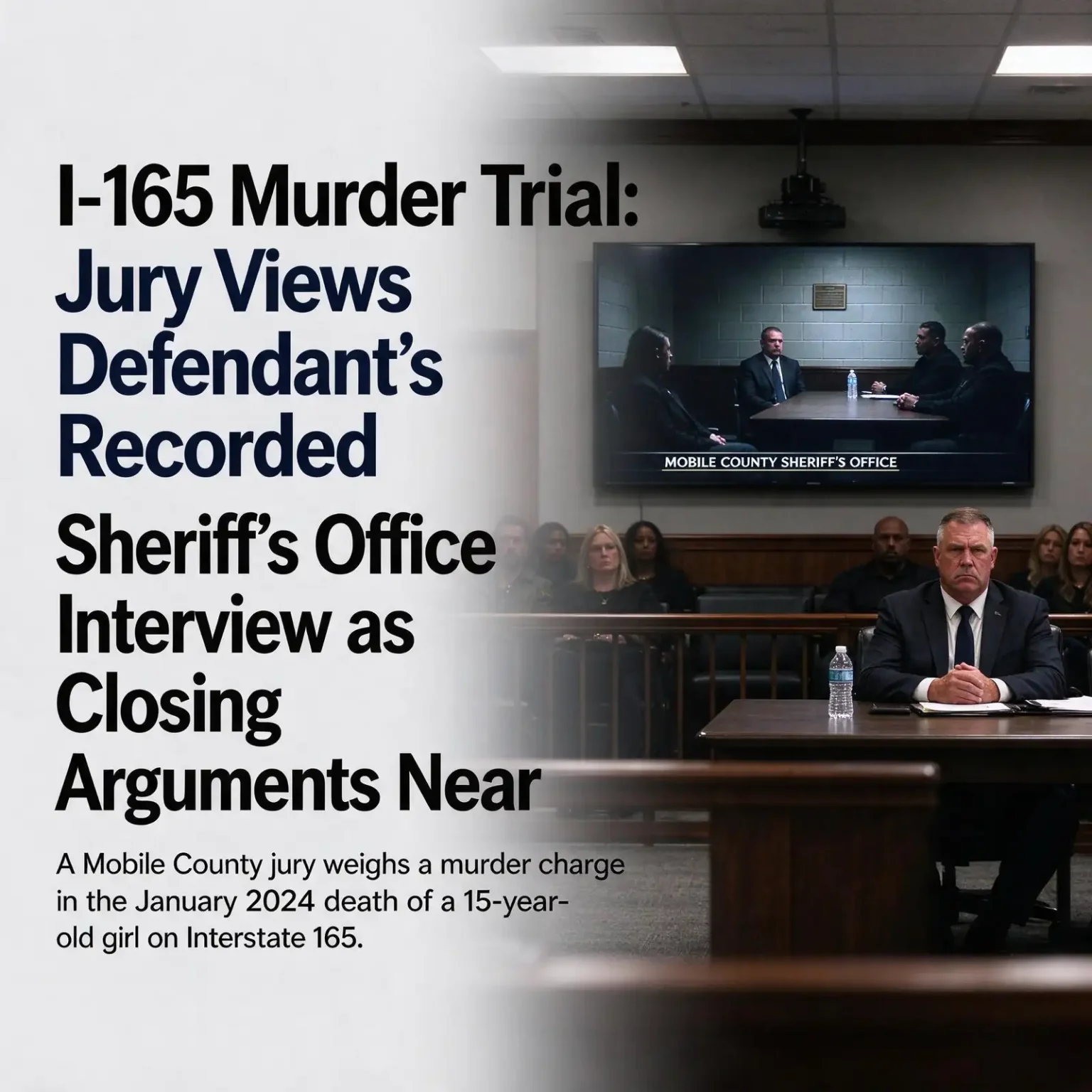
A Mobile County jury weighing a murder charge in the January 2024 death of a 15-year-old girl on Interstate 165 spent part of Wednesday, Nov. 18, viewing the recorded questioning of the man on trial. The 49-year-old Mobile defendant is accused of firing the shots that killed the girl and injured a 9-year-old boy during an exchange of gunfire between two moving vehicles.
The trial now appears to be close to its final stage. Closing arguments could begin as soon as Thursday morning, Nov. 19, after which jurors would receive their legal instructions and begin deliberating. A murder conviction would carry a sentence of 20 years to life in prison.
Update: Jury Begins Deliberating After Closing Arguments
The case went to the jury on Thursday, Nov. 19, after both sides delivered closing arguments. Jurors deliberated for roughly three hours and 15 minutes before stopping for the night, with deliberations set to continue. The defendant on trial is Dayell Lavon Davis, 49, of Mobile. Court proceedings have placed the shooting on Jan. 15, 2024, along I-165 near the line between Prichard and Mobile.
One Statement, Two Readings
In their final arguments, both sides agreed on one point: the outcome largely turns on what Davis told investigators in the weeks after the shootout. They disagreed sharply about what that statement means. Prosecutors told jurors it amounted to a confession in which Davis acknowledged carrying out the shooting. The defense argued the account was so implausible it could not be true and suggested Davis was trying to shield his son from being charged.
Davis’ son has not been charged in the case. Prosecutors addressed that theory directly, telling the jury that even if the son took part in the shooting, Davis would still be guilty of murder as someone who aided and abetted it. Under Alabama law, a person who intentionally helps or encourages another to commit a crime can be held just as responsible as the person who carries it out.
The State’s Case: An Unprovoked Attack
Prosecutors reminded jurors of testimony from the woman driving the Nissan Armada and described the gunfire that struck the SUV as sudden and unprovoked. They said the family had not been seeking any confrontation and was simply driving the children to a dentist appointment. The man in the rear passenger seat, they said, returned fire only in a desperate attempt to survive.
The state also told jurors that the wounded 9-year-old boy had been shot once before this incident, making the January 2024 shooting the second time he had been struck by gunfire.
To tie Davis to the scene, prosecutors pointed to surveillance video gathered from several businesses that they said showed the vehicle carrying Davis trailing the Armada. They also highlighted cellphone location records showing a gap of one hour and 37 minutes during which Davis’ phone was not in use, a window prosecutors said lined up with the time of the shootout and could not be dismissed as chance.
The Defense’s Case: An Account That Does Not Fit the Evidence
The defense countered that the phone records also contained other stretches of time when Davis’ phone sat unused, undercutting the significance of the gap the state emphasized. More importantly, the defense argued, parts of Davis’ statement simply could not have happened. Davis claimed he steered with one hand while firing a Draco-style weapon with the other, a feat the defense told jurors was the stuff of action movies rather than real life.
Davis also told investigators he had gotten rid of the gun in Tricentennial Park. The defense noted that sheriff’s deputies searched the park for hours and never found a weapon. In the defense’s view, those inconsistencies show the statement does not line up with the evidence and should not be treated as proof of guilt.
What the Jury Saw in the Interview Room
The recording shown in court captured investigators from the Mobile County Sheriff’s Office questioning the defendant after the shooting. Throughout the interview, he maintained that he only fired his weapon after someone in the other vehicle shot at him first.
At one point in the footage, the investigators conducting the interview left the room. Another sheriff’s office official then came in, offered the defendant a glass of water and asked him whether he was prepared to be truthful with the investigators.
The defendant did not change his version of events. He continued to tell investigators that he had been fired upon before he returned fire.
Recorded interviews of this kind are common evidence in homicide trials. Law enforcement agencies routinely record interrogations, and prosecutors often play them for jurors so the panel can hear a defendant’s account in his own words and judge it alongside the physical evidence and witness testimony. Defense attorneys, in turn, may point to a consistent account as a sign of credibility.
The Prosecution’s Theory
Prosecutors have framed the January 2024 shooting as an act of road rage. Under their theory, the defendant was the person whose gunfire struck the teenage girl, who was riding as a passenger in a Nissan Armada sport utility vehicle, and wounded the 9-year-old boy who was also inside.
Investigators at the time described the incident as a running gunfight that unfolded along the interstate as the vehicles traveled.
To win a murder conviction in Alabama, prosecutors generally must persuade all 12 jurors beyond a reasonable doubt that the defendant caused the victim’s death and did so with the mental state the law requires, such as an intent to kill or conduct showing extreme indifference to human life. When a defendant raises self-defense and there is evidence to support it, the jury is instructed on that defense as well, and the state carries the burden of overcoming it.
Testimony From the Other Driver’s Side
The man who exchanged fire with the defendant also appeared before jurors on Wednesday and gave his own account. He told the jury he had fired his weapon to defend himself.
He was a cousin of the 15-year-old girl and was in the SUV with her at the time. His 9-year-old brother, the boy who was wounded, was also in the vehicle.
In the immediate aftermath, prosecutors charged that man with reckless endangerment over his part in the shootout. That charge did not define how the office ultimately viewed his role. The Mobile County District Attorney’s Office later said prosecutors had every reason to believe he had acted in self-defense.
Under Alabama law, reckless endangerment is a misdemeanor that applies when a person recklessly engages in conduct that creates a substantial risk of serious physical injury to another person. It is a far less serious offense than the murder charge the defendant is facing.
Two Conflicting Accounts of Who Fired First
The case presents jurors with two men who each say they fired only in response to gunfire. The defendant told investigators that shots came from the other vehicle before he pulled the trigger. The man in the SUV told the jury that he was the one defending himself.
How jurors resolve that conflict is likely to be central to the verdict. Alabama’s self-defense statute allows a person to use deadly physical force when he reasonably believes another person is using or about to use unlawful deadly physical force against him. The law also says a person who is not engaged in unlawful activity and is in a place where he has a right to be has no duty to retreat before using force. However, the justification generally does not extend to a person who provoked the confrontation or who was the initial aggressor.
That framework helps explain why the question of who started shooting matters so much in a case like this one. If jurors conclude that the defendant was the aggressor, a claim of self-defense would be difficult to sustain. If they have a reasonable doubt on that point, the outcome could be very different.
A Short but Busy Stretch of Interstate
Interstate 165 is one of the shortest interstate routes in the country, running roughly five miles between Interstate 65 near Prichard and the downtown Mobile area. It serves as a key link for commuters and for traffic headed to and from the city center and the port district along the Mobile River.
Because the route is short and carries fast-moving traffic, a confrontation between vehicles there can unfold quickly and place nearby motorists at risk. In the January 2024 shooting, two children inside the same vehicle were struck, one of them fatally.
How Road Rage Incidents Escalate
Traffic safety organizations define road rage as aggressive driving that escalates into deliberate, angry acts aimed at another motorist, such as tailgating, cutting off a vehicle, brake-checking or, at the extreme end, assault with a vehicle or a weapon. Safety advocates commonly advise drivers who feel threatened to avoid eye contact or gestures, give the other vehicle space, refrain from following or confronting the other driver, and call 911 when safe to do so.
Law enforcement agencies in Alabama and across the country have repeatedly urged drivers not to engage with an aggressive motorist, noting that disputes that begin with a minor traffic slight can turn violent in seconds when a firearm is involved.
What Happens Next in the Courtroom
Once testimony concludes, each side will present closing arguments. Prosecutors typically speak first and last, with the defense arguing in between, because the state bears the burden of proof. These arguments are not evidence; they are each side’s summary of what it believes the evidence shows.
After closing arguments, the judge will read jurors the law that applies to the case, including the elements of murder and the rules governing self-defense. Depending on the evidence and the requests of the parties, a judge may also instruct jurors on lesser offenses that are included within the murder charge. The jury will then retire to deliberate in private.
A verdict in an Alabama criminal case must be unanimous. If jurors find the defendant guilty of murder, sentencing would follow at a later hearing, where the judge would impose a term within the range set by law. Murder is a Class A felony in Alabama, punishable by 20 years to life in prison.
If jurors acquit, the defendant would be cleared of the charge. If they cannot reach a unanimous decision, the judge could declare a mistrial, and prosecutors would then decide whether to try the case again.
A Case Nearly Two Years in the Making
The shooting took place in January 2024, meaning the case has taken nearly two years to reach a jury. That timeline is not unusual for a homicide prosecution. Murder cases in Alabama typically move through several stages before trial, including arrest, a preliminary hearing or grand jury indictment, arraignment, discovery, pretrial motions and scheduling in circuit court.
For the families involved, the trial represents the first time the evidence has been laid out in full before a jury. The jury’s decision will determine whether the defendant is held criminally responsible for the 15-year-old girl’s death.
Key Facts at a Glance
- The shooting occurred on Interstate 165 in January 2024.
- A 15-year-old girl riding in a Nissan Armada SUV was killed, and a 9-year-old boy in the same vehicle was wounded.
- A 49-year-old Mobile man is on trial for murder; prosecutors describe the shooting as road rage.
- The defendant told sheriff’s investigators he fired only after being shot at from the other vehicle, and he kept to that account throughout the recorded interview.
- The man who fired from the SUV, a cousin of the girl, testified that he acted in self-defense. He was initially charged with reckless endangerment, but the district attorney’s office later said it had every reason to believe he was defending himself.
- Closing arguments took place Thursday, Nov. 19, and jurors deliberated about three hours and 15 minutes before breaking for the night.
- A murder conviction carries 20 years to life in prison.
Jurors are expected to receive the case once both sides have finished their final arguments and the judge has delivered instructions on the law.