Orange Beach Adopts Vacation Rental Ordinance Requiring Written Agreements and Guest Contact Details Before Airbnb Policy Shift
The Orange Beach City Council voted 5-0 on Nov. 17 to require written rental agreements with renter contact details, a $200 license fee and fines up to $500. Gulf Shores takes up a similar measure Nov. 23.
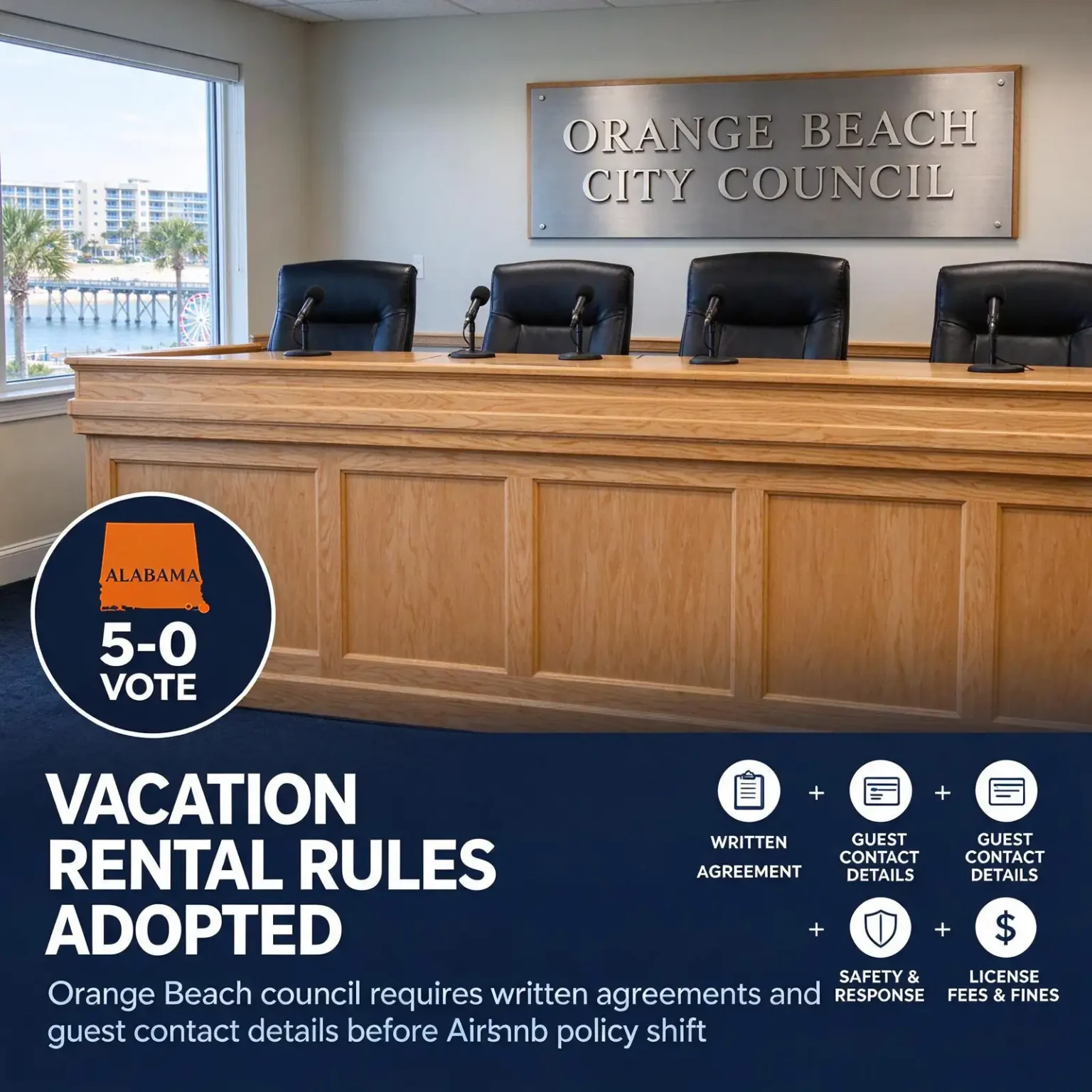
ORANGE BEACH, Ala. — Every short-term vacation rental in Orange Beach must now operate under a written rental agreement that identifies the renter and lists a working phone number and home address, after the City Council adopted a new rental ordinance on Tuesday, Nov. 17. The vote was 5-0 and came three days before Airbnb begins enforcing host policy changes that local property managers say would cut them off from basic information about the people staying in the homes and condominiums they manage.
Council members suspended the rules so the ordinance could be approved at the same meeting where it was introduced. One council member was absent. The measure takes effect once it has been adopted and published.
Gulf Shores, which shares Pleasure Island with Orange Beach, is weighing a similar amendment of its own. That proposal is set for consideration at the Gulf Shores City Council‘s regular meeting on Monday, Nov. 23, at 4 p.m., a step that would put comparable rules in place across the island.
What Orange Beach Rental Owners Must Now Do
The adopted ordinance sets out requirements in several areas: the paperwork behind each stay, how quickly owners must respond to the city, basic safety equipment and licensing.
Rental agreements
- A written rental agreement is required for each rental.
- The agreement must list the renter’s name, age, phone number and home address.
- It must spell out the property’s occupancy limits, noise rules and parking rules.
- Owners must keep each agreement on file for two years.
Availability and response time
- An owner or the owner’s agent must be reachable 24 hours a day for the length of every stay.
- Once the city sends a notice about a property, the owner or agent has one hour to respond.
Safety equipment
- Each rental must have working smoke detectors.
- Carbon monoxide detectors are required where applicable.
- A fire extinguisher must be kept in the kitchen.
Fees and penalties
- The annual license fee for a short-term rental is $200.
- Each violation can bring a fine of up to $500.
- Owners who violate the rules repeatedly risk having their license suspended or revoked.
What the Ordinance Leaves to Owners
Some questions raised by managers and owners in recent weeks are not answered in the text. The ordinance does not explicitly require owners to inspect a government-issued photo ID, and it does not say the person who makes a reservation must be the one who actually stays at the property.
City leaders said owners can fill those gaps through their own rental agreements. A council member who helped lead the effort said that, as he reads the ordinance, owners now have the option of writing a photo ID requirement for the person responsible for the booking into their agreements. The city’s administration likewise said it believes owners can use their agreements to require that the person who books a property be the responsible guest and be present during the stay, rather than reserving it for someone else.
That distinction matters to at least one owner who supports the new law. The co-owner of a three-bedroom beachfront condo said her own agreement already requires one person who is at least 25 years old to be responsible for each reservation. She said she wants to be sure someone of that age cannot rent the unit and then turn it over to younger guests, and that whether the ordinance reaches the person actually staying in the unit remains an open question for her.
She said she attended the meeting so council members would hear directly from owners and managers, and that she does not want booking platforms to strip owners of the ability to know who is sleeping in their condos. She acknowledged that her concerns rest on her own reading of the platform’s policy changes. She praised the city for acting and said she believes the ordinance will help beachfront communities keep their character.
Why the City Moved Now
The timing was driven by Airbnb. According to city leaders, discussion of an ordinance began after Orange Beach learned that the platform planned changes that could limit hosts’ ability to require rental agreements, identification and phone numbers from guests. Those changes are scheduled to take effect Thursday, Nov. 20.
The council member who helped lead the effort said the goal was to set clear, consistent requirements for vacation rentals in a city that handles many thousands of them each year, regardless of whether a guest books through Airbnb, Vrbo or another online travel agency. He described the issue as mainly one of safety, pointing to the problem of reaching guests if a mandatory evacuation is ordered.
He said the city is not trying to drive Airbnb out of Orange Beach. Instead, he said, the aim is to make sure the platform cannot sever the line of contact between local owners and managers and the guests in their properties. He framed the ordinance as a matter of accountability and protecting property, the city and the Gulf Coast.
Another council member, who owned and operated a local vacation rental company before retiring and selling the business in June, said his main objection is that a third-party platform would let guests remain anonymous while licensed real estate companies must follow strict operating standards. He said it is unacceptable for a rental manager or a property owners association to be kept from knowing who a guest is and from having the guest’s address, phone number and email address.
Industry ties on the council
The rental business is well represented on the Orange Beach council. Three of its members own or have previously owned short-term rental management companies. Two members are former owners of vacation rental businesses.
The member who missed the Nov. 17 meeting co-owns Beachball Properties, a vacation rental company, with her husband. He was recently appointed by the council to the board of directors of Gulf Shores and Orange Beach Tourism, the government tourism agency funded through lodging tax collections. She was out of town for the vote and said she would have abstained had she been present.
Ahead of the recent meetings, a representative of the company issued a statement urging both the Orange Beach and Gulf Shores councils to support the ordinance changes. The statement argued that without identification, owners have no protection against fraud, theft or damage, and that without contact details, managers cannot reach guests during an emergency or an evacuation.
Airbnb’s Objections
Airbnb opposed the measures. In a written statement, the company said local hosts and property rights groups had raised concerns about the proposal, including what it described as a conflict of interest involving a sitting council member who advocated for the changes and owns a property management company that stands to benefit.
The company also argued that the new requirements repeat protections it already has in place, and said they would create needless complications for hosts on the Alabama coast.
Public comment during the Orange Beach discussion touched on several points of friction, including whether guests should be required to show verified identification before their stay, as well as claims that third-party listing platforms had sent misleading correspondence to local property owners.
Gulf Shores Takes Up the Same Question
Gulf Shores council members discussed their version of the rules at length during a work session on Nov. 16. Work sessions in Gulf Shores are not voting meetings, which is why the measure moves to the Nov. 23 regular meeting.
A staff memo prepared for the council explains the reasoning. It says online booking platforms have adopted policies that restrict owners and management companies from requiring renters to sign separate written rental agreements unless local law specifically calls for one. Many local operators, the memo says, worry that without a written agreement they could lose the ability to use existing city code provisions meant to deal with problem guests and to protect neighbors and visitors. The memo says approving the change would help owners, managers and police keep the tools they need to handle nuisance behavior and protect public safety and quality of life as platform policies shift.
Under the Gulf Shores proposal, a rental agreement would have to include:
- The name and age of the responsible renter.
- A way to contact the responsible renter directly during the stay.
- The renter’s acknowledgment of the property’s maximum occupancy.
- The renter’s acknowledgment and acceptance of the rental’s terms and conditions.
- Any other information needed to comply with local rules and support enforcement.
Local rental companies have pressed the case in Gulf Shores as well. At the council’s Nov. 9 meeting, a representative of one company asked members to adopt guidelines like those in Orange Beach so that the same protections would cover the whole island. That speaker said the industry wants to protect guest safety and property owners and to hold guests accountable for damage, unauthorized occupants and refusals to follow the rules, adding that local companies were already meeting resistance from the platform over separate agreements.
A representative of another rental company told the Gulf Shores council at the same meeting that Airbnb is reducing the guest information management companies have routinely received. That speaker said supporters are not asking for new rules, but for the existing arrangement to continue, and said the proposed measure would accomplish that.
A Big Market With a Lot Riding on It
Vacation rentals are a central part of the economy in both beach cities. Orange Beach has the largest concentration of short-term rentals in coastal Alabama. The number changes daily, but industry estimates put the count of homes and condominiums actively listed for short-term rental in the city at more than 2,700.
Those rentals support a wide range of local work beyond the owners and management firms themselves, including real estate sales, cleaning services, locksmiths, property association management, city administration and law enforcement. Online platforms such as Airbnb, Vrbo and Booking.com have grown their reach through national advertising and ties to credit card rewards programs, while local managers and city officials handle the problems that surface on the ground when a stay goes wrong or local codes are broken.
Lodging taxes collected on these stays also fund tourism promotion through Gulf Shores and Orange Beach Tourism, the agency that markets the two cities as a destination.
How the Vote Worked and What Comes Next
Under Alabama law, an ordinance of a permanent nature is normally introduced at one council meeting and voted on at a later one. A council can skip that waiting period only if all members present agree to suspend the rules, which is what Orange Beach did so the ordinance could be adopted in a single night. Municipal ordinances in Alabama generally take effect after they are published, and the new Orange Beach rules will apply once that step is complete.
For owners and managers, the practical next steps include reviewing rental agreements to make sure they carry the required renter details and house rules, confirming that someone will be on call around the clock during every stay, and checking that smoke detectors, carbon monoxide detectors and kitchen fire extinguishers are in place. Owners who want to require photo identification, a minimum age for the responsible guest or proof that the person who books is the person who stays can write those terms into their agreements, according to city leaders.
Attention now turns to Gulf Shores, where the council is set to take up its own amendment on Nov. 23, after Airbnb’s new policies have taken effect. With the busy spring and summer seasons ahead, managers in both cities have said they want clear local rules in place well before the next wave of visitors arrives.
For background on how the debate developed, see earlier coverage of the rental managers’ first requests in Orange Beach and the Gulf Shores rental agreement proposal.