

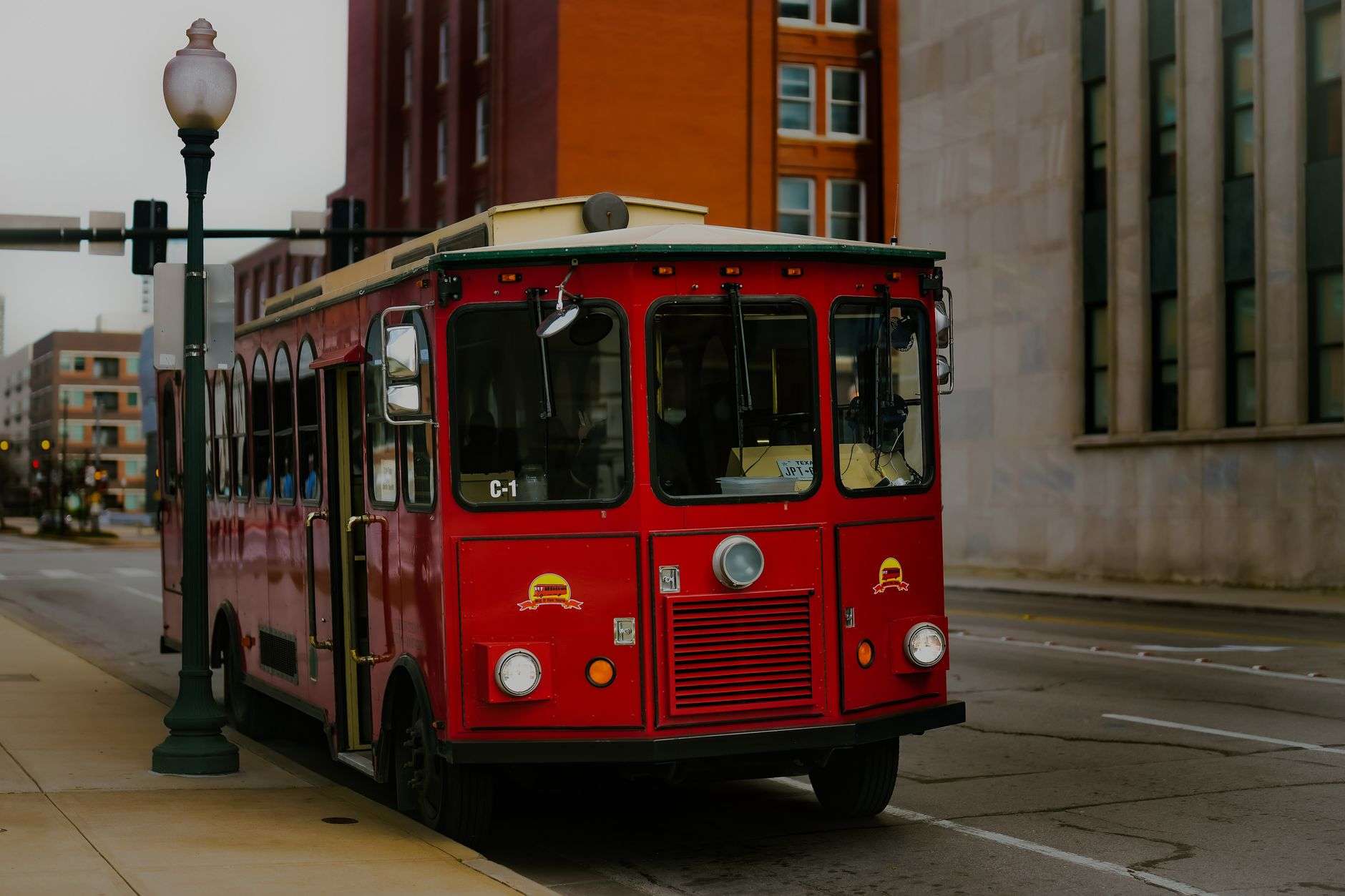
MOBILE, Ala. — Mayor Spiro Cheriogotis’ vision of a trolley-filled future for Mobile drew its first sustained pushback from the City Council on Tuesday, from a member who said the city should find out whether its first half-dozen trolleys actually increase ridership before it commits to buying more.
The council approved a resolution authorizing Cheriogotis to apply for up to $1.36 million from the Federal Transit Administration to purchase five trolley-style buses for the new Second Line Transit network. If awarded, the grant would require a local match of up to $320,000. The application is still pending, and the city cannot buy the vehicles unless the federal money comes through.
The vote passed. The argument around it did not end there.
‘We Should Probably Put the Brakes On a Bit’
District 4 Councilman Ben Reynolds raised his objections during a pre-meeting work session and returned to them during budget talks later in the day, where the Cheriogotis administration is seeking nearly $15 million to build out Second Line Transit.
Roughly $2 million of that amount would be a possible up-front allocation for additional trolleys — separate from the federal grant, and largely reimbursable later by the federal government.
It is that second pot of money, not the grant application, that Reynolds is most uneasy about.
“We brought on a new operator and haven’t really seen the results of their operation yet,” Reynolds said, referring to New York-based Via Transit, which is taking over the city’s public transportation system under a contract the council approved last year. “And then we are going head over heels in purchasing trolleys not only with the federal grant but with money set aside in the budget for additional trolleys.”
He added: “We should probably put the brakes on a bit.”
Reynolds was careful to say he is not opposed to trying trolleys. His position is sequencing: run the first batch, measure what happens, then decide.
“These five trolley buses. I think this is a start, Mr. Mayor. I think that’s kind of where it should stop for now,” Reynolds said. “Let’s try five out. Let’s see how this goes and we could explore the idea further later.”
“If we see real results, we can come back to the table and say ‘trolleys work, let’s go get them,'” he said.
The Mayor: Six Is Not Enough to Judge
Cheriogotis, who has described himself as “obsessed” with trolleys and campaigned on bringing them to Mobile during last year’s mayoral race, made the opposite argument — that a fleet too small to change anything cannot be used to prove that trolleys change nothing.
“It would not be fair to judge the efficacy of trolleys based on six,” the mayor said. “Six is not even replacing a fifth of our buses. We need to go further than that before we pause and take stock.”
The city already owns one trolley, which arrived earlier this month at a cost of roughly $100,000, purchased with money left over from a previous capital budget. Five more would bring the total to six.
Cheriogotis’ long-term goal is more ambitious than the current debate suggests: he wants to eventually replace the larger WAVE Transit buses with rubber-tired trolleys, and has said he is open to accelerating that transition even if doing so means incurring federal penalties for retiring buses before the end of their federally recognized 12-year service life.
“I think there is certainly data to back up this move,” Cheriogotis said. “I think we need to go all in when it comes to trolleys.”
The Case for Smaller Vehicles
The mayor’s operational argument rests on fit. He contends the trolleys will carry as many passengers as the larger buses while handling Mobile’s older neighborhoods and tighter street corners better — a real constraint in a city whose street grid in places predates the automobile entirely.
He has also pointed to workforce access as the strongest justification. Citing Mobile Chamber figures, Cheriogotis said roughly 30% of the city’s workforce has been unable to reach employment opportunities because of transportation limitations.
“If we are adding 5,000 to 6,000 jobs, we have to have those people,” he said.
And he framed frequency, not vehicle style, as the thing riders actually respond to.
“It primarily is improving frequency and the timing so that a citizen is not waiting for an hour or more for a bus, a trolley, or a microtransit transport to arrive,” Cheriogotis said. “So trolleys, I think, are integral to the plan.”
He was blunt about what does not work. “I’m not going to jump on a trolley if I have to wait out in the rain to catch the thing, or if I have to sit out in a blistering 115-degree heat index,” he said. “I think most citizens probably see it that way. They don’t care if it’s pink or yellow or if it’s a trolley. I’m not going to go out there and sit on the side of the road and suffer to catch the thing.”
That admission points at the tension in the plan. If shelter and frequency are what determine ridership, the case for spending capital dollars specifically on trolley-styled vehicles rather than on stops, shelters and service hours becomes harder to make — which is close to the point Reynolds was pressing.
The Kansas City Comparison, and Its Limits
Cheriogotis has repeatedly cited Kansas City as evidence that trolleys drive ridership, along with San Francisco’s world-famous cable and streetcar lines.
The Kansas City comparison does not map cleanly onto what Mobile is proposing, and the mayor has acknowledged as much.
The KC Streetcar is an electric rail system running on tracks embedded in city streets. It opened in 2016 as a downtown line a little over two miles long, heavily subsidized by the federal government, and has since expanded by roughly another three and a half miles. Ridership has grown steadily. It charges no fare at all.
Mobile’s proposal involves none of that. Second Line Transit would use rubber-tired buses styled to look like trolleys, running on existing streets. There is no rail, no dedicated right-of-way and no track construction. A light rail system would require substantial new infrastructure and federal funding, and while Cheriogotis has not ruled out pursuing rail in the distant future, he said cost keeps it off the table now.
Reynolds rejected the comparison outright.
“KC has a billion-dollar airport and a professional football team, it’s not comparable,” Reynolds said. “We are heavily reliant on using our own vehicles. Let’s see if the changes we already agreed and have been made, let’s see if they produce results. Then let’s have a smaller trolley space in downtown to the (new) airport. But to suggest we need a trolley riding around at Government and Azalea, I don’t know if that is required.”
Pressed on the evidence, Cheriogotis conceded that his confidence rests less on formal study than on instinct and example. He acknowledged his belief in the future success of trolleys is largely a “gut” reaction based on other cities. He also noted that Home Town Trolley, the company that manufactures the vehicles, has seen a surge in sales.
Reynolds Isn’t the Only One With Questions
Councilwoman Samantha Ingram said she would like to see a comparative analysis of public transit ridership using smaller buses — a request that would produce exactly the kind of data Reynolds says should come before the next purchase.
During an afternoon Finance Committee meeting, Reynolds broadened the argument from transit to budget priorities generally, suggesting the city may have more pressing needs, including mowing roadsides and maintaining drainage ditches.
“There are areas in the budget that I think probably should get more money and we are forgoing that opportunity by doing some of this,” Reynolds said.
He also urged a fuller accounting of the transportation spending the city is weighing overall, including potential future support for Amtrak’s Mardi Gras Service between downtown Mobile and New Orleans.
What Else the Money Is Buying
Cheriogotis said the capital investment behind the new transit system extends well past the vehicles themselves. The city still needs to launch Via’s microtransit service, install new signage and improve bus stops. The total cost of those improvements remains unclear.
The mayor described the microtransit launch as the critical piece — smaller vehicles, requested primarily through a cellphone app, providing what he called more efficient curbside transportation, with a period of getting residents comfortable with the technology.
Speaking to reporters later in the morning, Cheriogotis indicated the city may consider waiving fares to build early ridership.
“Any promotional activity like free rides for a time is absolutely on the table,” he said.
What Happens Next
Second Line Transit is scheduled to launch Sept. 28, with the city’s first trolley entering service on the Downtown Circulator route on Saturdays and rotating through fixed routes during the week. New routes and microtransit service are expected to begin at the end of the month.
The federal grant decision will come separately. Until the FTA acts, the five additional trolleys remain a request rather than a purchase — and the roughly $2 million in the fleet-maintenance budget remains the open question the council will settle when it finalizes the spending plan.